
The Baseplate Compass for Hillwalking UK That Comes Recommended, and Where It Slips Up
We earn commission from qualifying Amazon purchases. It costs you nothing and does not affect what we recommend.
Ask a UK mountain instructor which compass a beginner should learn on, and the Silva Expedition 4 comes up again and again. It handles OS maps beautifully, but a real minority of buyers report faults that could leave you misnavigating on the hill.
- Why the Flat Transparent Plate Earns Its Bulk on an OS Map
- Taking a Bearing: The Job It's Built For
- Reading Grid References With the Romer Scales
- Night Nav and Hill Fog: The Luminous-Needle Catch
- When the Needle Points South: Faults to Check the Day It Arrives
- The Verdict: A Trusted Hill Standard, With Caveats
Walk onto any UK hill-skills weekend or Mountain Leader assessment and there is a fair chance the compass clipped to the instructor's map is a Silva Expedition 4. It has been the standard teaching compass on British hills for decades, and the reviews are full of people buying their second, third or fourth one after wearing out the last. So when a search like baseplate compass for hillwalking uk sends you looking, this is the model most experienced navigators will steer you towards.
That reputation holds up on the map. It is not, going by recent feedback, the whole story. Across the 100 most-recent reviews the average has slipped to 4.0 out of 5, and 18 of those buyers left a single star, most describing units that arrived faulty, needles pointing the wrong way, or markings harder to read than they should be. This review works through what the Expedition 4 does well for hillwalkers, and the quality-control lottery you want to rule out the day it lands on your doormat.
Why the Flat Transparent Plate Earns Its Bulk on an OS Map
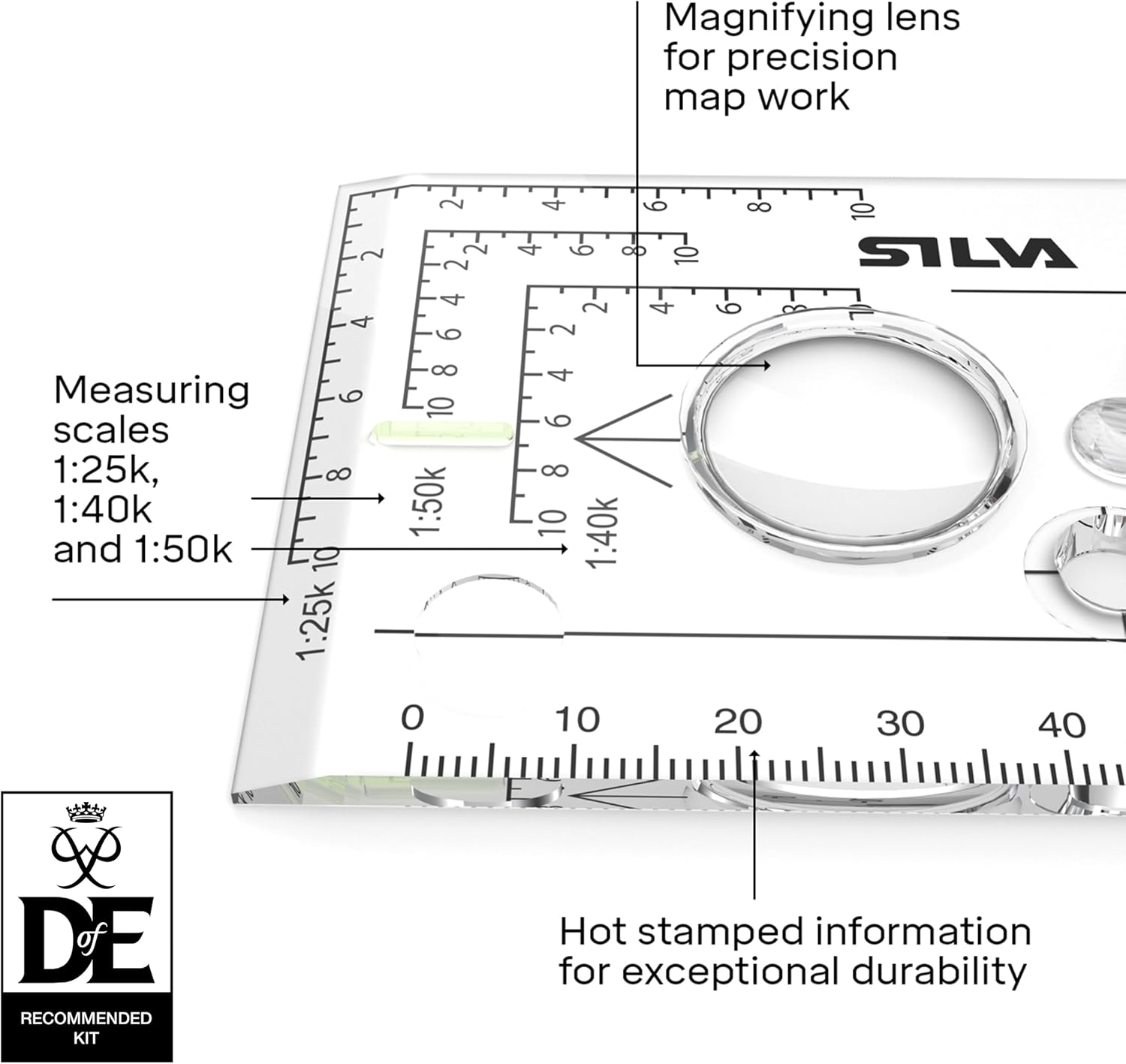
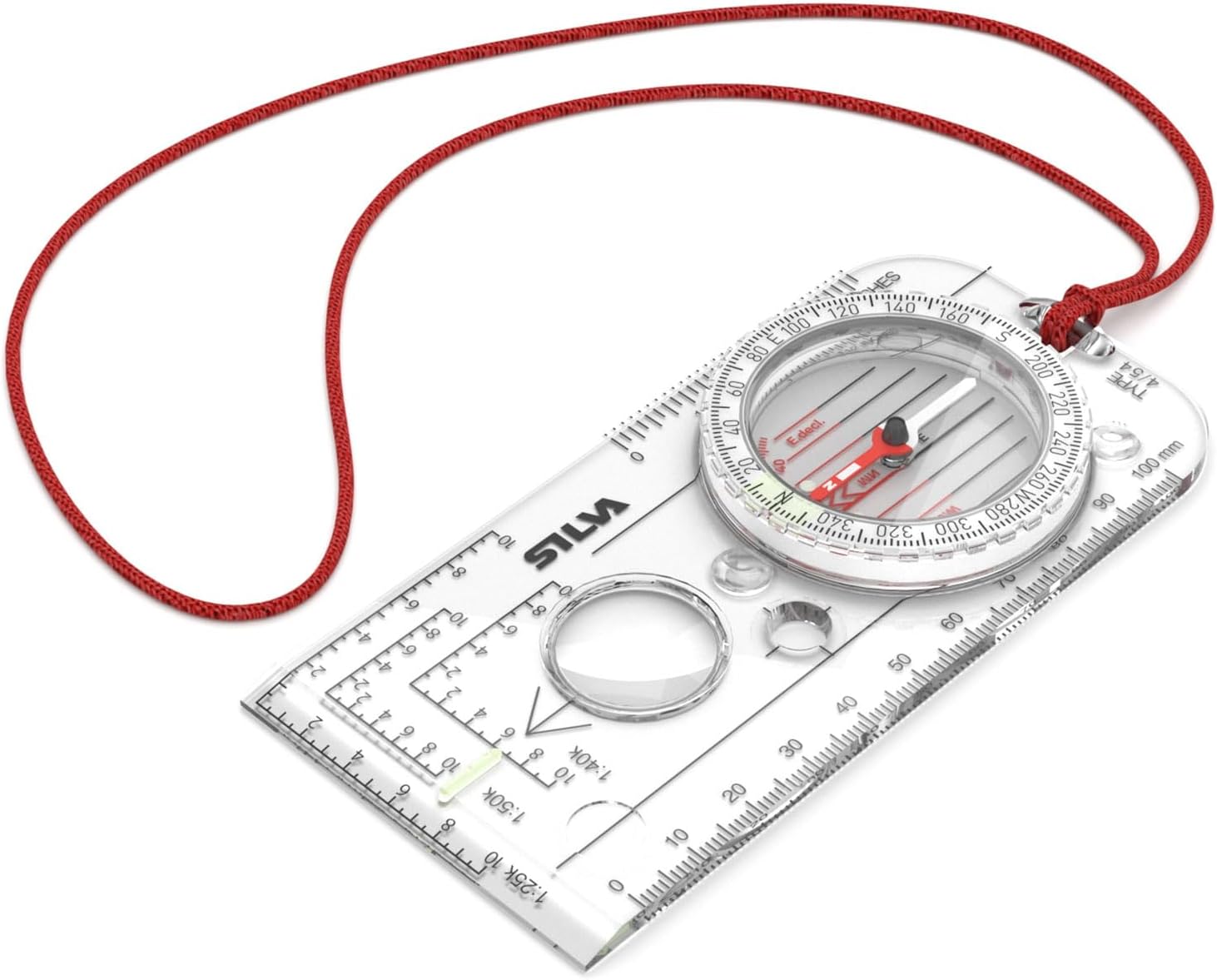
If your only reference point is the button compass on a survival whistle, a full-size baseplate compass looks like overkill. The extra size pays off the first time you put it on an Ordnance Survey map. The "baseplate" is simply the flat, transparent plastic plate the compass sits in. Because you can see the map through it, you can lay it down, line its edge up between where you are and where you want to be, and read a bearing straight off the map instead of guessing.
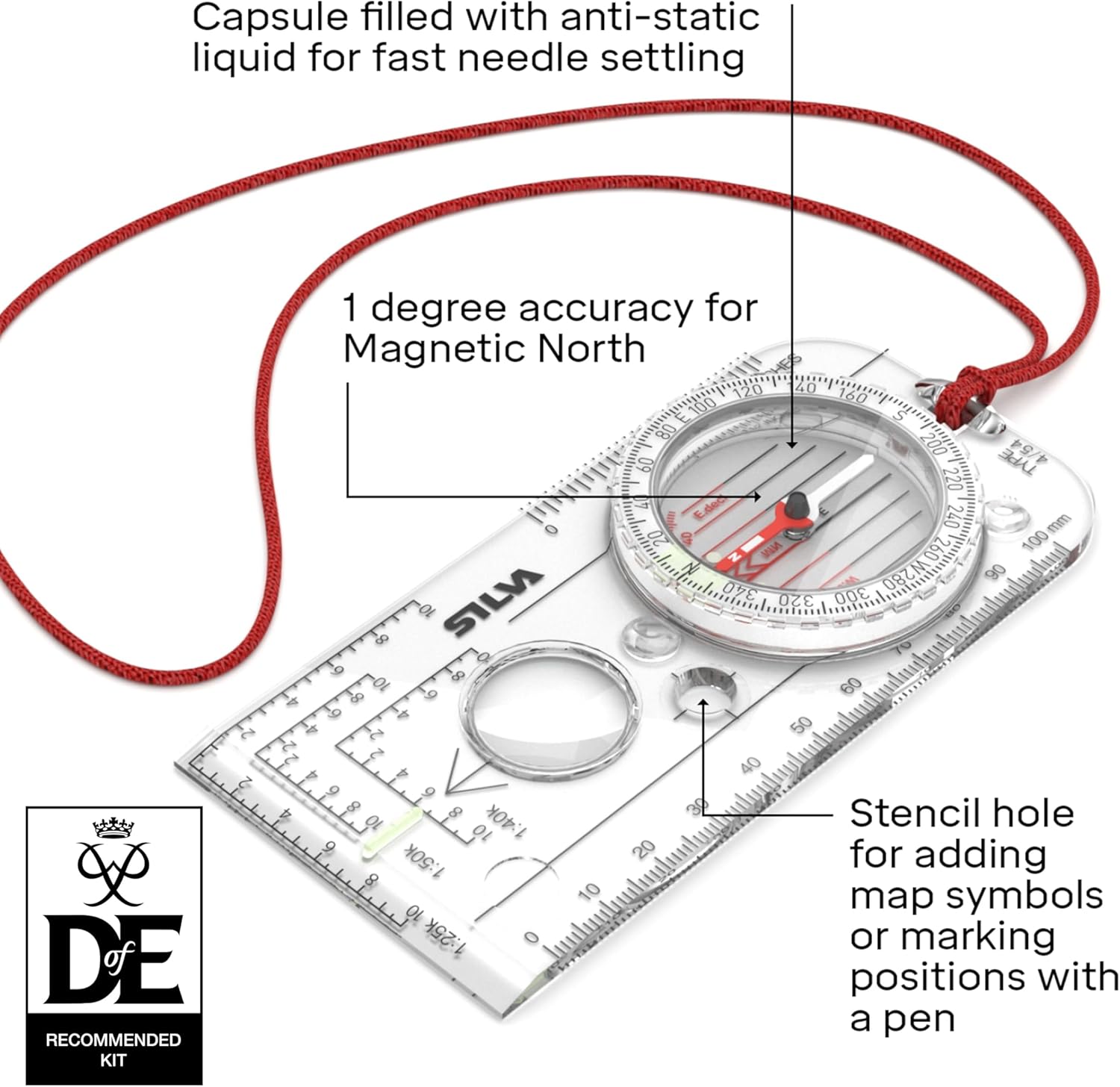
Around the housing sits a rotating bezel, the dial marked in degrees that you turn to set or read a bearing. Inside the sealed capsule, the magnetised needle floats on a sapphire jewel bearing: a tiny, hard-wearing pivot that lets the needle swing freely and settle quickly rather than drift. On the baseplate itself you get romer scales, short rulers printed at 1:25,000, 1:40,000 and 1:50,000 that let you read a grid reference down to the nearest 100 metres without mental arithmetic. Those three scales are not chosen at random. They match the maps British walkers actually carry: OS Explorer at 1:25k, OS Landranger at 1:50k, and Harvey's maps at 1:40k.
Put together, that is a compass made for real map-and-compass navigation rather than a rough sense of which way is north. One buyer learning navigation in North Wales summed up the appeal of the scales, saying he liked "the romer of 1:25,00 1:50,000 and 1:40,000 which you need for OS and Harvey's map in the UK." It is a serious tool aimed at people who plan routes on paper, not a keyring novelty.
Taking a Bearing: The Job It's Built For

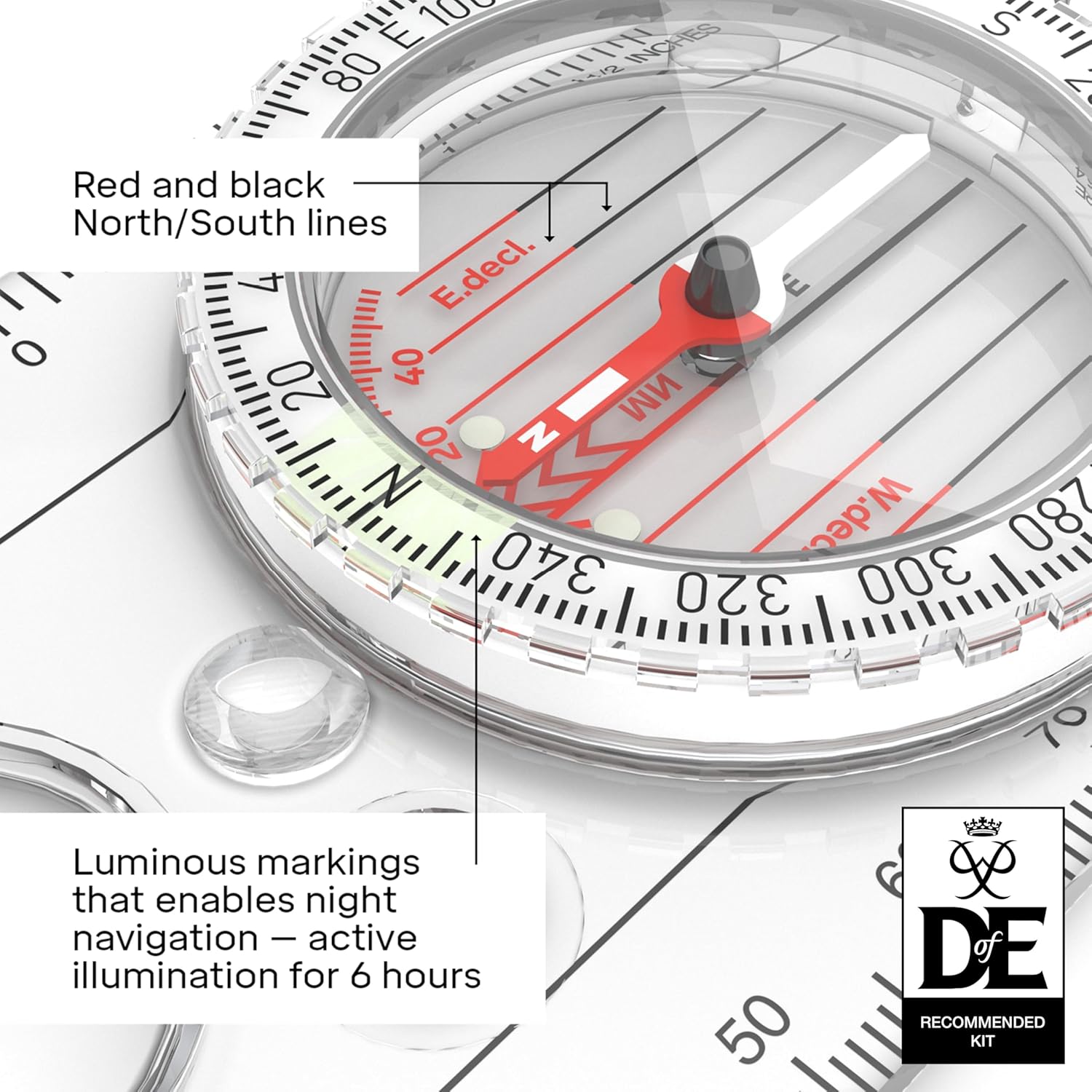
Taking a bearing is the task a hill compass lives or dies on, and for most buyers this is where the Expedition 4 feels like money well spent. The needle is a good size and settles fast, so you are not stood on a windy col waiting for it to stop wandering. The rotating housing has just enough friction to stay where you set it, and the red and black north-south lines in the base of the capsule make it easy to line the needle up with the meridian lines on your map. Silva's own 1-2-3 method leans on exactly this: put the compass edge on your route line, twist the housing until its lines match the map's grid, then turn your whole body until the needle sits inside the orienting arrow (navigators call it "the shed") and walk off on the bearing.
Small touches back this up in the field. The grippy feet on the base, which Silva calls silicon friction feet, stop the compass sliding around while you work on the map, a detail one reviewer, Kevvy, singled out: the "rubber feet on the base so when you put it on the map it doesn't slip about." Another buyer, MR M., rated it "a good size for taking bearings, quick to stabilise." That is the experience the majority describe, and it is why the compass keeps getting recommended on navigation courses.
The catch is that a handful of buyers never got that far, because the needle on their unit would not swing freely. Mark returned his after finding the needle "un balanced so would not spin without touching the base plate even when on a flat surface." Martyn described the same defect after a few months of light use: "when the compass is flat the needle rests on the inner surface making it completely useless for nav exercises." A needle that drags is not a cosmetic issue. If it cannot rotate cleanly it cannot point reliably, so this is the first thing to test when yours arrives.
Silva Expedition 4 Compass
The teaching-standard baseplate compass for UK hillwalking, with romer scales for OS and Harvey's maps, declination adjustment and a sapphire jewel bearing. Just check the needle the day it lands.
Reading Grid References With the Romer Scales
Beyond pointing you along a bearing, the Expedition 4 is set up for the fiddly desk-work of navigation: pinpointing a grid reference, measuring the distance to your next feature, reading tiny detail in a cluttered valley. The three romer scales handle grid references quickly once you learn which edge matches your map, and long-time users rate them. FW, who uses his for hill days and long-distance trails, wrote that he likes "the three Romer scales which are ideal for the three commonest map scales in the UK." Robert Banks made the value case plainly: it is "a bit expensive," but "you get what you pay for, and this is designed to last."
Where the picture gets muddier is legibility, and it is worth taking seriously because it shapes everyday reading. The bearing numbers sit on a narrow clear strip of the housing, and PS, an experienced navigator, found that "even with reading glasses I need to 'work' to read the bearing as they are marked on a narrow transparent piece of the housing." He had the same trouble with the baseplate's black print, noting the "black markings in the baseplate can get difficult to see over a map" where the map already has plenty of black lines. Rock, who had used an earlier version for more than a decade, felt the magnifying lens had gone backwards: "the magnifier was really good on the earlier version, but on this new version, the magnifier is practically useless." None of this stops the compass working, but if your eyes are not what they were, handle one before you commit.
Night Nav and Hill Fog: The Luminous-Needle Catch
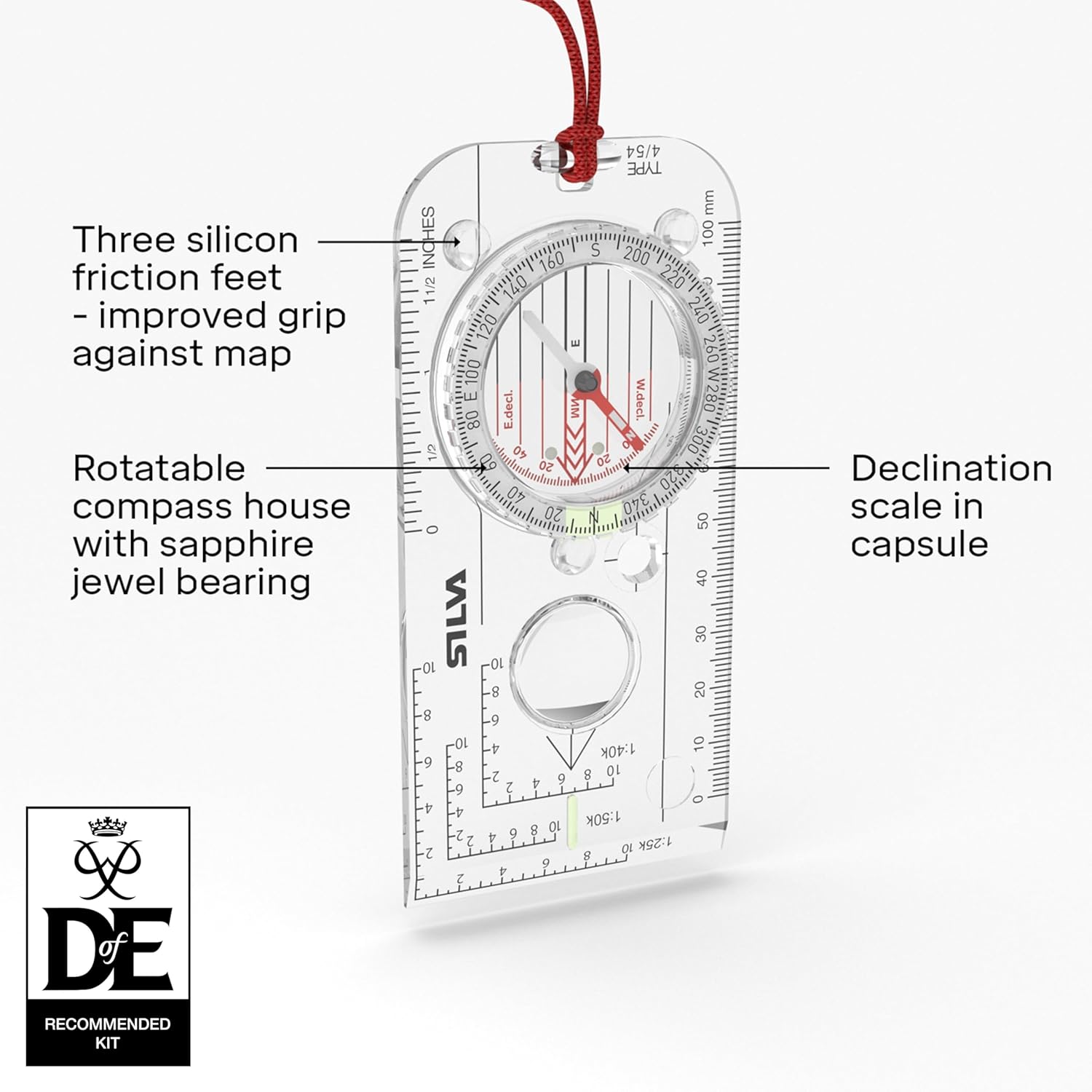
British hillwalking means navigating when you can barely see, whether that is Scottish cloud sitting on a plateau or an afternoon that runs out of light in the Lakes. The Expedition 4 has two features aimed squarely at that. The first is declination adjustment. Magnetic north and the grid north printed on your map are not the same direction, and the gap between them (the declination) varies by location and shifts over the years. A declination scale inside the capsule lets you set that offset once, so you are not adding or subtracting degrees on every bearing. Across most of Britain the difference is small at the moment, but it still matters at the margins and it does drift, so a compass that can allow for it is one less thing to get wrong in poor visibility.
The second is luminosity. The markings are treated to glow for up to six hours after being charged in daylight, enough to read a bearing in the dark without constantly reaching for a torch. That is the theory, and it is where the Expedition 4 draws its sharpest recurring complaint: the needle itself is not luminous. Several reviewers flagged it. mitch, who bought one for his son, found the needle glow "unfit for purpose for night Nav without a lit head torch." Their logic is hard to fault, because if the dial glows but the needle you are lining up does not, you still need a light source in true darkness. If you do a lot of night navigation, go in expecting to keep a head torch on, or look at a compass with a fully luminous needle. For dusk and dull-day use, MR M.'s verdict is closer to most people's: "just enough luminescence to be useful without worrying whether it should be in a lead-lined case."
When the Needle Points South: Faults to Check the Day It Arrives
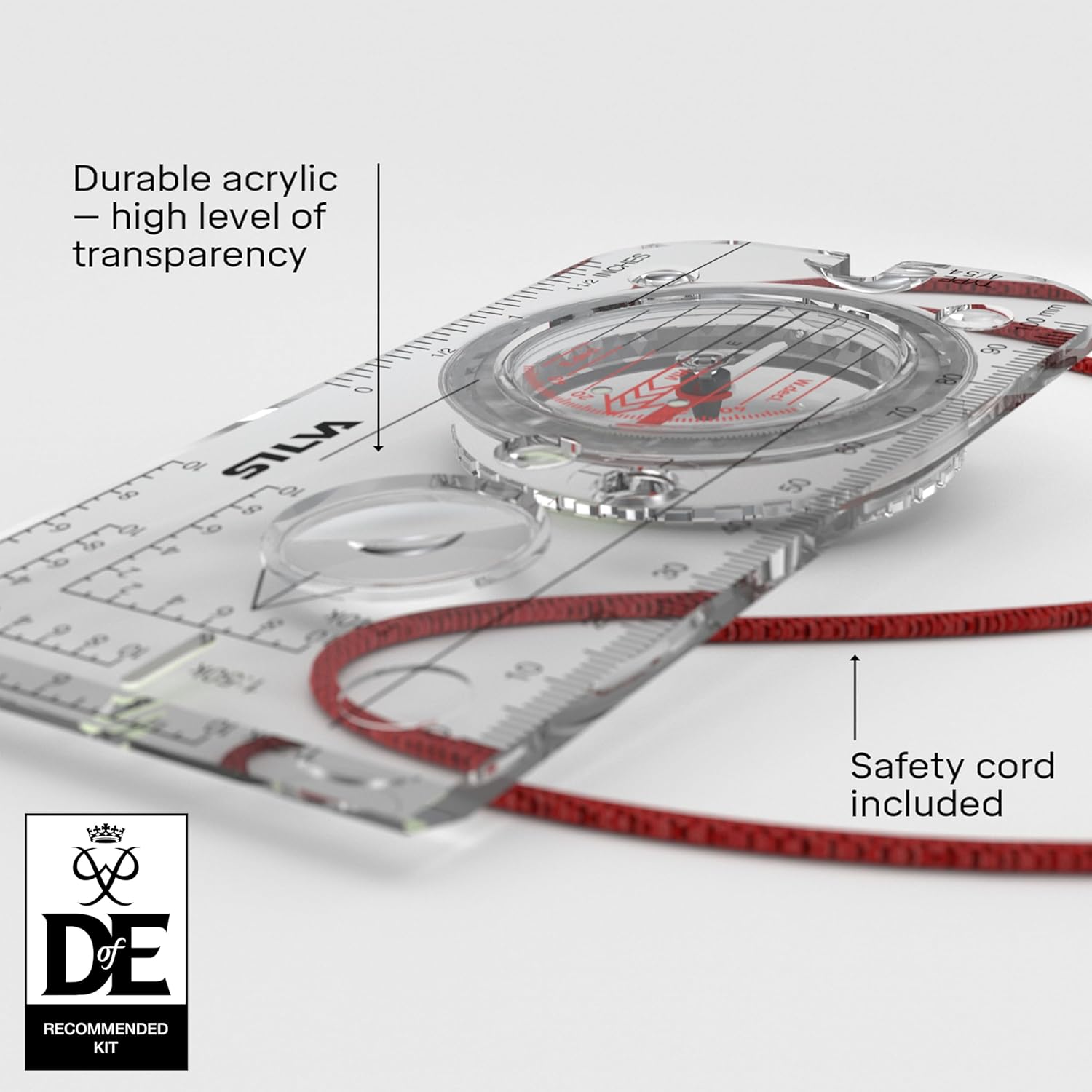
Now the part the headline 4.6 rating hides. Of the 100 most-recent reviews, 18 are one-star, and they cluster around a few specific failures rather than scattered grumbles. The most alarming is a needle that points south instead of north. Several buyers describe it, and MD's account is typical: the compass "came with reversed polarity (North pointing South)," which MD noted "seems to be a common problem reading other reviews." One reviewer only spotted the fault while navigating in the mountains in Scotland; another realised his was 180 degrees out half way up a mountain, which is exactly the wrong place to find out.
It helps to understand why this happens, because some of it is avoidable. A compass needle can have its polarity reversed by being stored or carried against a strong magnet: the magnets in phone cases and speakers, magnetic bag clasps, even another compass. Once flipped, north points south until it is re-magnetised. Some of these units may well have left the factory faulty, but keeping the compass away from magnets and phones is a sensible habit either way. The other recurring gripes in the one-star pile are bubbles forming in the capsule fluid, which throw the needle off, and a bezel that a few careful users measured as a degree or two out of true. Kie's arrived "already with a large bubble, which will only get bigger and affect performance."
Then there is the Sweden question. Silva is a Swedish name, but current stock is made in China, and it clearly niggles some buyers. Stuart M still gave five stars while noting it is "Swedish designed but now made in China." A few went further and suspected the faulty units they received were counterfeit rather than real Silva stock, though that is their suspicion, not something a review can confirm. The counterweight is Silva's guarantee: more than one reviewer mentioned the five-year cover, and one buyer whose compass developed a bubble years after purchase had a replacement arranged by Silva within hours. The practical takeaway is simple. Treat the first five minutes after unboxing as an acceptance test. On a flat surface, well away from metal and phones, check the needle swings freely and settles, confirm north matches a compass you already trust or a known landmark, and look for bubbles in the fluid. Faults on arrival are common enough here that checking is not paranoia, and the return window is your friend if something is off.
The Verdict: A Trusted Hill Standard, With Caveats
So where does that leave the Expedition 4? For the core job it is still the compass most UK navigators would hand a beginner, and the reviews from experienced hands back that up: durable, accurate when it is right, and set up perfectly for OS and Harvey's maps. JCD, who bought one on his navigation course provider's recommendation, summed up the toughness after a few drops and a fall: "it survived better than I did." If you are starting a hill-skills or Mountain Leader pathway, working towards a Duke of Edinburgh award, or replacing a worn-out Silva, this is a sensible choice, and a strong candidate for a reliable backup compass too.
Who should think twice? If you need pinpoint long-range bearings, a mirror sighting compass will beat a flat baseplate for aiming at a distant peak, and one reviewer neatly frames the Expedition 4 as the pick for when "you don't need a mirrored or specialist compass." If most of your walking is after dark, the non-luminous needle will nag at you. And whoever you are, budget for the chance of a return: the quality-control tail here is real, and the gap between a great compass and a dangerous one is a five-minute check on arrival.
On balance this is a very good compass saddled with a quality-control weakness, and that mix is what drags an otherwise excellent design down. Weighing the strong core performance against the faulty-on-arrival reports and the legibility niggles, our verdict lands at 4 out of 5: buy it, but check it properly before you trust it on a hill. You can check today's price on Amazon and read the current reviews before deciding.
Silva Expedition 4 Compass
The teaching-standard baseplate compass for UK hillwalking, with romer scales for OS and Harvey's maps, declination adjustment and a sapphire jewel bearing. Just check the needle the day it lands.