
Your Portable Flush Toilet for Tent Camping UK Needs Somewhere to Live
We earn commission from qualifying Amazon purchases. It costs you nothing and does not affect what we recommend.
Thetford puts a tent icon on this listing. In the 100 most-recent UK reviews, exactly one person mentions using it in one. Here is what the Porta Potti Qube 165 asks of you before it works on a tent pitch, and the one number on the listing you should not plan around.
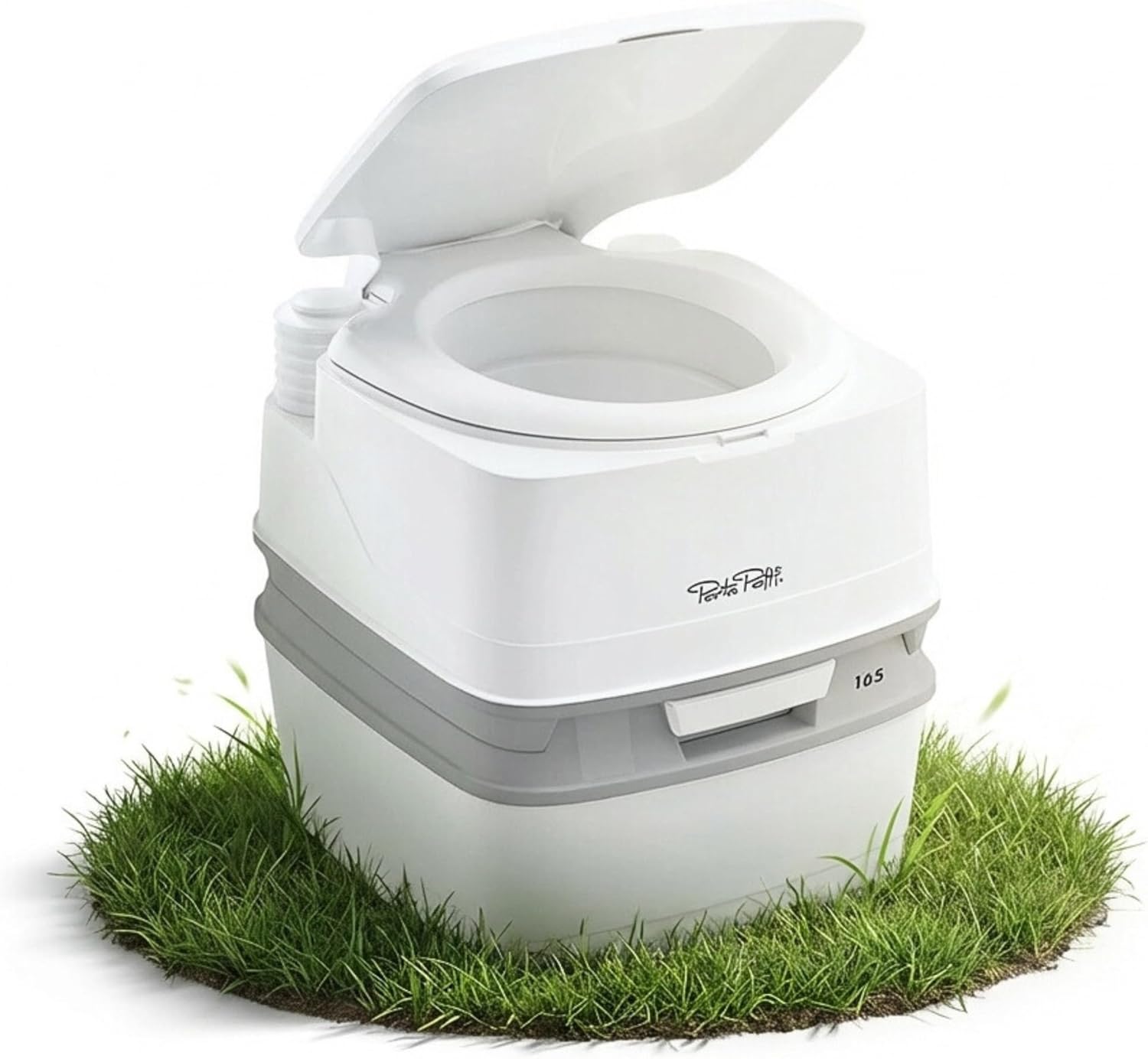
- In a Van It Slides Under the Bench. In a Tent, Where?
- A Sixth of These Reviews Are Not From Campers
- The Listing Cannot Agree With Itself
- What Thetford's Own Photos Say That the Text Does Not
- The Flush Is a Hand Pump, and You Have to Mean It
- Emptying Is the Bit That Decides Everything
- Comfortable to Sit On, Which Is Not a Given
- Buy the Toilet, Then Buy It Somewhere to Stand
Thetford stamps a row of icons on this listing: a caravan, a car, a wheelchair, and a tent. So tent campers are officially invited. Then you read the reviews and something odd turns up. Across the 100 most-recent UK reviews of the Thetford Porta Potty, exactly one person mentions a tent, and they keep theirs in a pop-up tent parked next to their van.
That is not a reason to walk away. This is a very good portable loo. 83 of those 100 reviewers gave it five stars, the lifetime score sits at 4.7 from 4,372 ratings, and the reviewers who owned a cheaper toilet first are quick to say this one is better. But this toilet was designed to slide under a caravan bench, and a tent does not have one. The question to settle before you order is not whether it works. It is where you are going to put it.
There is a second problem, and it belongs to the Amazon page rather than to Thetford's factory. The listing cannot agree with itself about how big the waste tank is or how much the thing weighs. I will show you exactly where, because it changes what you can plan around. You can check today's price on Amazon, but read this first.
In a Van It Slides Under the Bench. In a Tent, Where?
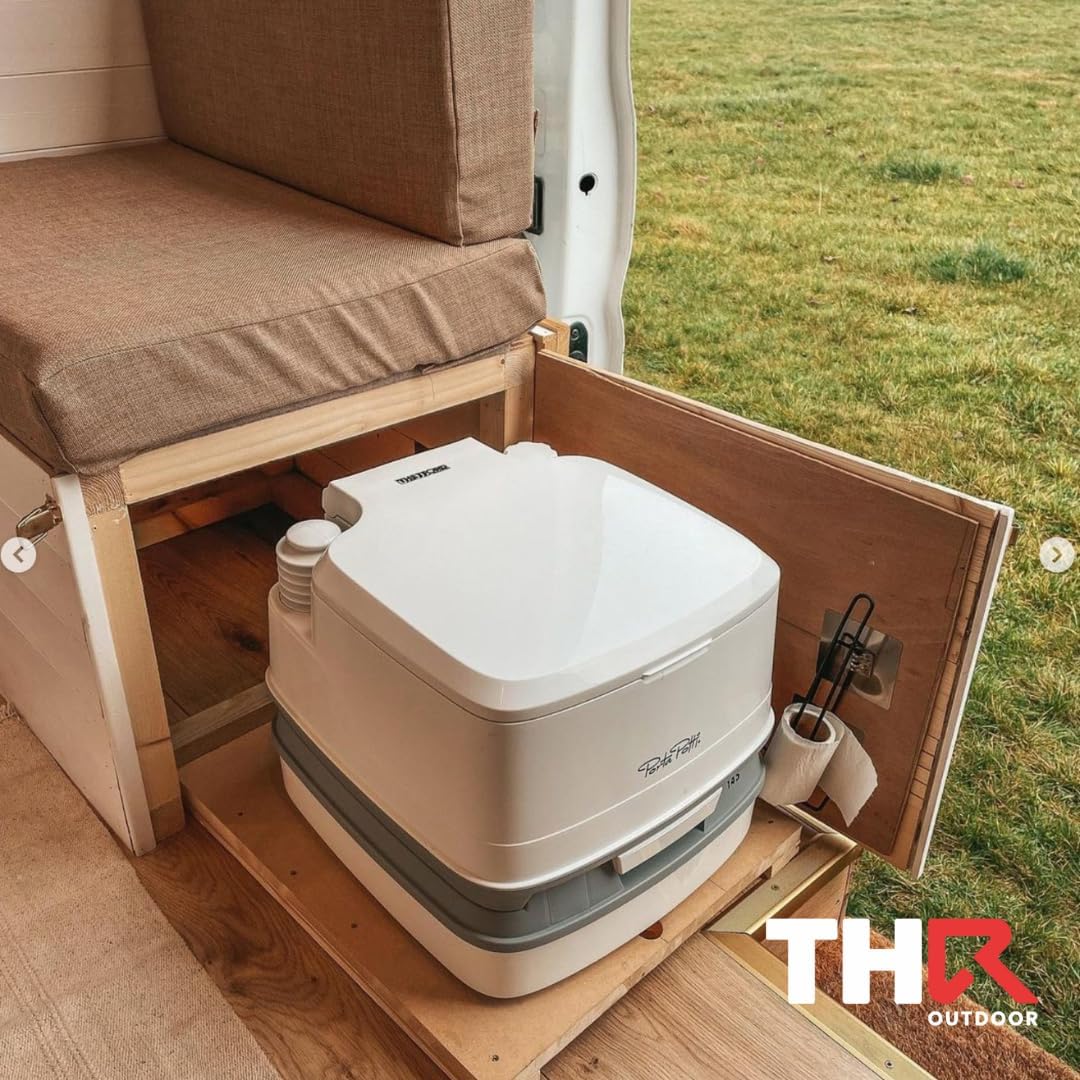
In a caravan or a van conversion this problem is already solved. You build a box under the bench seat, the Porta Potti slides into it, you screw a loo roll holder to the inside of the door, and the whole thing disappears. One of the listing photos shows exactly that installation, and it explains why so many van owners in the reviews sound so relaxed about ownership.
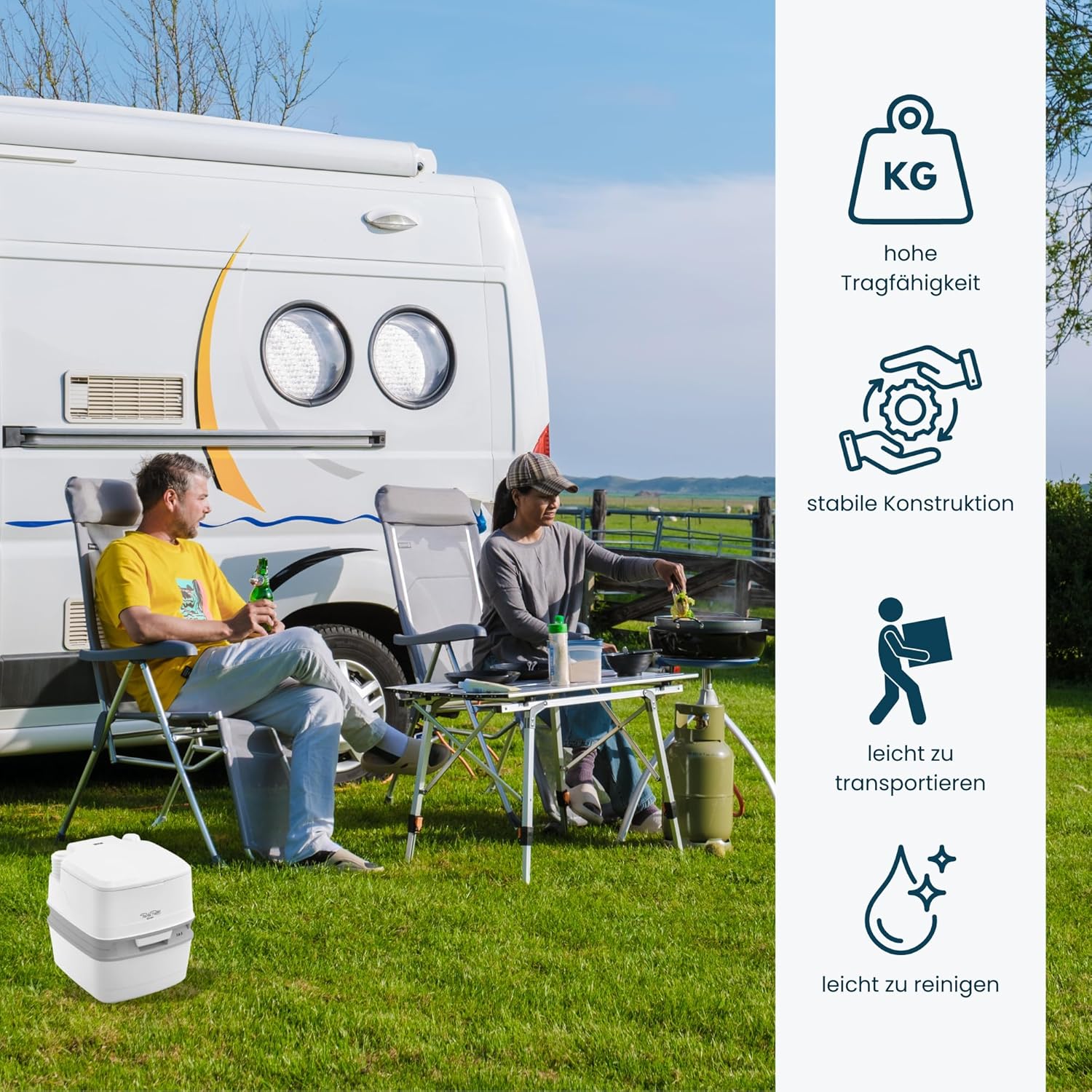
A tent has no bench. What you have instead is a 38.3 cm wide, 42.7 cm deep, 41.3 cm tall block of white plastic that needs somewhere flat, somewhere private, and somewhere you can reach at 3am in the rain without treading on anybody's head. Three arrangements actually work:
- A pop-up toilet tent. The cheapest answer and the most common one. The single reviewer in the whole sample who mentions a tent does precisely this: "We have a small van and keep our cases in a small pop up tent with the toilet." Their luggage and their loo share a pop-up next to the van. Budget for it, because nobody selling you the toilet is going to mention that you need it.
- The porch of a big tent. Run a large family tunnel tent with a proper porch and the Qube 165 will stand in it happily. It will also be in the way of the boots, the stove and the dog, so this suits a week on one pitch better than a two-night dash.
- A driveaway awning. If you are tent camping alongside a van, this gives you the caravanner's setup without the caravan.
And one arrangement that will bite you: a slope. A three-star reviewer found the limit of the design, in a van of all places. "When it's parked on a slope. Liquid gets around the shutter and leaks on a floor." They add that this happened "on a moderate slope that didn't need the van to have chocks", which is to say a surface most of us would call flat. Tent pitches slope. If yours does, give the toilet the most level square metre you own and stand it on something you can wipe.
A Sixth of These Reviews Are Not From Campers

Thetford markets this toilet for camping, fishing, the beach and garden plots, and the listing carries an accessibility icon as well. The review pool reflects that spread, and you want to know its shape before you read too much into a 4.7-star average.
I sorted all 100 of the most-recent reviews by what the reviewer says they are using it for. 26 mention camping, a caravan, a campervan or a van. 17 describe a use with nothing to do with camping at all: a boat, an allotment shed, a potting shed at the end of a long garden, a beach hut, a spare corner during a bathroom renovation, a downstairs room after a knee operation. The remaining 57 give no context whatsoever and simply report that it works.
Those 17 are not noise. They are a large part of why this product is so widely loved, and several of them are the most detailed write-ups in the file. Katherine keeps hers in "our allotment shed". Nick Wild put his in the potting shed because "Mine's a long garden, and it must be an age thing". Both are legitimate, and both are irrelevant to you. An allotment shed does not get rained on sideways for 48 hours, and a potting shed sits on a concrete slab. If what you want to know is how this toilet behaves in a field in Snowdonia, only about a quarter of the sample is talking to you.
The Listing Cannot Agree With Itself
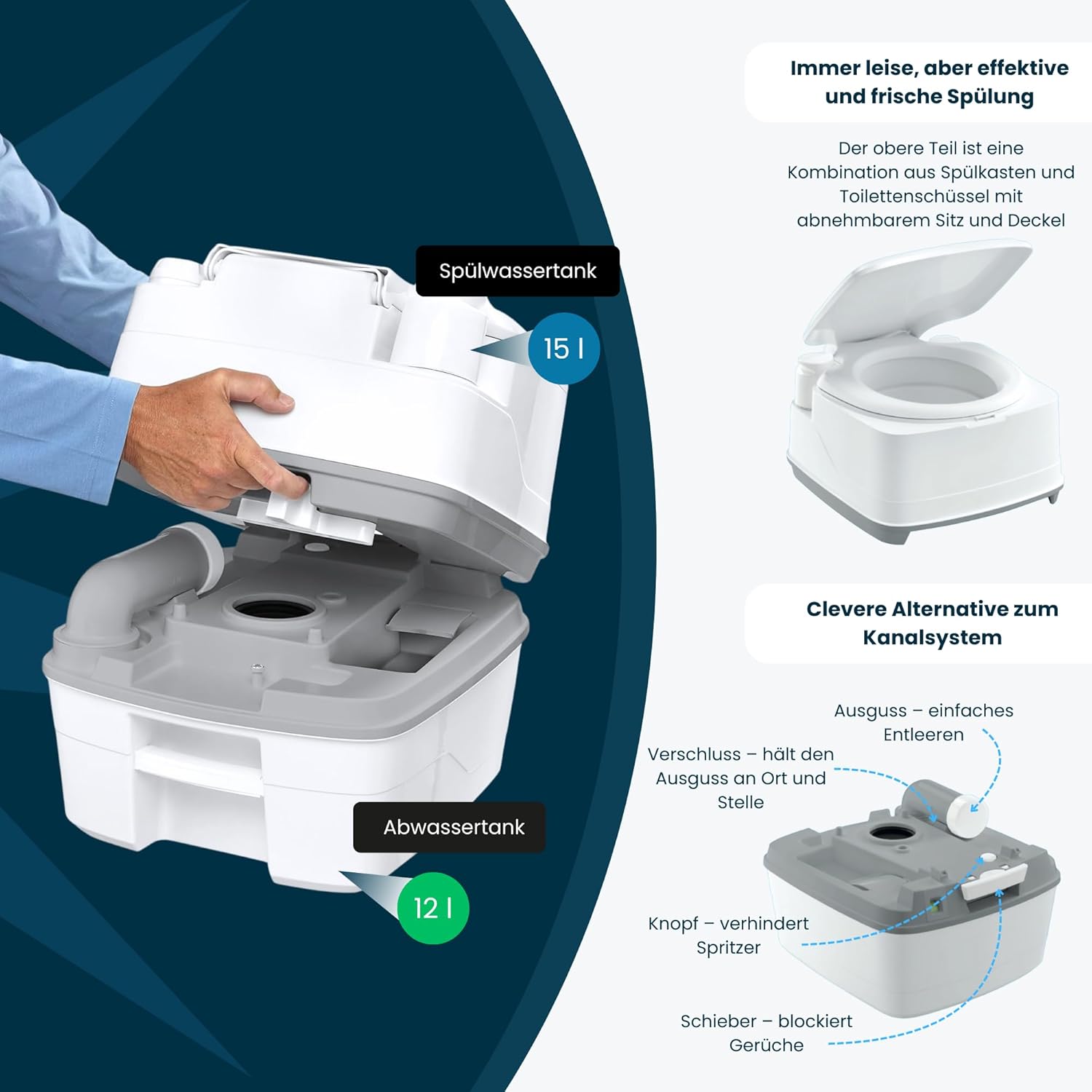
This is the part that made me read everything twice. The Amazon listing for this toilet runs to three bullet points and no description at all, and one of those bullets trails off into the fragment "(19 pieces)", which means nothing.
Then it gets worse. The bullet states a tank capacity of 21 litres. One of Thetford's own listing diagrams agrees and prints 21 L on the waste tank. A different listing diagram, on the same page, labels the waste tank 12 L. Two sources say 21, one says 12, and I am not going to pretend I can settle it for you. The 21 litre figure is Thetford's own spec and it is what two of the three sources show, but you are buying from a page that also tells you 12.
The weight has the same disease. The bullet says 4.1 kg. The dimension diagram says 3.8 kg. Call it around 4 kg and move on, because that gap is trivial. The tank gap is not.
The reviewers cannot settle it either, which is the detail I find most telling. Richard Barratt says it is "small and lightweight but don't hold that much - ideal for small 1-2 family campervan". Susie Hampson warns that "it holds A LOT of liquid". A four-star reviewer reports "Has a high capacity, only need emptying every five days". Mrs S A Pitts says "the waste tank is good size and there is plenty of water for flushing". Three of those four are describing a big tank and one is describing a small one, and not one of them can actually check.
Because the 165 has no level indicator. A four-star reviewer, pete, puts it bluntly: "beware the 165 does NOT have a level indicator to show when it's full. Pretty basic feature IMHO." The listing text never mentions the omission, on the grounds that the listing text barely mentions anything. So you empty it on a schedule and a guess.
Thetford Porta Potti Qube 165 Portable Toilet
The camping toilet the caravanners already trust, and the one to take to a tent pitch if you give it somewhere flat to stand. Comfortable full-size seat, 15 litre flush tank, blade valve that keeps the smell in, and a three-year warranty Thetford forgot to advertise.
What Thetford's Own Photos Say That the Text Does Not
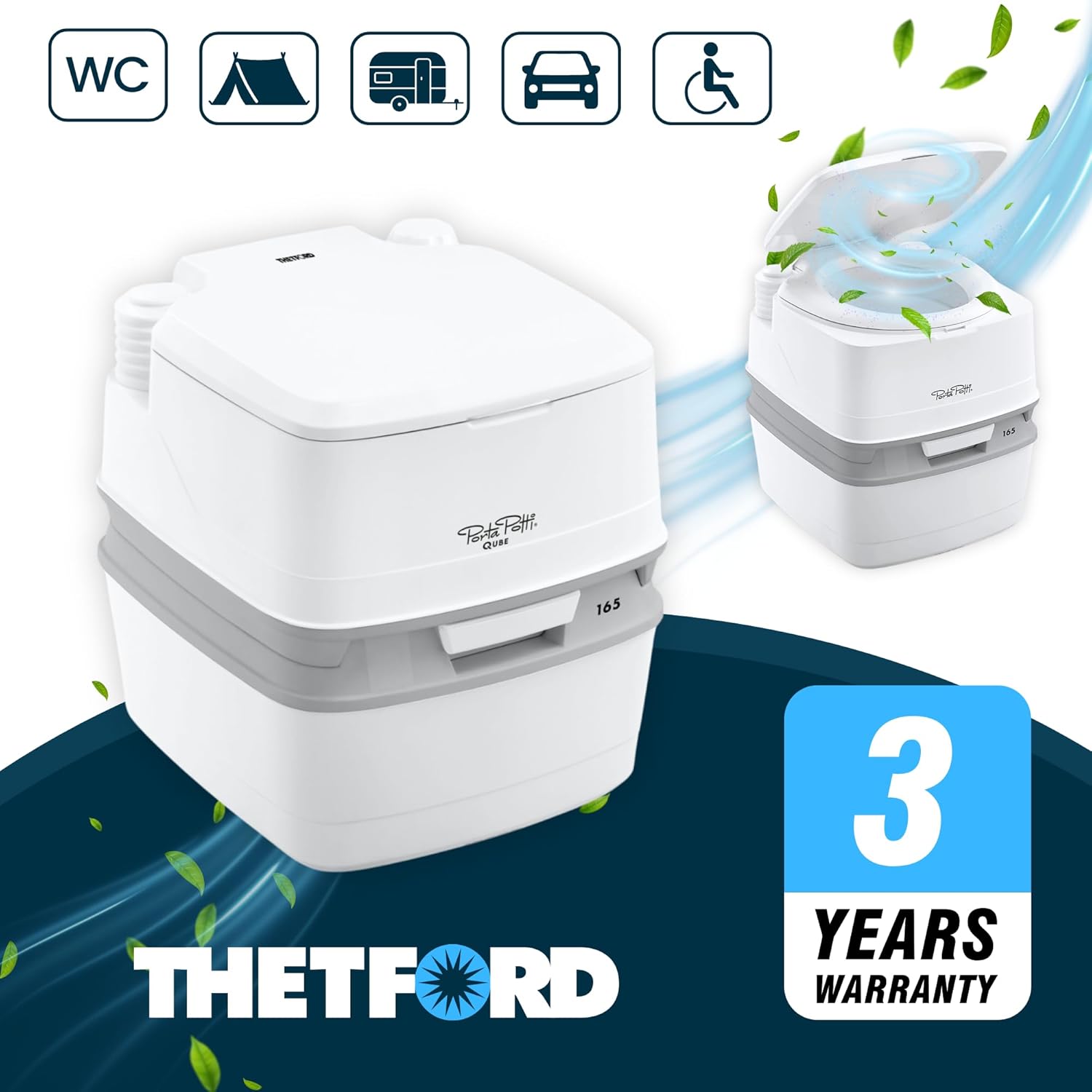
Read the listing images instead of the listing text and you pick up three useful things nobody could be bothered to type out.
It is a Porta Potti Qube 165. The Amazon title only says "Porta Potty". The model badge is sitting there on the tank in several of the ten photos, and pete's review names it too. The model number matters the moment you go hunting for a spare seal, a matching stand or the right chemicals.
It carries a three-year warranty. That is printed on one of the listing images and appears nowhere in the listing text. For a plastic tank with a rubber blade valve and a pump you press with your hand, three years is a real argument for paying Thetford money rather than buying the cheapest lookalike on the page.
It needs no plumbing of any kind. Another image spells it out: no connection to sewage, water or a drain. That is obvious once you own one and surprisingly easy to doubt when you are buying a "flush" toilet online for the first time.
One caveat on that warranty. Taz, who left two stars, says the handle that opens and closes the waste tank "snapped within a day of being used", ordered a second one which did the same thing, and then reports that "despite a two year warranty, they have not responded". The listing image promises three years and Taz was working on two. Either way, the grievance is not the length of the warranty, it is that nobody wrote back.
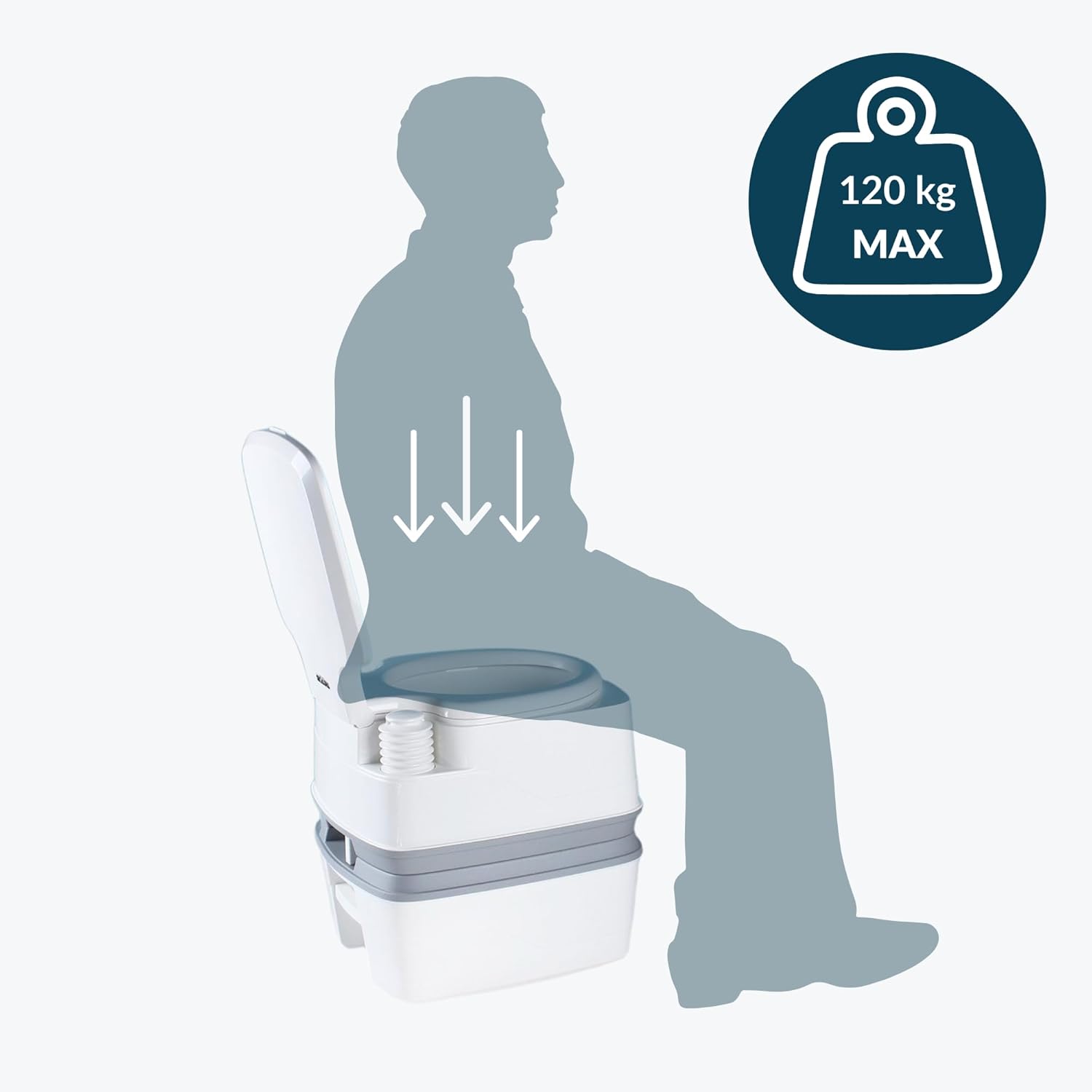
The specs that two independent sources agree on are the ones you can safely plan around: a 15 litre flush water tank, a 120 kg maximum user weight, and those 38.3 x 41.3 x 42.7 cm dimensions.
The Flush Is a Hand Pump, and You Have to Mean It
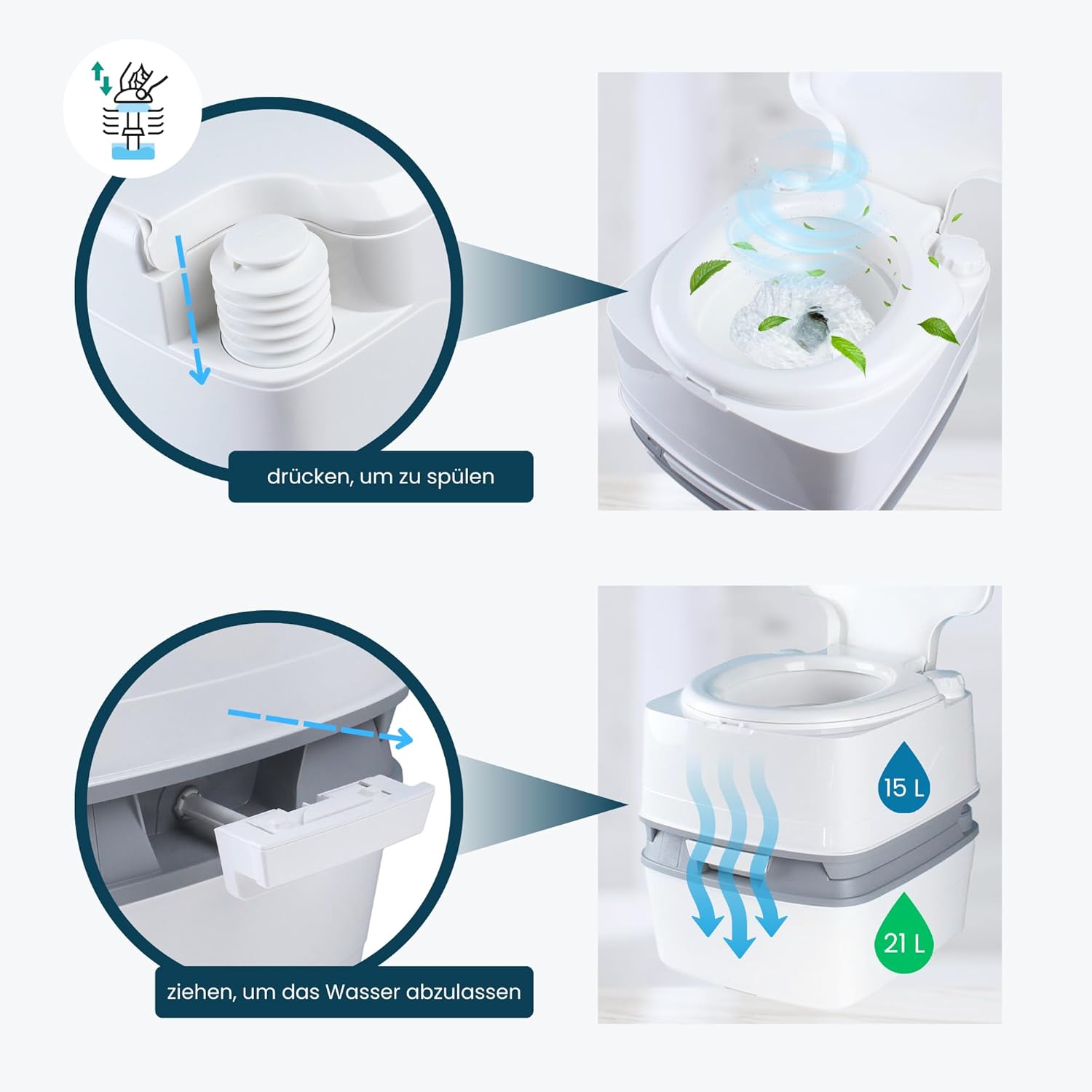
There is no battery in this toilet and no mains anything. The flush is a bellows piston on the top left of the cistern that you press down with the heel of your hand, and Thetford's diagram says exactly that: press to flush. Fifteen litres of clean water sit in the top half, your hand does the pumping, and a rinse runs round the bowl.
It works, and two reviewers want you to know it is hard work. Ed Campbell gave four stars and one sentence: "The flush needs strength to push down to get a good flush. Otherwise great item." Another four-star reviewer, who is otherwise delighted, signs off with "The flushing button is stiff though." Nobody calls this a dealbreaker. But if you are buying partly with children or weaker hands in mind, it is the one bit of the design worth thinking about, and it is only fair to note that a different four-star reviewer, Matthew king, says "it's suitable for children to use".
The real fault is not stiffness. It is the flush failing outright, and two of the four one-star reviews are exactly that. One buyer bought the toilet as a gift for their son, who took it on a camping trip where there were "No other toilets on site. Product did not flush." He had to go out and buy a replacement. Mr. D. Scott set his up on the day it arrived and found "it doesn't flush" and that "it leaks and i now have a blue stained carpet".
Two more reviewers opened the box and found a part missing altogether. Vincent Bygrave: "Supplied without a cap for the waste outlet!!" Salar G.: "It is missing the Bellow Pump in the package." That makes four of the 100 who received a unit that was not right. Four in a hundred is a low rate, and it also produces the single most useful instruction in this review: unpack it, fill the flush tank from the kitchen tap and work the pump before the thing ever goes near the car. A field in the Lake District is a rotten place to discover a missing cap.
Emptying Is the Bit That Decides Everything
Every portable toilet review arrives here eventually, and this is where the reviews split hardest.
The grimmest account in the file comes from a two-star reviewer posting as Dissappointed: "Emptying this toilet was one of the worst experiences of my life. I was instantly sick." They describe "so much splash back too all over the bathroom" and a smell that hung around for days. Read it closely, though, and two details stand out. They were emptying it indoors, into a domestic bathroom. And they say themselves: "I would say use a lot of extra chemical amounts inside than what is stated."
Now the other end of the scale. One of the most-upvoted reviews in the sample comes from Luke, who lived on a boat with an electric pump-out toilet for seven and a half years before switching to this. He is a boat-dweller and not a tent camper, so weigh him accordingly, but his conclusion is worth the space: with the right chemicals, "tip-out is a relatively clean and smell-free process". He names what he uses, Thetford Blue and Thetford Pink, and says dissolvable toilet paper is what keeps the tank from turning lumpy.
The hardware is built for this job. The waste tank unclips from the bowl at a catch on the front, so only the bottom half travels to the disposal point. A blade valve slider seals it and blocks the odours. A vent button releases the pressure that causes the splash-back which ruined Dissappointed's afternoon. A rotating pouring spout, capped in transit, does the pouring. Les Ruffles describes the version of this that goes well: "there are no unpleasant smells from this, there is a sliding seal that keeps the waste separate when not in use".
So, for a tent camper: use the chemicals, use dissolvable paper, and empty it at the campsite's chemical disposal point, the Elsan point, never down an ordinary drain and never into a hedge. If you are wild camping with no facilities at all, you are carrying a full tank back to the car, and that is the moment the tank-size argument stops being academic. If it really is 21 litres, a full one is more than 20 kg of liquid. The reviewers duly split on this too: one says it is "very heavy when full", another insists "Not too heavy when full." Both are telling the truth, and the difference is how long they left it.
Comfortable to Sit On, Which Is Not a Given
A lot of portable toilets are a bucket with ambitions. This one has a full-size seat and lid that lift away from the tank for cleaning, and the people best placed to judge it are the ones who bought something cheaper first. Robert and Gail Olley did exactly that: "tried a cheaper version before and it was too sharp and hard to sit on!"
The maximum user weight is 120 kg, a shade under 19 stone, and that figure is corroborated by both the listing bullet and a listing diagram. Annie, who describes herself as fat, reports that "this holds me perfectly happily". Clairabella calls it "Reasonable size for me & my partner who is approx 16 stone". If anyone in your party is over 120 kg, this is not your toilet, and at least Thetford is upfront about the limit.
Seat height is the other thing buyers care about and the listing never states. Two reviewers bracket it for you. One moved up from a smaller toilet they "found it to be to low" and says this one is "so much better". DYLAN, using it at home under an NHS support frame, moved down from the taller 365 model, which "WAS TOO HIGH". The 165 lands between them, which is roughly where a normal person wants a toilet to be.
Buy the Toilet, Then Buy It Somewhere to Stand

Eight of the 100 most-recent reviews scored this toilet three stars or lower, and I have quoted nearly all of them above, because there are few enough to fit. Three of the eight received a toilet that did not work or was missing a part. One leaks on a slope. One had the tank handle snap twice and could not get Thetford to answer an email. One was an emptying catastrophe in a domestic bathroom. One is not intelligible enough to judge. And one awarded three stars while calling it "an expensive but well made portable potty", which is a compliment wearing a frown.
So where does a tent camper land? I score it 4.3 out of 5, below the 4.7 Amazon average, and that gap is deliberate. Almost nothing in the reviews points at the build. The seat is comfortable, the blade valve seals, the odours stay where they belong, the plastic justifies the Thetford badge, and there is a three-year warranty behind it that the listing forgot to tell you about. What pulls it down is a quality control rate you can feel at four in a hundred, a flush that wants a firm hand, no way of knowing when the tank is full, a product page that cannot state the tank size or the weight consistently, and the leak on a slope that its owner calls "Pretty bad design" and that a tent pitch is very likely to expose.
Buy it. Then buy the toilet tent, a bottle of Thetford Blue and a roll of dissolvable paper, and test the flush on your kitchen floor before you leave the house. Do that and this is the portable flush toilet I would take to a field. Several reviewers also point out that it costs less here than on the high street: one says flatly that "it was a lot cheaper than go outdoors", which is worth knowing before you drive to a shop.
Thetford Porta Potti Qube 165 Portable Toilet
The camping toilet the caravanners already trust, and the one to take to a tent pitch if you give it somewhere flat to stand. Comfortable full-size seat, 15 litre flush tank, blade valve that keeps the smell in, and a three-year warranty Thetford forgot to advertise.