
The 25m Caravan Mains Hook Up Cable UK Campers Rate 4.7 Stars While Calling It Thin
We earn commission from qualifying Amazon purchases. It costs you nothing and does not affect what we recommend.
One reviewer calls it "RIDICULOUSLY thin". Another says "The thinner gauge makes coiling and storing a lot easier compared to beefier wires". They are describing the same cable, and which of them you side with comes down entirely to what you intend to plug in at the far end.
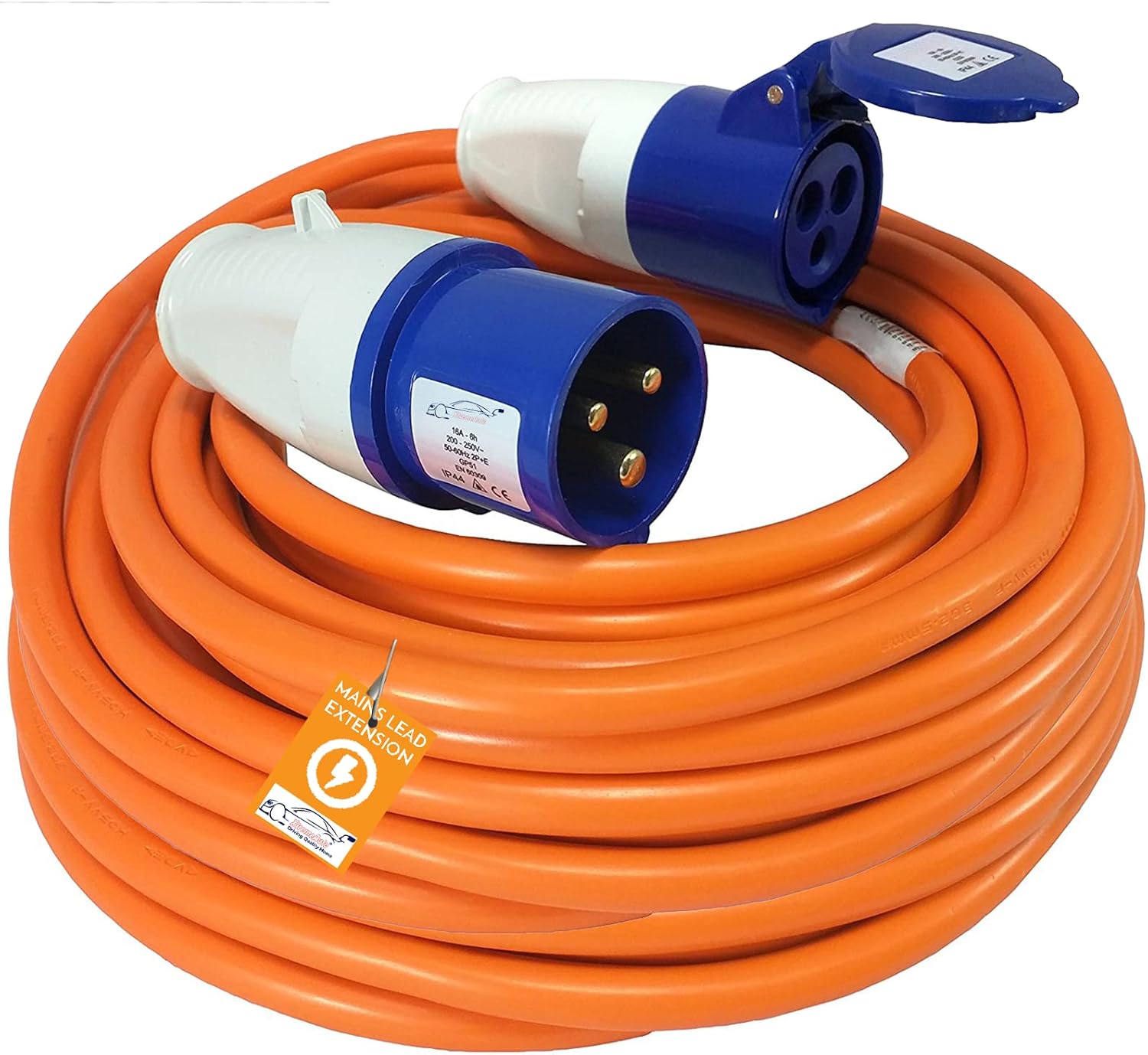
Search for a 25m caravan hook up lead and what you get is shops. Amazon's results page, the individual product listings, the caravan accessory catalogues: they all want to sell you a cable, and not one of them stops to tell you what is inside it.
The number that decides this purchase is 1.5. Xtremeauto's 25m lead runs on 1.5mm² conductors, and you will not find that figure in the product title, the bullet points or the description. It appears in one place only: a dimensions panel sitting in the listing's own image carousel, which reads 25M LONG CABLE, 8MM THICK and 1.5MM THICK CABLE.
That matters because the same listing calls the lead heavy duty, and it carries 4.7 stars from 1,448 ratings. Read the 100 most recent reviews and something odd surfaces: 15 of them stop to comment on the cable's thickness, and those 15 are spread across every rating from one star to five. Almost nobody disputes the physical facts. The argument is only ever about whether 1.5mm² is enough for what you are about to plug in, and that is a question you can settle for yourself in about a minute.
One Bollard, Six Pitches, and Where You Happen to Park

Site electrics are laid out for the site's convenience, not yours. Hook up bollards get shared between four or six pitches, and where you end up parked decides whether a 15 metre lead is plenty or useless. Kindle Customer bought this one after learning that lesson the hard way, having had to move pitches because my 15m lead wasn't quite long enough. Twenty five metres is the length that stops that happening.
Length praise is quietly one of the most common notes in the sample. Nine of the 100 most recent reviewers mention the run being long enough, and nobody at all complains that 25 metres is short in practice. The one person who measured it is Huey, whose 4-star review is the most careful in the pool. He found the lead came up 12cm short of 25 metres even counting the connector bodies, and thought that a bit frugal. It is a fair criticism and a small one: 12cm is not going to decide whether you reach the bollard.
The flip side is that 25 metres is a lot of cable to carry, coil and store for someone who only ever pitches next to the post. If your van is usually within 10 or 15 metres of the hook up, a shorter lead is less to wrestle with, and Xtremeauto sells one. That choice matters more than it looks, for reasons covered further down.
1.5mm² Is the Whole Review
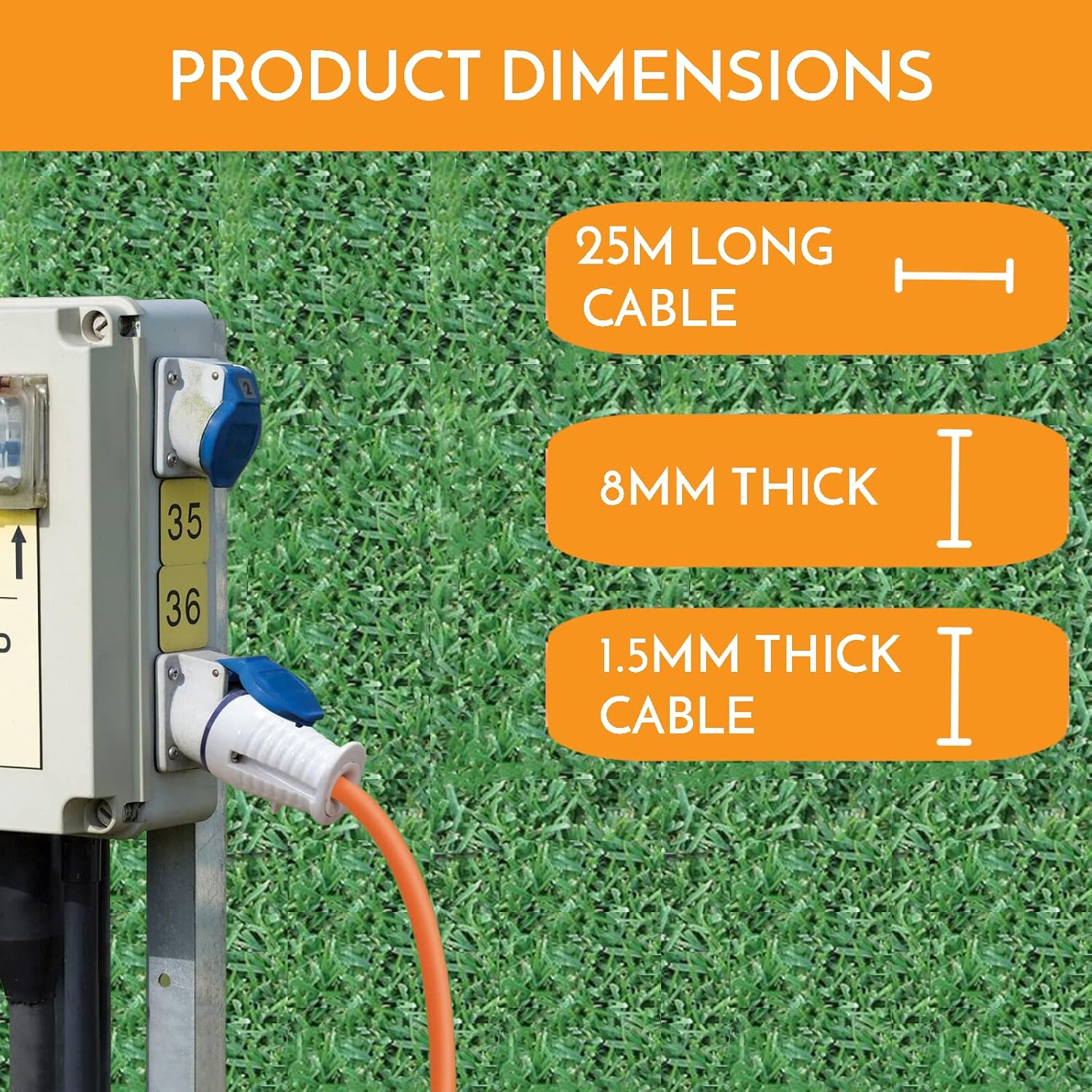
Here is the spec panel the description does not give you. The listing's dimensions image states three things: 25M LONG CABLE, 8MM THICK, 1.5MM THICK CABLE. The 8mm is the outside diameter of the orange sheath. The 1.5mm is a loose way of writing 1.5mm², the cross sectional area of each copper conductor inside, which is the figure that actually governs how much current a cable will carry comfortably.
You do not have to take the panel's word for it, because three separate reviewers report the same number. Huey stripped his back and confirmed the conductors as stranded 1.5mm2. CM (2 stars) wrote that Cable size is only 1.5mm sq. NigelP noted that The product description does say that it is 1.5mm cable. Caroline Satterley went further and compared hers against the same lead she bought in 2023 and 2024, measuring 8mm where she had previously had 10mm, and concluded Xtremeauto had thinned the cable while holding the price.
For comparison, 2.5mm² is the gauge the objectors expect at this length: CM would rather pay a few pounds more for 2.5mm² from another brand, and Huey expects it of anything billed as heavy duty over a run like this. So the thicker option exists, and buyers who want it know it exists. That is the entire substance of this review, and everything below is about whether it should stop you.
Everyone Agrees It's Thin. They Split on Whether It Matters.
This is the part that makes the listing interesting. Of the 100 most recent reviews, 15 comment on how thick or thin the cable is, and the split by rating is five 1-star, two 2-star, one 3-star, four 4-star and three 5-star. The observation runs the entire length of the scale. What changes from one end to the other is not the reading of the cable, it is the verdict on it.
At one end, Rich (1 star) calls the delivered product RIDICULOUSLY thin cable. dekhelia (3 stars) writes that The cable itself is no thicker than a regular power cord. Mr. P. R. Moore (4 stars) is more measured: Looks ok but is thinner than my old cable. Thinner normally means lower current rating.
At the other end, the same physical fact gets logged as a feature. One 5-star reviewer writes that The thinner gauge makes coiling and storing a lot easier compared to beefier wires. Stuart B. Campbell (4 stars) shrugs it off: The actual cable is thinner than I expected, but that shouldn't affect its performance. Even Schrödinger's cat, who left five stars, records that it is smaller diameter and lighter weight than my 25m heavy duty lead, even though the rating is the same. Exactly one voice in the sample dissents on the facts themselves: Anony-Mouse, who reports that the cable is thick and the connectors are decent.
Where the listing takes a real hit is the word heavy duty, which it uses in the title and repeats in the bullets while its own spec panel says 1.5mm². Seven of the nine 1 and 2-star reviews are that complaint in one form or another. The other two are about different things: one reports the lead arcing on first use and returned it, the other disputes the 16A wording. That is a clean pattern, and it is about billing rather than breakage.
Xtremeauto 25M Extension Lead Cable
A 25 metre 16A hook up lead on 1.5mm² conductors, with EN 60309 commando connectors and a storage bag. The right buy if your pitch is far from the bollard and your load is modest.
So What Can You Actually Run Through It?
The listing's claims are specific enough to repeat: it says the cable conforms to BS 7671 and EN 60309, that the cable meets BS6500, the connector EN 60309-2 and the plug EN 60309-1, and that it carries an IP44 splash rating. Zoom into the plug in the first listing photo and the moulded label agrees on the headline points: 16A, 200-250V, 50-60Hz, 2P+E, IP44, EN 60309.
The reviews are the more useful guide, and on the question everyone worries about they are quiet in a reassuring way. Across all 100, not one person reports the lead melting, scorching, overheating, or tripping a hook up bollard. The only reviewer who mentions heat at all mentions its absence: MR A P DEAMER ran a 3kW rice cooker off it for a stall and reported that it Works perfectly, doesn't get hot or anything. A 3kW load is roughly 12.5A at UK mains voltage, which is most of what a 16A hook up will give you, and it is a real data point against the idea that this cable folds under load.
Against that, CM (2 stars) draws the sensible line: Cable is okay for general use. But if using on the larger loading appliances or multiple appliances in the same time. I am not recommended. Huey's objection is about margin rather than failure. He points out the lead does not have the increased thickness of 2.5mm2 conductors (that reduce voltage drop over distance and increase robustness) that he would expect from something billed as heavy duty at this length, and by his own logic a 25 metre run is where that margin counts for most.
So the practical answer: if you are running lights, a fridge, a phone charger, a kettle on its own, the reviews say this is a non issue. If you plan to sit at or near the full 16A, or run several heavy things at once, buy a 2.5mm² lead instead and stop thinking about it. Richard Long's 1-star adds one more consideration, that some campsites may refuse it if they check, though that is his expectation rather than anything we can confirm, and he is describing the shorter lead rather than this one.
Two Lengths, One Review Pile
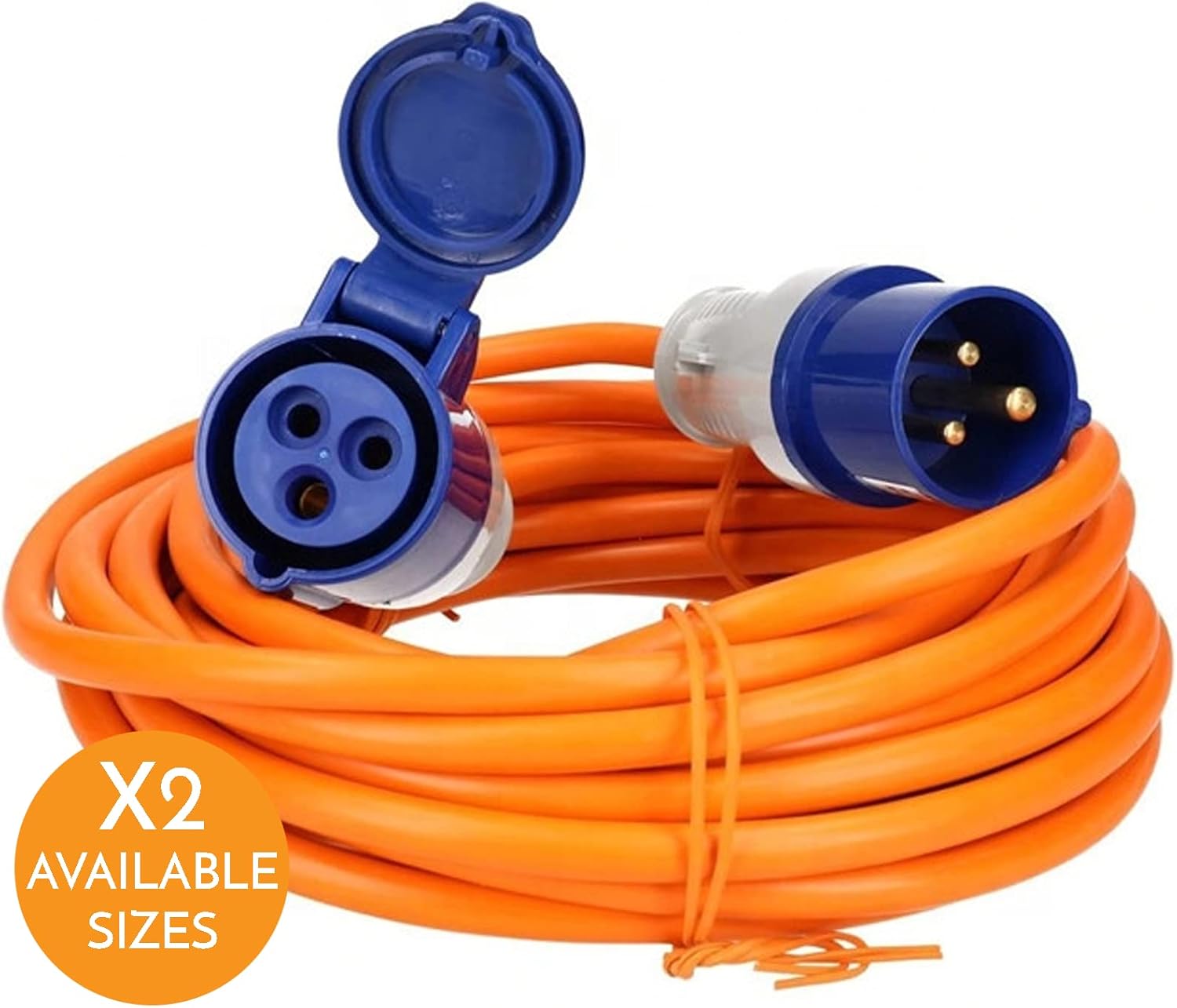
Before you weigh any of those reviews, know what you are reading. Amazon pools the ratings for this listing across both sizes Xtremeauto sells, which is why the listing images carry an X2 AVAILABLE SIZES badge and why the 25M and the 10M both show the same 4.7 stars from 1,448 ratings. The reviews you scroll through are a mix of two different cables.
It shows up in the sample. Mr. A. M. Hood titled his 4-star review Standard 10 M cable all good if a little expensive. Richard Long, whose 1-star is the most technically specific negative in the whole pool, opens with This 10m lead. Dave Hillier does not name a length, but says he needed a shorter lead that the 20m lead I normally use when caravaning, which cannot describe a 25 metre cable. So at least three of the 100 are reviewing the sibling product.
This is worth caring about for one reason above all: Richard Long's review is the one that names 1.5mm² PVC flex and calls it undersized for UK campsite hook ups, and it is the review most likely to make you close the tab. His technical point about the gauge carries across, because both sizes use the same cable. His conclusion about campsite suitability was formed on a 10 metre lead, where volt drop over the run is a much smaller worry than it is over 25 metres. If anything, the concern he raises applies more to this product than to the one he actually bought.
Good Connectors, Fading Orange
Strip the gauge argument out and what is left is a well liked cable. Twenty nine of the 100 most recent reviewers use words like quality, well made, sturdy, solid or durable, and 18 mention price or value approvingly. The connectors in particular get a clean run. Stuart B. Campbell reckons Both plugs appear to be as rugged as others I've used. Huey, again the most thorough, lifted the covers and found each conductor's strands contained in a ferrule, before being tightly clamped by each screw in the terminal block, noted the earth had a longer ferrule and two clamping screws, and confirmed that reverse polarity was not detected. That is a better bill of health than most leads at this money get.
Two practical notes worth having before you order. James morris found You need to remove the cap so it can fit in the vehicle. And Frankie, who left four stars, found the Plugs are difficult for a person with dexterity problems to put together and pull apart, which is the sort of thing nobody mentions until it matters to them.
The bag divides people, mildly. Roy liked the lead but Struggled to get it to fit back into its bag again, while Crafty65 counts it as a win that I can actually get it back in the bag for storage. That difference is the thin cable's one clear upside: the lighter flex is the reason it packs down at all.
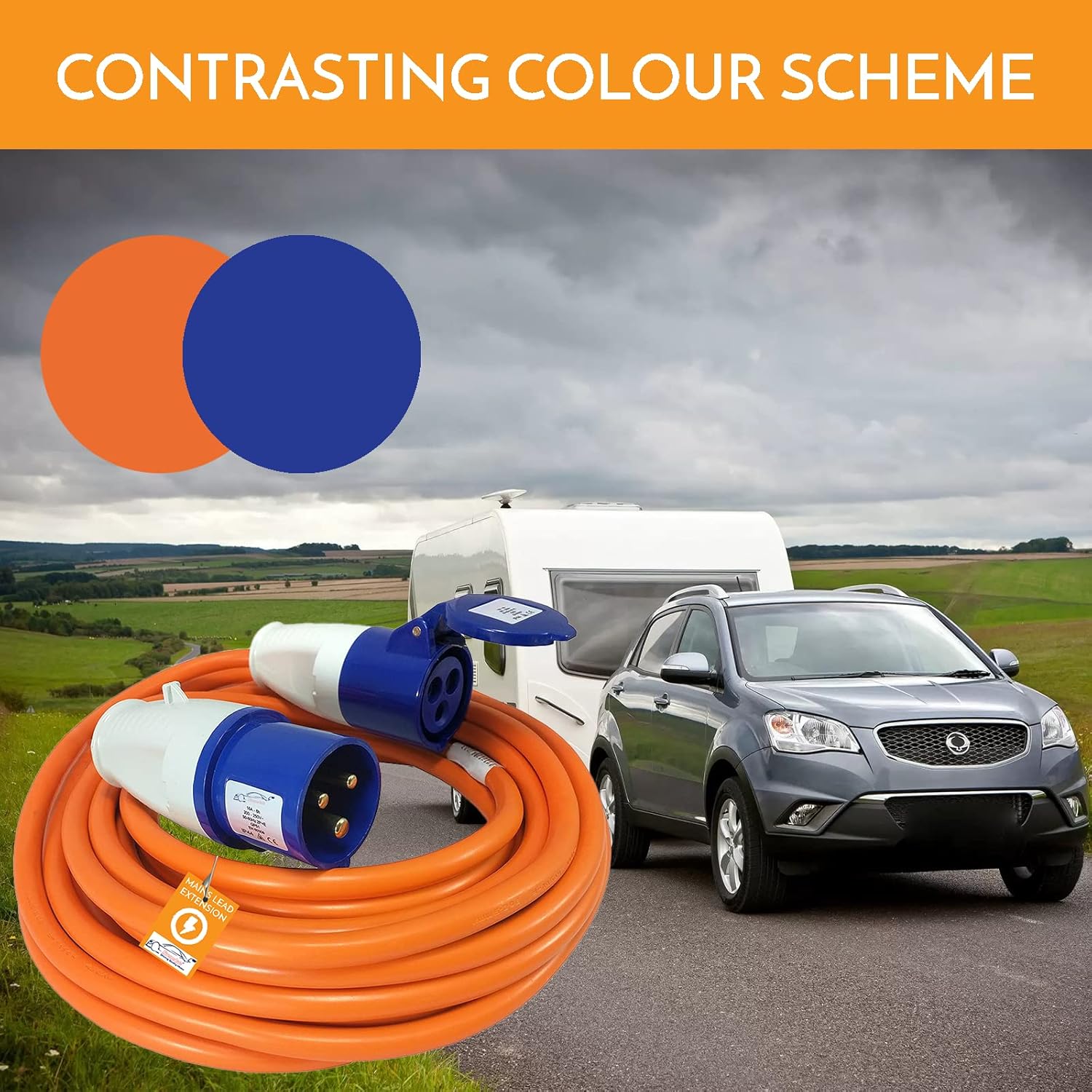
The one flaw nobody markets around is the colour. The listing sells the orange hard, with a whole panel on its contrasting colour scheme and high vis orange in the product title. Two of the three 3-star reviews are about that orange not lasting. Paul nicholls writes that it starts of orange then turns to yellow in the sun, and dekhelia that the colour fades very quickly from orange to a kind of washed-out yellow. It is cosmetic, but if the high visibility is the reason you are buying, know it has a shelf life.
It Depends What You're Plugging In
This is a good cable wearing the wrong label. The build is sound, the connectors are better than the price suggests, 25 metres solves the far pitch problem, and in 100 reviews not a single person reports it failing under load. Buy it for a caravan, motorhome, campervan or tent where the draw is lighting, charging, a fridge and a kettle, and you will most likely land among the 88 in 100 who rate it four or five stars.
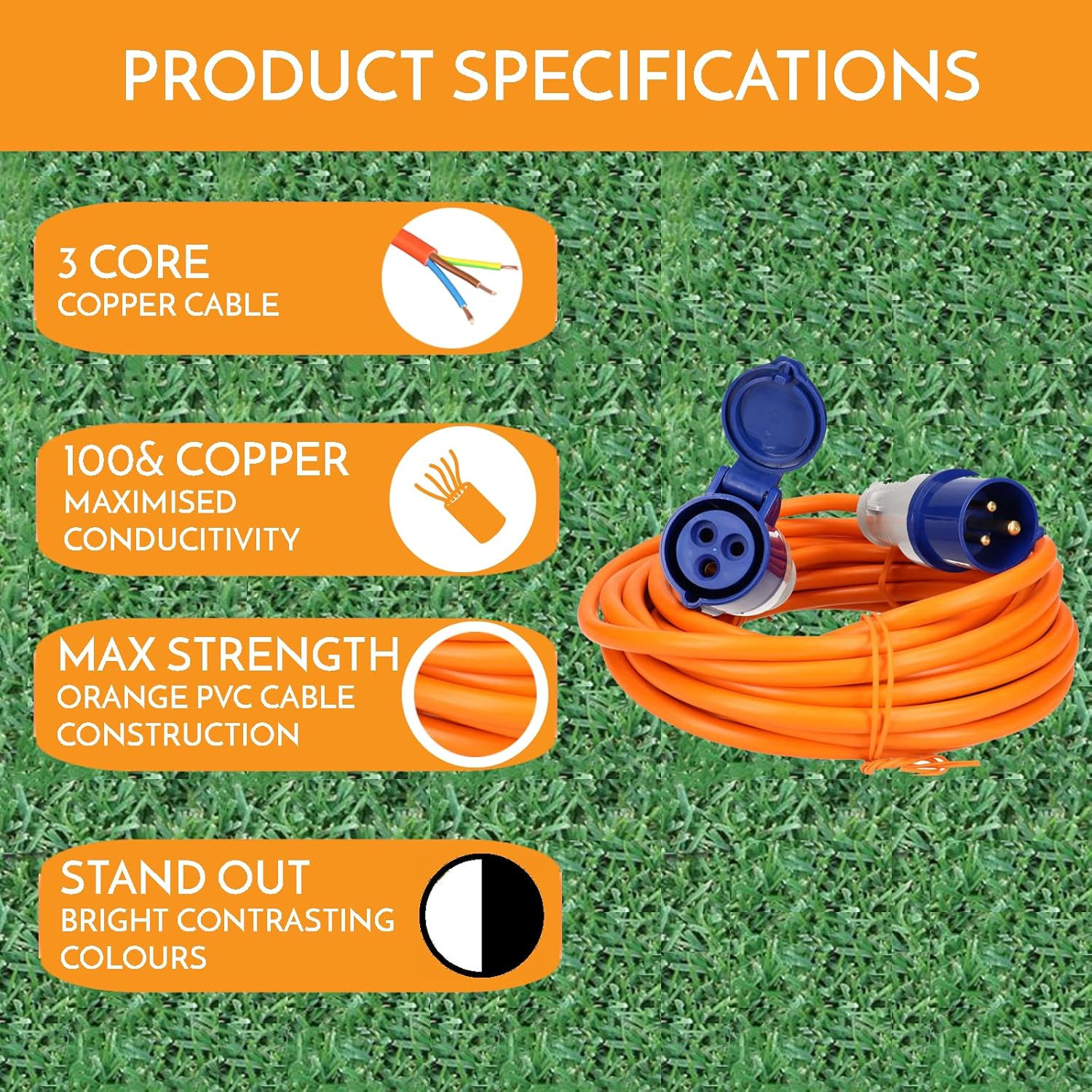
What it is not is heavy duty, whatever the title says. Xtremeauto put 1.5mm² conductors in a lead it markets on ruggedness, photographed it so the cable looks considerably fatter than the 8mm it is, and buried the only straight statement of the spec in an image most buyers never open. NigelP's complaint that the photo provided gives a false impression of how robust it is is fair comment, and Chris's narrower point is fair too: the package, he says, says more correctly that it's a copper cable with 16A connectors. The connectors are the part carrying the 16A badge.
So the decision is simple, and it is yours rather than ours. Know your load. If it is modest, this is a lot of usable cable for the money and the criticism above should not put you off. If you want to run heavy appliances at 25 metres, or you just want the margin, pay the small premium for a 2.5mm² lead and buy once. Our score reflects the gap between what this is sold as and what it is, not a fault in the thing itself.
Xtremeauto 25M Extension Lead Cable
A 25 metre 16A hook up lead on 1.5mm² conductors, with EN 60309 commando connectors and a storage bag. The right buy if your pitch is far from the bollard and your load is modest.