
Do Not Trust the 5-Ton Headline: The KATSU Caravan Levelling Ramps for Uneven Grass Pitches UK, Reviewed
We earn commission from qualifying Amazon purchases. It costs you nothing and does not affect what we recommend.
Nobody in the 100 most-recent reviews mentions grass. Not once. That is a strange gap in a product most British caravanners buy for exactly one reason: the pitch slopes, and the ground under it is soft.
- Levelling a Caravan on Grass Is a Different Job to Levelling It on Tarmac
- 5 Tons, 2.5 Tonnes, 5 Tons Again: The Load Rating Nobody Can Pin Down
- Seven Failures in a Hundred Reviews, and a Five-Star Review That Says They Break
- If Your Caravan Has a Motor Mover, Read This Before You Order
- Turn One Over: an Open Honeycomb, Not a Solid Block
- The Loud Yellow Is Doing a Job
- The Verdict: Cheap Insurance for a Sloping Pitch, With Two Caveats
You have reversed onto the pitch, the kettle is on, and the little bubble level stuck to the caravan floor is sitting stubbornly off to one side. The fridge will sulk, the shower tray will not drain, and everyone will roll into the same corner of the bed at 2am. This is the exact problem levelling ramps exist to solve, and on a British site it almost always happens on grass.
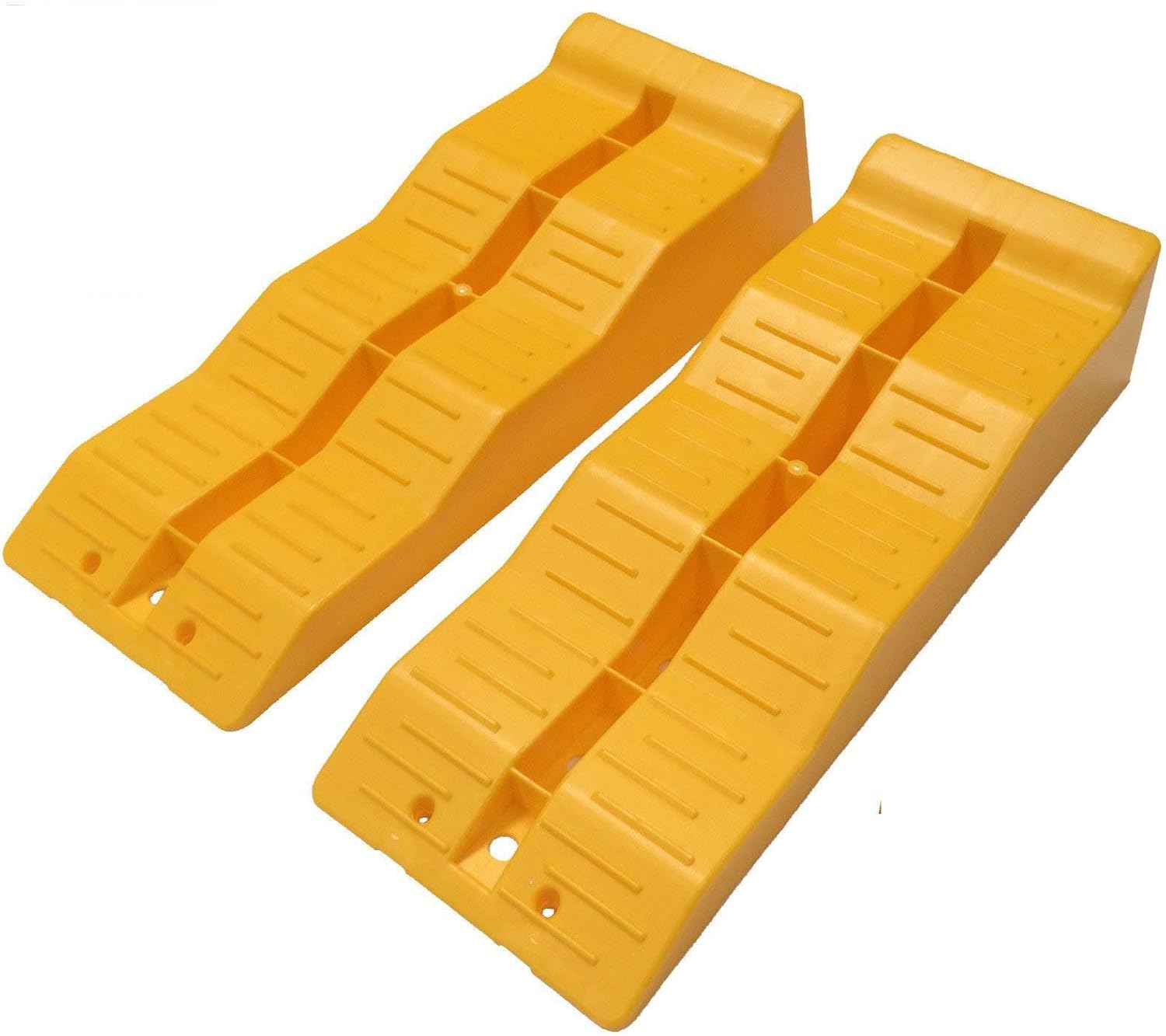
The KATSU set is one of the cheapest ways out of it: two yellow polyethylene wedges with three steps each, holding a 4.6-star average across 521 Amazon ratings. We read the 100 most-recent of those reviews line by line, and two things jumped out. The listing cannot make up its mind how much weight these ramps hold, quoting three different figures on one page. And not a single reviewer in the sample mentions grass, mud or soft ground, which for a product sold on levelling caravans in fields is a gap we are going to talk about rather than paper over.
Levelling a Caravan on Grass Is a Different Job to Levelling It on Tarmac
On hardstanding, a levelling ramp only has to do one thing: sit still while a wheel climbs it. On a grass pitch it has to do that on a surface that slopes, undulates, and after a wet week has roughly the consistency of a sponge. UK sites rarely hand you a flat rectangle. You get camber, you get last season's tyre ruts, you get the tussock nobody mowed.
One reviewer, writing in German, puts it better than any product page: "Wenn man campt, kommt man an den Dingern nicht vorbei, da es auf vielen Plätzen nicht immer ganz gerade ist." Our translation: if you camp, you cannot get around these things, because a lot of pitches are never quite level. The most-upvoted review in our entire sample says the same thing in one line: "used for levelling my caravan on uneven ground".
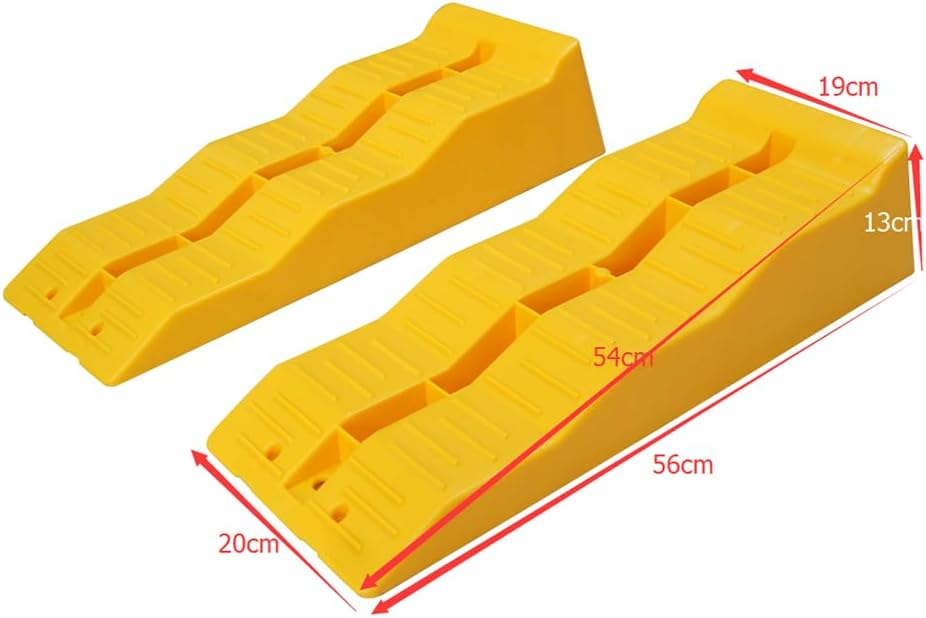
What you are buying is 57cm long, 20cm wide and 13cm at the top step, moulded in UV-resistant polyethylene with three stepped levels and a ribbed tread. The listing puts the weight at 2.8kg. Light enough to carry one in each hand, thin enough to slide into a locker. (The dimension diagram in the listing photos actually says 56cm, not 57cm, which tells you something about the care taken over this product page. We will come back to that.)
One thing about the reviews themselves before we go further. Amazon pools this listing's ratings across its European stores, so the 100 most-recent are not all British: 51 come from the UK, 20 from Germany, 15 from Spain, 7 from Italy and 7 from France. That is useful, because the continental caravanning crowd is hard on kit, but it does mean half the sample is describing pitches you will never park on. Translations below are ours.
5 Tons, 2.5 Tonnes, 5 Tons Again: The Load Rating Nobody Can Pin Down
Read the KATSU listing from top to bottom and you get three different answers to the only question that really matters for a load-bearing ramp.
The bullet points say "For heavy duty use, 5000kg load capacity per wheel". The description, a few lines below, says "Leveling Ramps are rated for 2.5 tonnes". The feature list under that says "Maximum axle weight 5 tons". Five tonnes per wheel, two and a half tonnes, or five tonnes per axle. Those cannot all be true, and we are not going to quietly pick the flattering one and build you an argument on it.
What we can do is look at what happened to people who actually put weight on them. The buyer who took the 5-ton headline at face value came back with two stars: "It's said to support 5Tons, but my heaviest axle, with only 3.5Tons, was enough to inflict this damage." That was after a single use. A German reviewer, also two stars, is blunter: "Bei unter 3,5 Tonnen sollte so was schon halten und nicht auseinander gedrückt werden." At under 3.5 tonnes, something like this ought to hold and not get squashed apart.
Except that another German owner, at the same weight, has no complaint whatsoever: "Halten ohne Biegungen oder der gleichen unsere 3,5 tonnen." They take our 3.5 tonnes without bending or anything of the sort. And an owner running a 1.6 tonne caravan, which is the sort of weight a great many UK tourers actually sit at, reports: "Die Rampen halten meinen 1,6t-Wohnwagen bisher mühelos aus. Keine Brüche oder Risse." The ramps have handled my 1.6 tonne caravan effortlessly so far. No breaks, no cracks.
Look at where the argument is happening. It is all at the 3.5 tonne end, which is a large van or a motorhome at the top of its class. Down where a mid-size touring caravan lives, the complaints go quiet. So treat the 5-ton headline as marketing copy rather than a specification you can lean on, and understand that if what you tow is heavy, the review evidence stops being reassuring and starts being a coin toss.
Seven Failures in a Hundred Reviews, and a Five-Star Review That Says They Break
Seven of the 100 most-recent reviews describe the plastic cracking, splitting, breaking or deforming. That is not a landslide, but for something a caravan is going to sit on, it is worth knowing precisely who it happened to.
A UK buyer, two stars: "used a few times, ramps cracked". Another, three stars, is fairer about it: "Good ramps for price, although 1 split when first used", adding in brackets that it was possibly user error. A review written in Portuguese reports the corners going the first time out: "Partiram os cantos na primeira vez que utilizei".
The most instructive of the seven is a four-star review in French from someone living in their van full time. After a year of daily use: "Avec le froid et les terrains montagneux, les cales fissures et se cassent." With the cold and the mountainous terrain, the chocks crack and break. They say they do not regret the purchase. They have since made themselves a heavier wooden pair, and they keep the yellow ones in the boot as a backup. That is a fair summary of what this product is: not the last ramp you will ever own, but the one that lives in the locker and gets the job done.
Then there is the review that should make you sceptical of star averages in general. One Italian reviewer awarded five stars. The complete body of that review reads: "Si rompono quasi subito". They break almost immediately.
Pushing back the other way is Lynn Q., five stars, who bought them expecting exactly this problem: "was a bit dubious about these ramps as a lot of people saying these plastic types shatter easily, I have used them on a steep drive with my MK 7 ford transit camper van, easy to use & no sign of stress on them at all." A Transit camper on a steep drive is a harder ask than a level-ish grass pitch, and the ramps shrugged it off.
Read the seven failures together and the pattern is only half there. Where a failure names a weight, it is at the 3.5 tonne end. The one full-timer among them is a van dweller on cold mountain roads. But four of the seven give no context at all: one says only that the ramps cracked after a few uses, another that a corner went the first time out. So the fair reading is this. Work them hard, with a heavy axle or in daily winter use, and the sample says some will let go. Use them a dozen weekends a year under a touring caravan and the odds are strongly with you, because the sample is full of caravan and motorhome owners doing exactly that without a word of complaint. What we cannot do is promise you a good one.
KATSU Caravan Levelling Ramps, 3 Step, Set of 2
Two light, stackable polyethylene levelling ramps with three stepped levels and a ribbed tread. Strong under a touring caravan or campervan on an uneven pitch, and small enough to live in the locker all season.
If Your Caravan Has a Motor Mover, Read This Before You Order
This is the finding that matters most if you shunt your caravan onto the pitch with a mover rather than reversing it on under engine power, which is how a great many British vans get positioned.
A German reviewer gave the ramps four stars with this caveat: "für Wohnmobile sicher gut geeignet, bei unserem Wohnwagen dreht der Mover am Reifen durch - die Rampen sind dafür wohl etwas zu steil - mit anderen Rampen hatte ich diesbezüglich keine Probleme." Our translation: certainly well suited to motorhomes, but on our caravan the mover spins on the tyre, the ramps are probably a little too steep for it. I had no problems in that respect with other ramps.
That is one report out of 100, and we are not going to tell you your mover will definitely struggle. But it is the single most relevant complaint in the whole sample for the people buying these, and it sits alongside something a five-star reviewer says about driving up under engine power: "needs revs to get to the top level, solidly constructed and longish, do the job well." Needing revs is no problem when you have an engine and a right foot behind the wheel. Whether your mover has that in reserve is the question, and it is a question worth asking before you order.
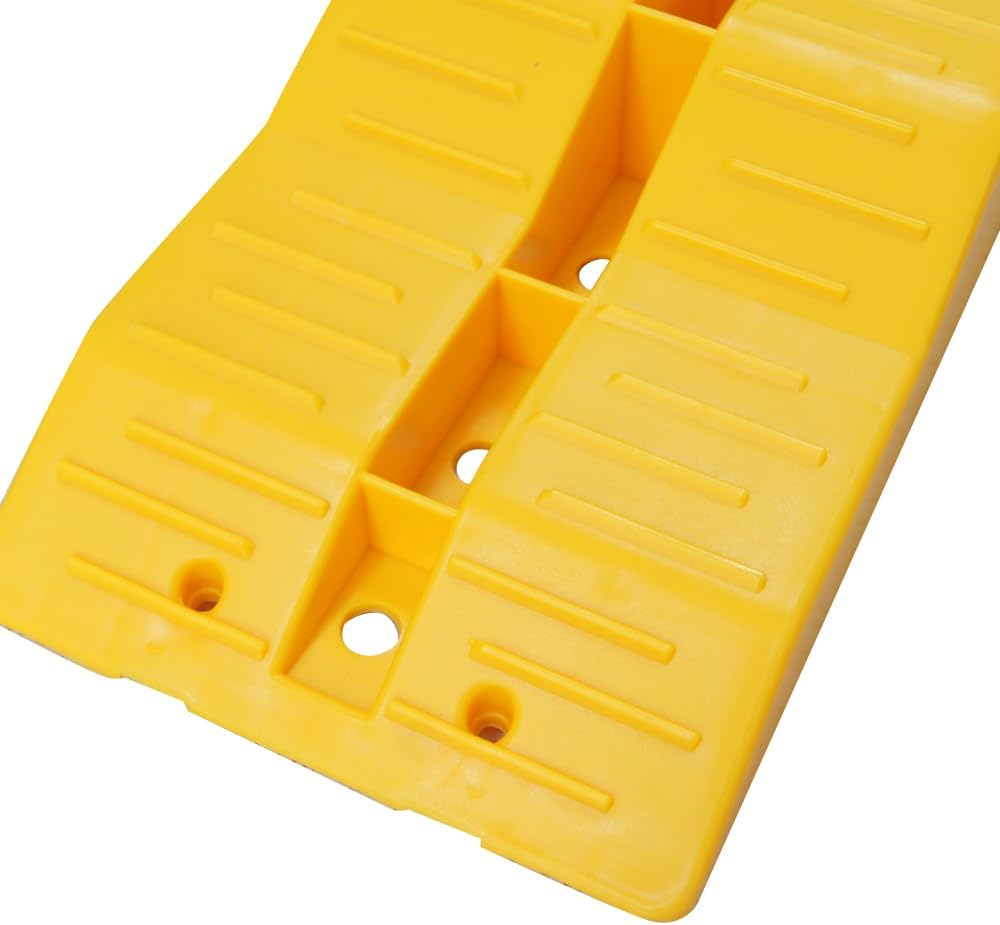
The three steps are the other thing to get your head round. You cannot fine-tune the lift here: you get step one, step two or step three, and that is your lot. One camper van owner is relaxed about it: "Being stepped, you can’t fine tune the lift angle but so long as your head isn’t below your feet when sleeping and the cooking pans are reasonably level, that’s not an issue." The steps do give you feedback through the wheel as you climb, which is worth a lot when you are the one driving and cannot see the ramp.
Two reviewers want the flat sections longer. One, on a motorhome: "The steps provide a feel for where you are on the ramp, however they are too short for a motorhome wheel to rest on completely." The other is using them to lift a low car for a trolley jack rather than to level a caravan, but the geometry gripe carries straight over: "I wish the flat sections in these where a bit longer so you don't feel like you are going to roll back off." On a big motorhome tyre, expect the wheel to overhang its step. The listing also recommends chocking the other side of the vehicle when ramps are in use, which on a sloping pitch is advice worth taking.
Turn One Over: an Open Honeycomb, Not a Solid Block
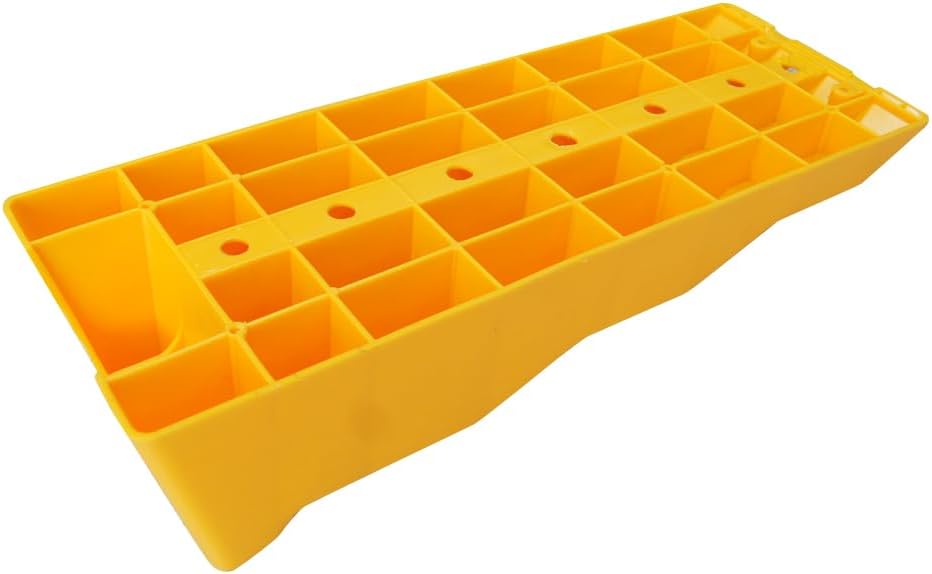
Turn one over and it is not a solid block. The underside is an open honeycomb: a grid of hollow moulded cells inside a solid rim, with drainage holes running right through the treads. That is how a ramp this size stays this light, and it means water and mud drain through rather than collecting inside. They hose off easily too, which is presumably why the whole body of one five-star review reads "Easy to use and clean".
Now the part we cannot answer for you. Not one of the 100 reviews we read mentions grass, mud or soft ground. Not one. We could have invented a reviewer sinking into a wet field, because that is precisely what this section wants, but no such reviewer exists in the sample and you would be making a buying decision on fiction. What the photograph shows is a base that meets the ground on the edges of those cells rather than on a solid slab. What that does on a soggy September pitch, the reviews simply do not say.
The nearest anyone comes to your question is a four-star review in German warning that the ramps are "nicht sehr formstabil wenn der Untergrund der Auflagefläche nicht völlig eben ist": not very dimensionally stable when the ground beneath the contact surface is not completely even. The same reviewer adds that you need to hit the ramp squarely or it can tip sideways, and that they are not suited to wide tyres.
What the reviews do cover is skidding, and the pattern there is more reassuring than it first looks. Three reviewers report the ramp sliding away as the wheel comes onto it, and the two who name the surface are both indoors. One, in German, says the ramps find no purchase on a smooth concrete workshop floor, then adds the half of the sentence that matters to us: "Auf normalem Teer oder Pflastersteinen war die Reibung groß genug und hat gut funktioniert." On normal tarmac or paving, the friction was enough and it worked well. The other, in Italian, says that on a tiled garage floor you need to put something grippy underneath. Slipping is a hard-floor complaint in this sample, not a campsite one.
So, practically. On firm, dry grass, put them down and drive on. On a soft or waterlogged pitch, put something under them first: a scrap of decking board, a plastic levelling pad, an offcut of ply, anything that spreads the load across a wider footprint than the ramp's own edges. That is standard practice with any plastic ramp on soft ground, it costs next to nothing, and it is the one thing we would add to what the listing tells you.
The Loud Yellow Is Doing a Job
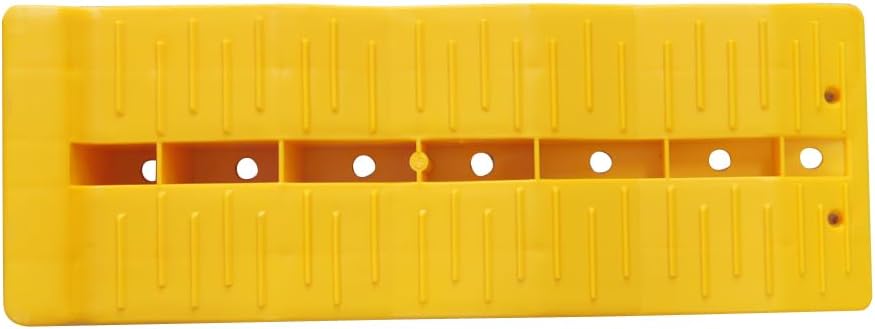
These are an aggressive, high-vis yellow, and not everybody is charmed. One four-star reviewer reckons they "will look better after they have been used and the colour dulled down". Fair enough.
But the colour is not a styling accident. A Spanish reviewer catches the reason in passing: "con el color siempre te acuerdas de que estan puestos". With the colour, you always remember they are in place. And one five-star review is titled, simply, "Do not forget to pick them up when you leave site". Pulling off a pitch with a ramp still under a wheel is an expensive way to end a holiday, and a slab of bright yellow plastic in the corner of your mirror is a cheap safeguard against it.
Storage is the other quiet win. The two ramps nest into one another: "They fit together for storage too", as one reviewer puts it, while another notes that "Handy stacking makes for easy storage". At 57cm they slide into a locker or lie flat in a boot, and at the listed 2.8kg nobody is going to feel them in the payload. Reviewers keep pairing lightness and strength in the same sentence, like ColinJD: "Light weight and very sturdy, ideal for levelling up our caravan".
Two small gripes worth passing on. One reviewer wishes they came with a carry bag: "Pena não trazer uma bolsa de transporte". Another wants a clip or catch to lock the pair together for transport, which would stop them rattling round a locker. Neither is a reason not to buy, but both are the sort of thing you notice on trip three.
The Verdict: Cheap Insurance for a Sloping Pitch, With Two Caveats
Amazon's crowd has these at 4.6 stars from 521 ratings, and the 100 reviews we read came out at 4.62, with 75 of them five-star. We have marked them down to 4.0, and here is the working.
The first caveat is the load rating. Three different figures on one listing page is careless, and the buyer who trusted the biggest of them is the buyer who came back angriest. For a touring caravan or a campervan, the review evidence is firmly on your side. For a 3.5 tonne motorhome, you are buying into the part of the data where owners flatly contradict each other.
The second is the mover. One report only, but a direct hit on the way a lot of British caravans get onto a pitch. If yours goes on under mover power rather than engine power, order in the knowledge that the roller might spin on the tyre.
Then the gap: nobody in this sample has told us how they behave on soft, wet grass. So take a board.
What KATSU gets right is more or less everything else. They are strong at the weights most people put on them, they are light, they nest, the steps tell your wheel where it is, and they cost little enough that a spare pair in the locker is not a difficult decision. Ninety-two of the 100 most-recent reviewers gave them four or five stars, and the single one-star review in the sample is not about the ramps at all: it is a complaint about being unable to download an invoice.
For a weekend on a lumpy field, that is a good deal. Just do not ask them to be a 5-ton ramp, because their own listing is not convinced they are. Check today's price on Amazon and buy them for what they actually are: cheap, light, effective plastic wedges that stop your fridge sulking.
KATSU Caravan Levelling Ramps, 3 Step, Set of 2
Two light, stackable polyethylene levelling ramps with three stepped levels and a ribbed tread. Strong under a touring caravan or campervan on an uneven pitch, and small enough to live in the locker all season.