
Sounds Like a Small Hoover, Cools Like a Proper Fan: The WHATOOK Turbo Handheld Fan Reviewed
We earn commission from qualifying Amazon purchases. It costs you nothing and does not affect what we recommend.
Your tent hits greenhouse temperature by 7am and the nearest plug socket is two fields away. The WHATOOK turbo fan solves that problem loudly, in every sense of the word.
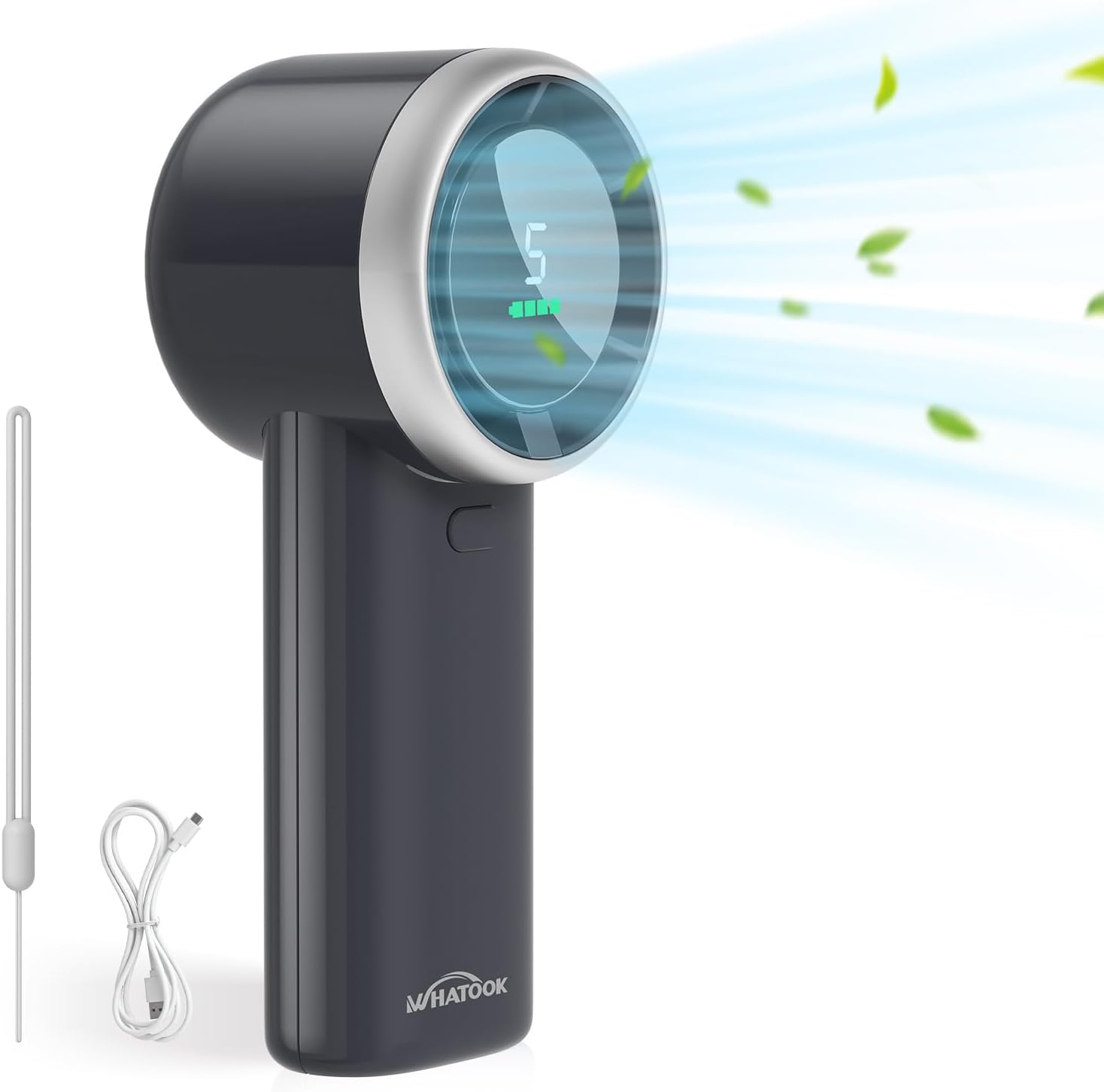
Two reviewers, both named Clare, between them tell you most of what you need to know about the WHATOOK handheld fan. One gave it five stars in January: "Far more powerful than the little cheap ones, I’ve bought 2 more". The other gave it two stars after hers stopped charging and the seller never replied. That is the whole product in miniature: a fan strong enough that people buy spares for the family, from a budget brand where the occasional unit gives up early.
It holds 4.6 stars across 2,905 Amazon ratings, and in the roughly 100 most-recent reviews the five-star share sits at 81%. We read that recent batch in full to work out what the fan does well, why the word "helicopter" keeps appearing, and whether it belongs in a UK camping bag. Short answer: yes, with one earplug-shaped caveat we should deal with first.
The Helicopter Problem
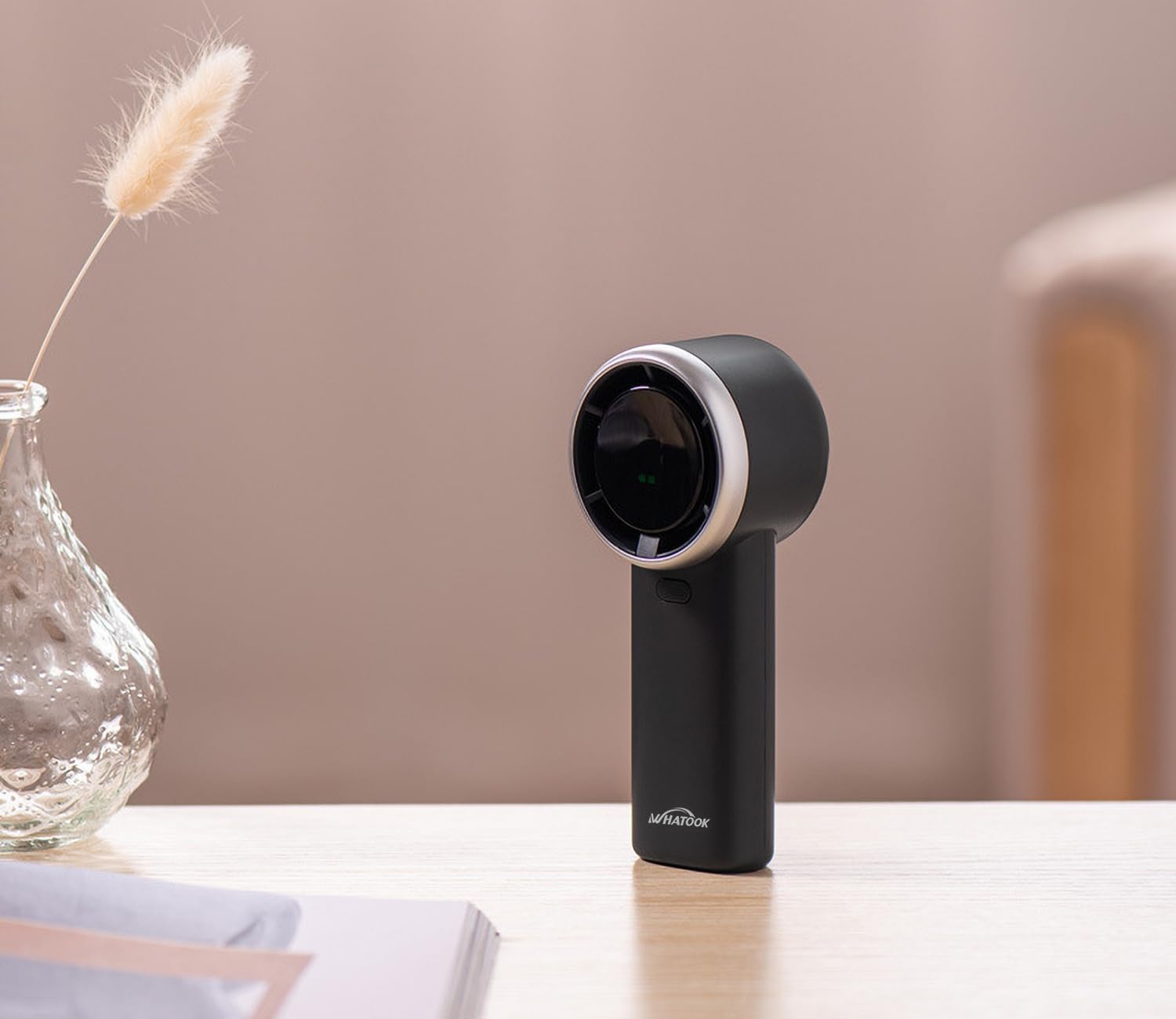
Start with the complaint, because it is the only recurring one. Around a dozen of the hundred most-recent reviews mention noise, and the comparisons are vivid. One three-star reviewer likens the sound to a helicopter. Bella J, who still rates the fan five stars, is more precise: "It sounds like a small hoover on the high setting". Andy Paul found it too noisy for his office and reports that "every time I turn it on someone asks what the weird noise is".
Karen goes a step further with the most useful warning for anyone planning long sessions: the fan vibrates, and if you hold it for a while it "makes your own hands vibrate afterwards". JonM, who wrote the most thorough review in the batch, packs earplugs for overnight use and stands the fan on a folded T-shirt to stop it buzzing against hard surfaces. That trick is worth stealing if you plan to run it on a camping table or a cool box lid.
Two things soften the picture. First, the noise scales with speed: JonM and Bella J both note that it gets louder as you climb the settings, and JonM reckons the lowest speed covers most situations anyway. Second, plenty of owners simply do not care. Paula Wright describes hers as "Quiet and real power", which mostly proves that noise tolerance varies wildly from one person to the next. On a breezy campsite in the afternoon you will not think about it. In a silent tent at 2am, you will.
Where the Noise Comes From: 13,500rpm in Your Pocket
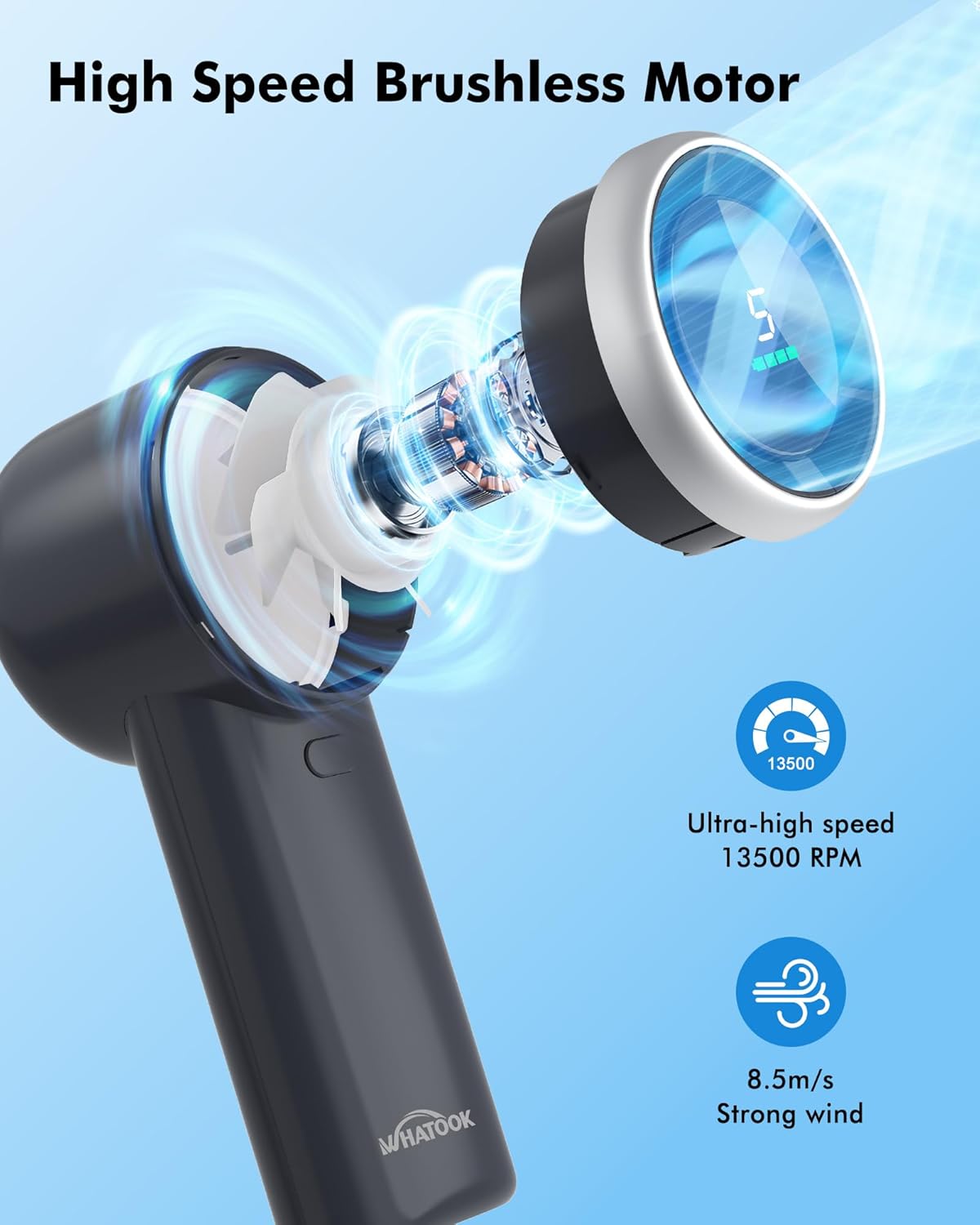
The racket has a cause, and it is the same thing everyone buys the fan for. WHATOOK fits a three-phase brushless motor rated in the listing at up to 13,500rpm with a top wind speed of 8.5m/s, which the brand claims is around three times the speed of an ordinary personal fan. Six spiral blades sit behind a wind-gathering shroud, and five speed settings run from a light breeze up to something that will part your fringe from arm's length.
Reviewers back the power claims up emphatically. Hannah ran her own comparison test: "Ordered 5 different highly rated ones to compare. This one blows them all out the water, literally." Sophie has never needed the top setting because "the lower settings have been strong enough". Robert B credits the brushless motor for how smoothly it runs and reckons cheaper mini fans give you far less for the saving. The pattern holds across the sample: 80 of the 99 most-recent reviews are five-star, and "powerful" is the word that comes up again and again.
For campers, the practical translation is this. The flimsy fans you grab at a supermarket checkout stir warm air around your face; this one produces an actual current you can feel across a tent porch. On a muggy, windless pitch, that difference is the entire product.
WHATOOK Handheld Turbo Fan
Brushless 13,500rpm turbo fan with 5 speeds, LED battery display and USB-C fast charging. Small enough for a jacket pocket, strong enough for a hot tent.
The Ten-Hour Claim and a Seven-Hour Test
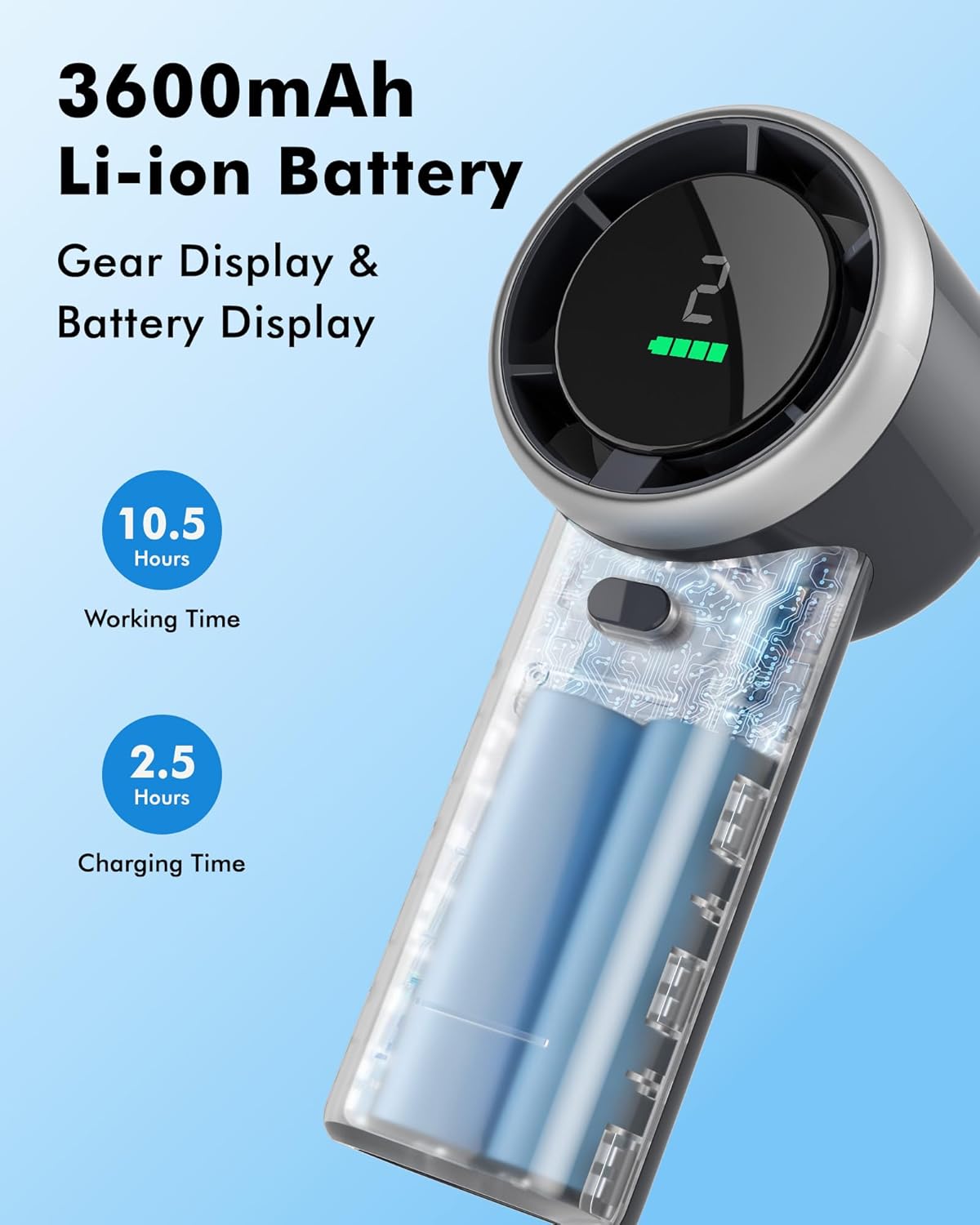
WHATOOK claims a two-hour full charge and up to ten hours of runtime, and as always the big number refers to the lowest speed. The most useful data point in the reviews comes from Bella J, who ran hers flat out: "This fan was running on full blast for around 7hrs before it died." Seven hours at maximum speed is a strong result for something this size, and it makes the ten-hour figure look conservative rather than optimistic.
Owners are consistently happy on this front. Loraine finds the "charge lasts days" in normal use, KD reports a long battery life alongside the power, and JonM points out that you can charge the fan while it is running, which matters at camp: clip it to a power bank and it will keep going as long as the bank does. Charging works from anything with a USB socket, including a car charger or laptop, and a short USB cable comes in the box.
The LED display on the fan face is more useful than it sounds. It shows the current speed and remaining battery, so you can check the level before you leave the car rather than discovering a dead fan halfway through a sweaty pitch setup. One dissenting voice: Diego's one-star review states flatly that the battery does not last. He is alone on that in this sample, but it leads neatly into the fan's real weak spot.
All Five Negative Reviews Say the Same Thing
Ninety of the 99 most-recent reviews score this fan four or five stars. The five that land at one or two stars are worth reading closely, because every one of them describes hardware failing rather than disappointment with the fan itself. Tino's stopped working after "just less than a month". Clare's stopped charging, and she got no response from the seller. Fol bought three, and two of them failed the same way, with a charging lead "broken within less than 28 days". Lesley Bows bought two in the space of a fortnight and both broke. Add Diego's short-lived battery and that is the complete negative column: five reports, all early failures.
Five out of 99 is a real failure rate, not a rounding error, but it needs context. The fan holds 4.6 stars across 2,905 ratings, so duds are a small minority of a very large pool. Shellbell's older one was still running after a couple of years and an unplanned dunk in a paddling pool. The sensible play: buy through Amazon rather than a marketplace reseller, run the fan hard in the first fortnight, and use the return window if you get a bad one. Going by Clare's experience, do not count on the seller's own customer service to sort it out afterwards.
On the Campsite: Hot Tents, Festival Queues and the Missing Stand

So where does it fit in a camping kit? Three places. The first is the hot-tent morning, the one every UK camper knows, where the sun turns your bedroom into a greenhouse by 7am. A fan this strong makes that first hour bearable while the kettle sorts itself out. The second is festivals: it is about 14cm long and under 200 grams by the listing's own figures, it comes with an anti-loss lanyard, and it slips into a jacket pocket for the long shuffle through a crowd. The third is the ordinary British heatwave, wherever it catches you. Nerys piper called hers "a great help during the recent heat wave", and reviews like that cluster around every hot spell in the sample.
Two design limits to know about before you order. There is no way to angle the head: the fan stands upright on its base or lies on its side, and that is it. JonM props his on folded clothing and says his next fan will be a folding model with a hinge; Mrs V M Cox simply wishes it had a stand. If you want something to point at your face while you sleep, this is not built for that job, and the noise would test whoever shares your tent anyway. Buy it as a handheld cooler that can moonlight as an upright table fan, not the other way round.
Verdict: 4.5 out of 5. The noise is real, a small number of units fail early, and you cannot aim it hands-free. Against that sits cooling power that embarrasses everything else at this size, a battery that survived a seven-hour full-blast test, and a five-star rate of 81% in the most recent hundred reviews. For solo campers, festival-goers and anyone who wilts in a hot tent, it is an easy recommendation. Check today's price on Amazon before the next warm spell arrives.
WHATOOK Handheld Turbo Fan
Brushless 13,500rpm turbo fan with 5 speeds, LED battery display and USB-C fast charging. Small enough for a jacket pocket, strong enough for a hot tent.