
Lepro Head Torch 2-Pack: The AAA-Battery Choice That Splits Reviewers Clean Down The Middle
We earn commission from qualifying Amazon purchases. It costs you nothing and does not affect what we recommend.
Most head torches under £15 ship with a built-in USB rechargeable battery. The Lepro 2-pack does the opposite: three AAAs per torch, none included. Reviewers either love it for that exact reason or return them in disappointment, and a wild-camping storm review explains where the trade-off actually bites.
- Why The AAA Battery Format Is The Whole Story Here
- The Dartmoor Storm Review You Should Read Before Wild Camping With It
- The Six Modes, And Which Ones Reviewers Actually Find Useful
- Fit, Weight, And The One Running-Specific Complaint
- Quality Control: The One-In-Ten Problem Worth Naming
- Where This Pair Actually Belongs In A UK Camper's Kit
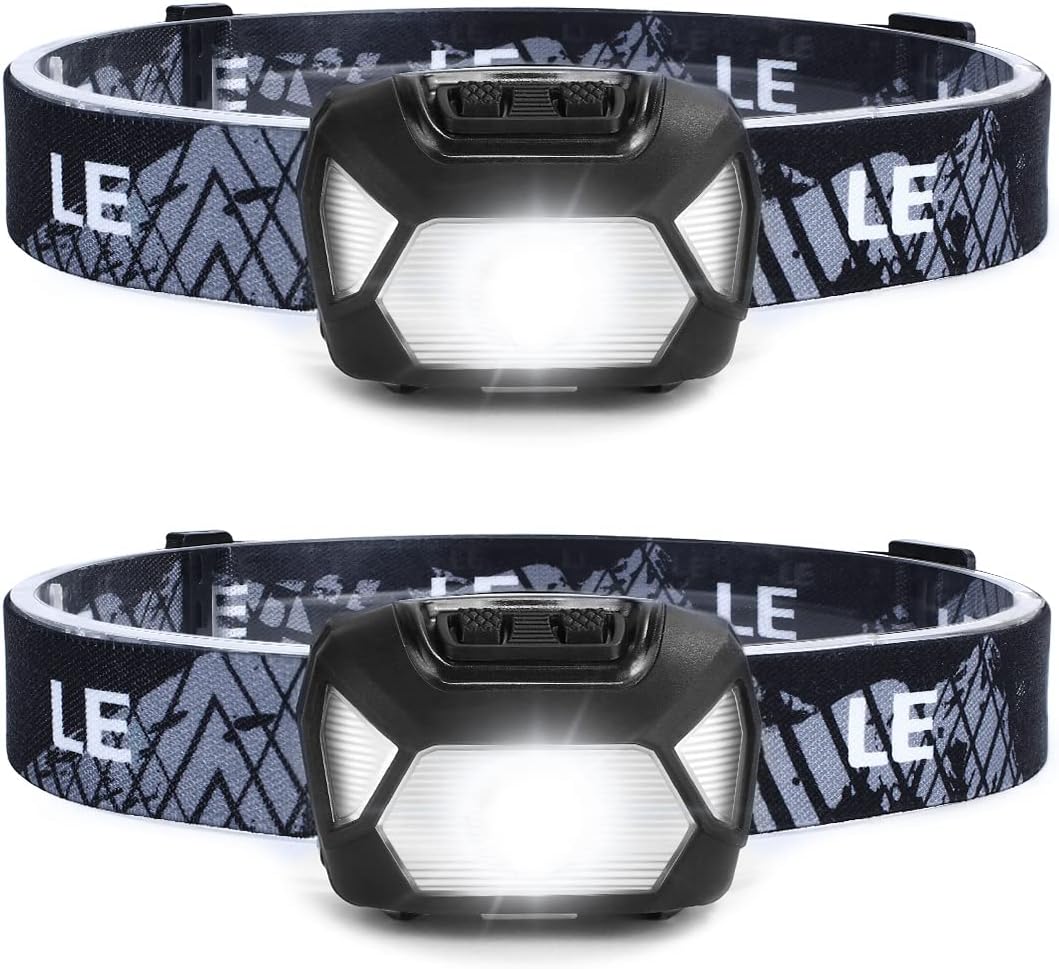
Walk down the head torch aisle on Amazon UK and every third product under £15 is a USB-rechargeable unit with a sealed lithium cell. The Lepro 2-pack is the stubborn exception. You get two torches, six lighting modes apiece, and a stern note on the listing: three AAA batteries required per torch, not included.
That single design decision is also, unintentionally, the clearest way to work out whether this set is right for you. The reviewers who love it tend to mention the same thing: they keep rechargeable AAAs in a drawer and never want to be hostage to a finicky USB cable. The reviewers who hate it tend to mention the opposite: they thought the description meant 'batteries included', or they assumed it recharged over USB and were blindsided when it didn't.
At £9.99 for two units, it's priced to be a glove-box-and-toolbox spare rather than a primary summit torch. Let's work through what 100 recent reviews actually say about that bet, including one wild-camper's first-hand account of where the IPX4 rating runs out of road.
Why The AAA Battery Format Is The Whole Story Here
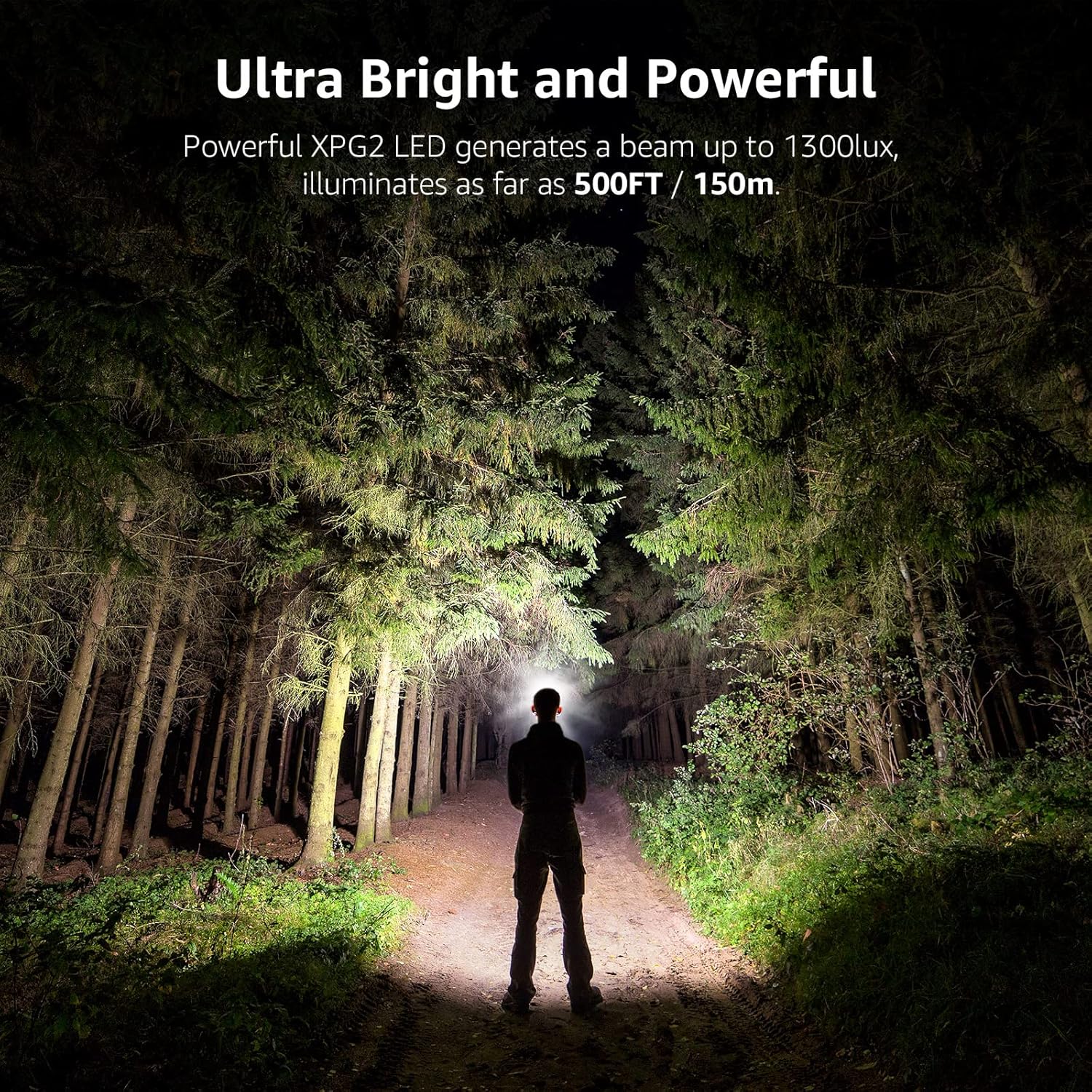
Open the Amazon listing and the most-highlighted spec is the 10-hour low-mode runtime. Read the reviews and the thing people actually argue about is the battery format itself.
Reviewer 43 (5 stars, 'Simple and reliable') puts the pro case clearly: 'with the option of taking AAA batteries which dispels the worry of recharging the battery, it is to me a more reliable product than other headlamps with internal battery which usually don't last long.' Reviewer 94, rating it 5 stars, makes the same point: 'They take AAA batteries which is a must for me as I have rechargeables so when it needs fresh batteries you can instantly swap them and not have to wait for the torch to re-charge like many other types that have sealed batteries!'
The anti case is just as strong. Reviewer 40 (1 star, 'Disappointed'): 'Did not get recharge cable so can't recharge I won't return will try to get Cable myself.' There is no cable. It isn't that kind of torch. And reviewer 54 flags a subtler issue: 'being battery powered and with 3 batteries means you can't use rechargeable as they are usually charged in pairs.' Most NiMH AAA chargers are 2-bay or 4-bay, so if you want to run rechargeables you'll either be charging an odd battery on its own or splitting a set across two torches.
Practical takeaway: if you already keep spare AAAs in the house for remotes, kids' toys, or bike lights, this is your torch. If you were hoping to grab a USB-C lead and plug it in overnight, it isn't.
The Dartmoor Storm Review You Should Read Before Wild Camping With It
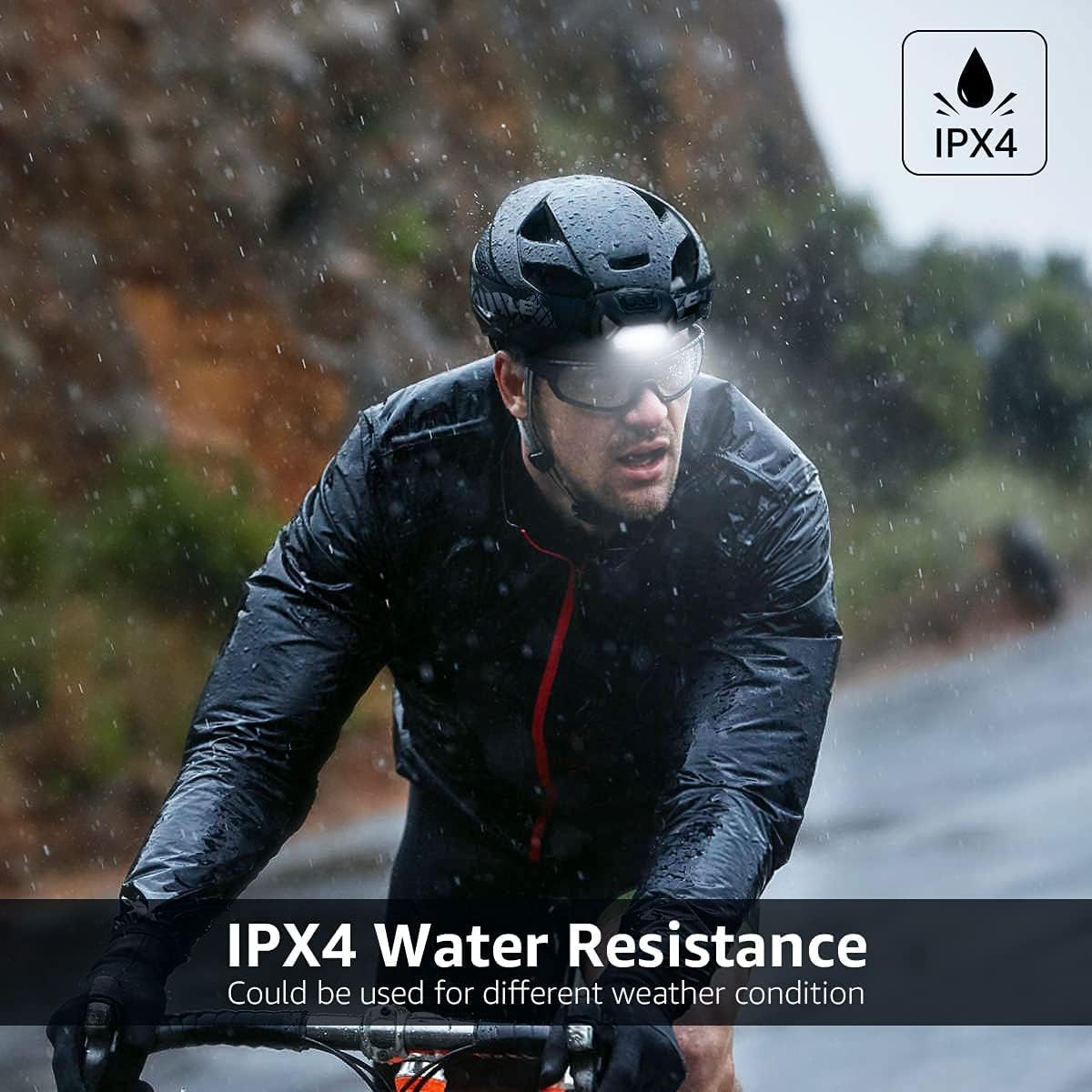
The listing rates the torch IPX4, which in plain English means it shrugs off splashes and rain from any direction. It does not mean you can submerge it, and it does not guarantee anything against sustained wet pressure. Reviewer 50 is the clearest test case in the feedback pile, and worth quoting at length because it's the single most useful review in the set for anyone considering this torch as proper camping kit.
Three stars, titled 'Does not work as a camping head torch': 'Don't buy this if you are wild camping in damp conditions. I am sure for dog walking quick uses where you are going back indoors it is fine. But wild camping in Dartmoor put paid to it in storm Amy it just could not handle the damp. Switch stopped working when I needed it the most. On inspection damp has got into the battery compartment and I presume elsewhere as the batteries still have 1.5 volts so it's not them. I tried a new set but to no availe.'
That lines up with what IPX4 actually covers. It's the splash rating you'd expect from a cycling torch or a light for walking the dog, not the IPX7/IPX8 submersion rating you'd want on a multi-day wild camp in British autumn weather. If your camping style is pitching in a storm on Dartmoor or in the Lakes, a torch in this price bracket isn't the tool to bet on. If your camping is family-friendly car camping, summer fishing nights, or festival trips where the torch lives in a tent-pocket and comes out for toilet runs, the waterproofing is more than fine.
A useful counterpoint: reviewer 47 used the torch for the Kilimanjaro summit push and wrote 'It was very useful for my Kilimanjaro climb especially on the last day when climbing summit because we do it at night. Also, when we have to get out of tent in dark at night.' Kilimanjaro is cold and thin-aired but not rain-heavy at the summit, and that's the kind of brief the torch handles well.
Lepro Head Torch 2-Pack
Two AAA-powered LED head torches with 6 lighting modes and IPX4 splash resistance. Ideal as a spare, a kid's first torch, or an emergency-kit mainstay at a price that lets you keep one in the car and one in the tent bag.
The Six Modes, And Which Ones Reviewers Actually Find Useful
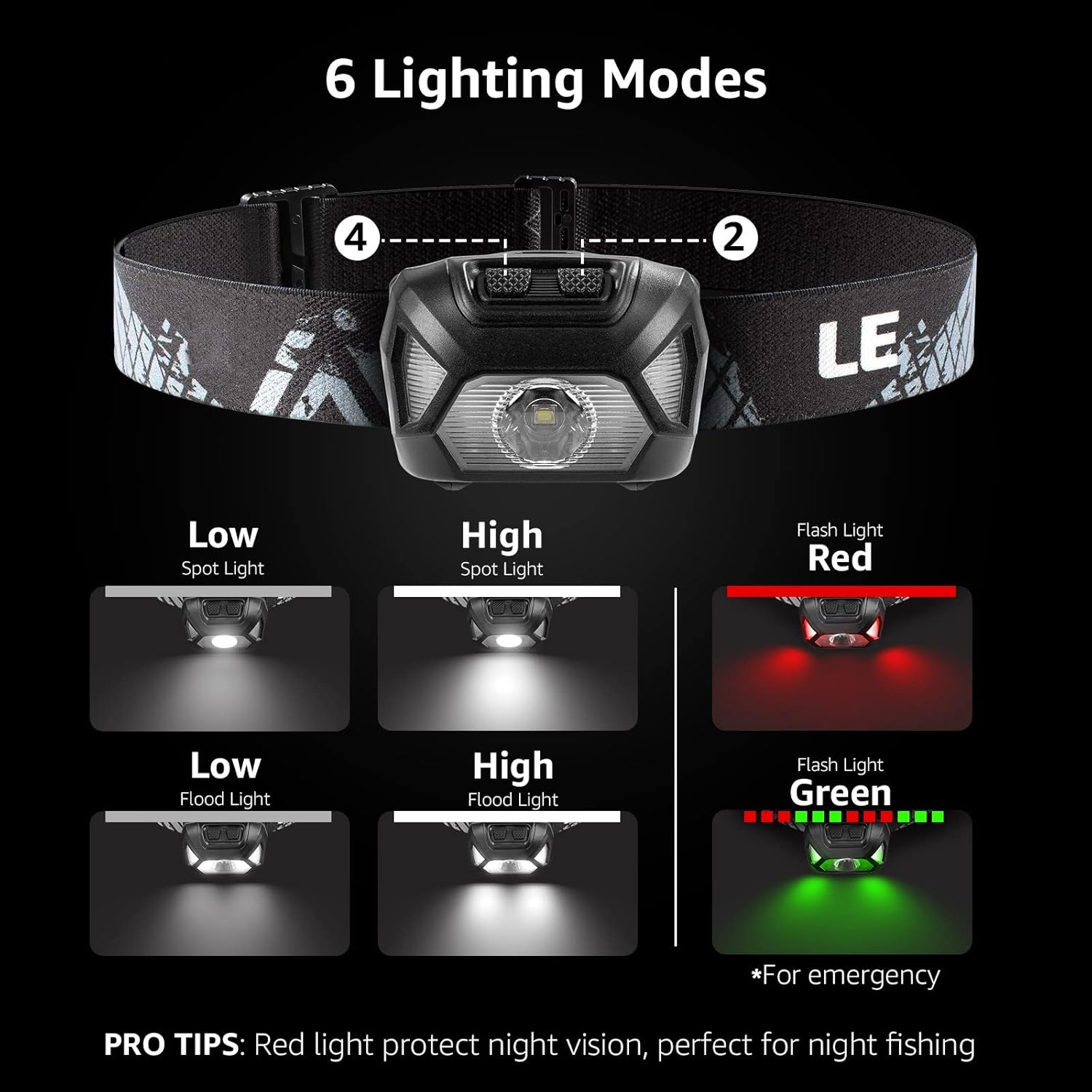
The listing promises six lighting modes: Low Spot, Low Flood, High Spot, High Flood, Steady Red, and Red/Green Flashing. That sounds like a lot, and reviewer reaction to it is mixed.
The usefulness verdicts cluster into three groups. First, the practical users. Reviewer 64 explains the red mode's actual purpose: 'The red light mode is especially good as it preserves night vision and means your eyes adjust more easily when you switch the torch off.' That's correct, and it's a feature most sub-£10 torches don't include at all. Anglers and astronomers will already know why this matters.
Second, the 'too many modes' camp. Reviewer 33 (3 stars): 'the spot light and flood light modes each have a low and high setting which have very little difference and are just an annoyance when changes modes.' And reviewer 67 is blunt about the red/green flashing mode: 'you can use them while riding a bike but why not have proper lights'. Fair point, the flashing emergency signal is not a substitute for a proper rear cycling light.
Third, the 'too bright' reviewers, which is a nicer problem to have. Reviewer 70 has the best line in the whole review pile: 'Virtually lost an eye on testing these. Extremely bright! If you like to look like a lighthouse, these will fill the void for you. I used them for night fishing and had to turn them down to the dim setting, for fear of accidentally communicating with life in deep space.'
The mode cycling is a single-button affair, which means to get from high flood back to red you either cycle all the way through or switch off and back on. If you find cycling modes annoying, you'll find this torch annoying. If you'd rather have the options than not, the red mode alone is a nice-to-have at this price.
Fit, Weight, And The One Running-Specific Complaint
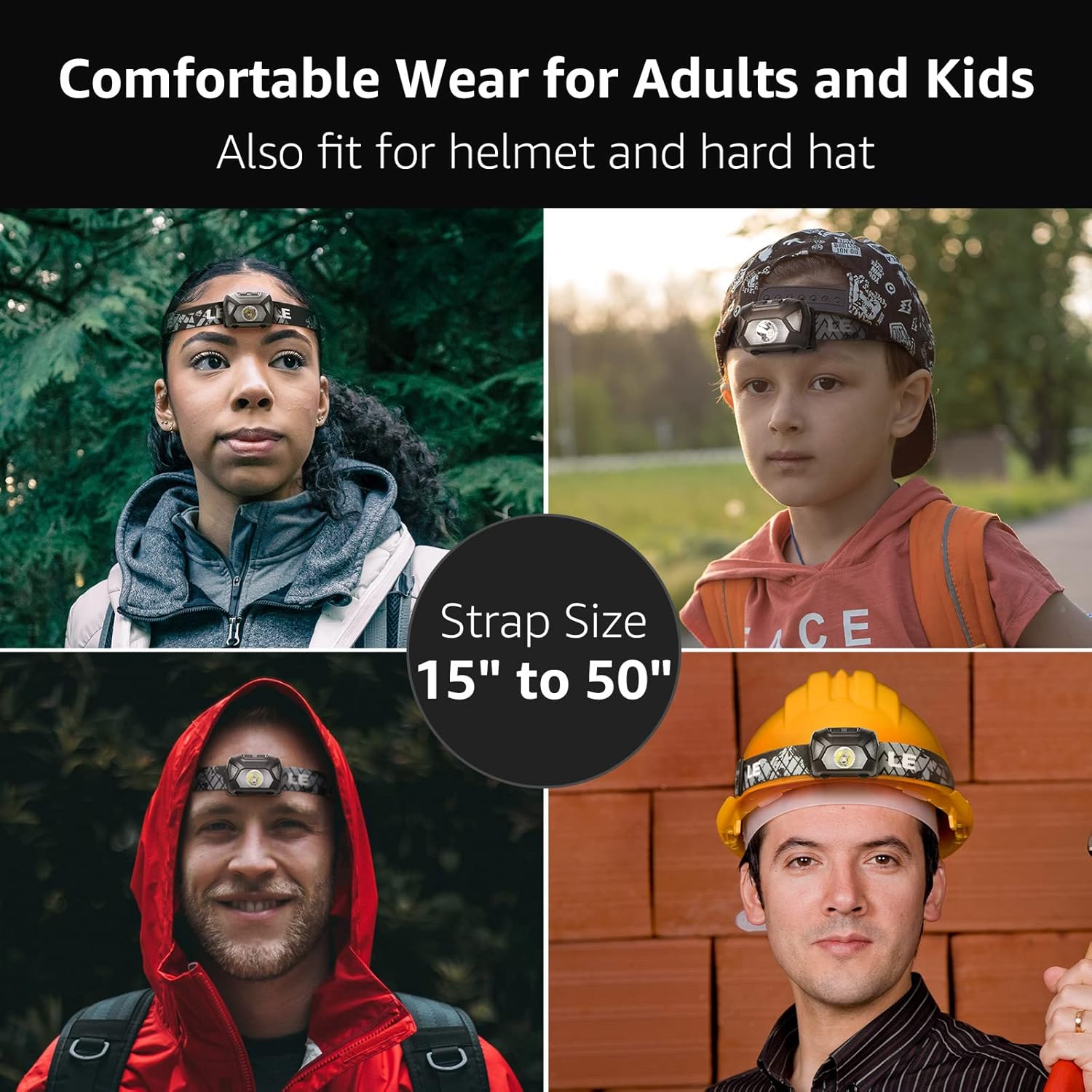
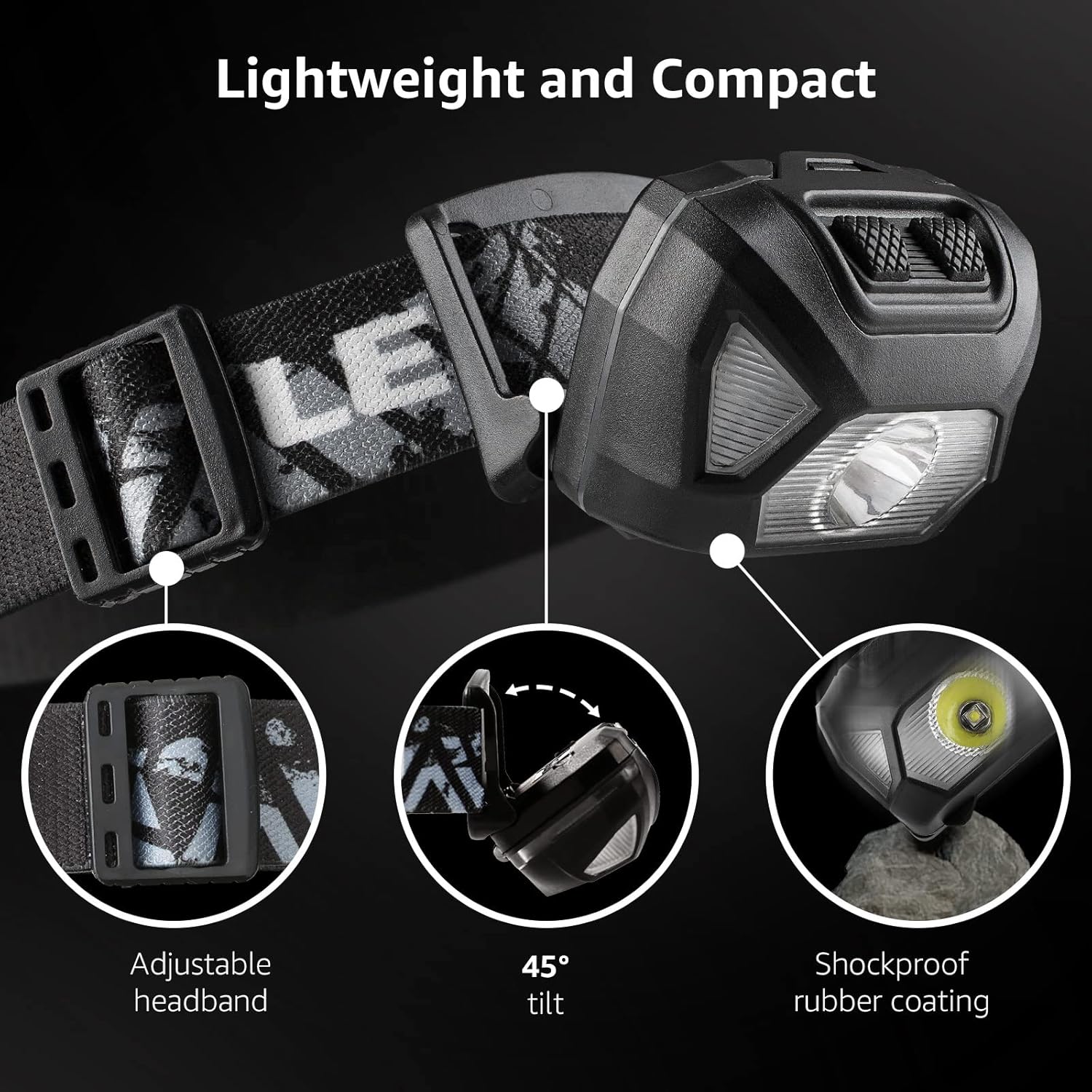
Most reviewers describe the headband as comfortable, stretchy, and happy to sit over a wooly hat. Reviewer 16 captures it well: 'They are also pretty comfortable and can be worn over a wooly hat too.' Reviewer 60 notes the size range stretches down to kids: 'Super good for my sons age 7 and 9. Adjustable size for any head size.'
There is one repeated complaint from the running-and-cycling crowd though, and it's worth flagging if that's your use case. Reviewer 33 again: 'It is small and light weight but doesn't have a middle strap so can slip down your head if running and the strap is not tight.' Premium running head torches use an over-the-crown strap to stop exactly that kind of slippage. This is a two-point headband, no crown strap. For brisk walking, fishing, dog walking, or static camp use it sits fine. For proper road running with any head bounce, it's a weaker fit than a dedicated trail-running torch at twice the price.
The 45-degree tilt gets consistent praise. Reviewer 89 (a long, detailed 5-star review): 'It pivots up and down, which is super handy for adjusting the beam without having to tilt your whole head.' That's the kind of detail that tells you the reviewer actually used the torch rather than unboxed it and wrote a three-word review.
Quality Control: The One-In-Ten Problem Worth Naming
Ten percent of the reviews sampled are 1-star, which is on the high side for a product averaging 4.5 stars. Reading them, most cluster into two categories.
Category one is unit failure on arrival. Reviewer 51: 'One of the headlamps arrived broken and not working.' Reviewer 93: 'Bought a pack of 2 only one worked.' Reviewer 98: '1 of the lights was never used to begin with and on my 1st use it doesn't work.' That's three separate reviews in the sample reporting one-of-two-failed-on-arrival, which is a consistent enough pattern to flag rather than dismiss. If you buy a pair, test both torches on the day they arrive so you're inside the return window if one is a dud.
Category two is the battery compartment being hard to open. Reviewer 19 wrote the most quotable version: 'This may well be a very fine torch but I couldn't open it to insert batteries. There is a catch to open it but the plastic is so hard and inflexible and doesn't bend so it just wouldn't open.' Reviewer 14 is a less angry version of the same: 'I am having great difficulty finding out how to install the batteries. I'm a bit afraid to pull on the back in case something breaks.' Worth factoring in if arthritis or hand strength is a consideration, or if you're buying for an older relative.
The rest of the 1-star pile is mostly either 'brightness too low for my expectations' (reviewer 17, reviewer 48, reviewer 74) or 'returned, wrong purchase'. On a torch this cheap, expectations about raw lumen output are the commonest source of disappointment.
Where This Pair Actually Belongs In A UK Camper's Kit
Put all of the above together and a clear use-case emerges.
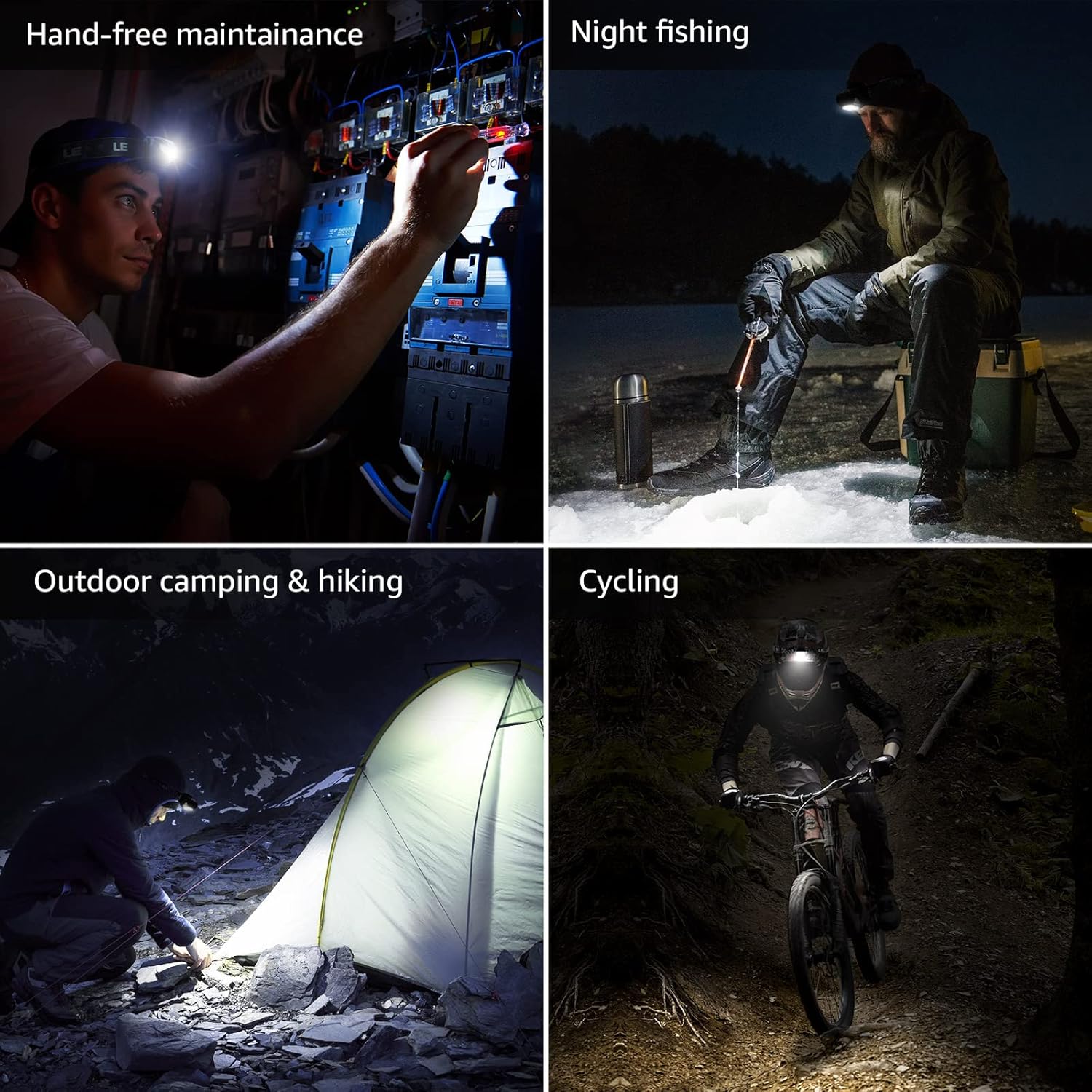
Spot-on for this torch:
- A spare torch that lives in the car boot or the bottom of the caravan drawer, for when you've forgotten your main one
- Kids' first proper head torch, especially at the 7 to 10 age bracket (reviewer 2 for a granddaughter, reviewer 60 for sons aged 7 and 9)
- Late-dusk dog walking, evening animal feeding rounds, or checking on the tent pegs in light rain
- Festival use where it lives in a tent pocket and comes out for toilet trips
- Car-camping summer trips in benign weather, or as a guest-tent 'here's a spare' torch
- Power cuts at home, as an emergency torch in a drawer
Not the right pick for:
- Wild camping in British autumn, winter, or storm conditions where waterproofing really matters (reviewer 50 on Dartmoor is the canary)
- Serious fell running or trail running where a bouncing torch is a problem
- A primary torch for someone who only wants USB-rechargeable kit and no loose batteries in the house
- Technical mountaineering or night navigation where beam reach and reliability are safety-critical
At £9.99 for two torches you're roughly at the cost of one decent AAA battery box from a supermarket. Judged against that price, and with the caveats above, it's a reasonable buy for the right slot in your kit. Just don't ask it to do jobs it isn't built for.
Lepro Head Torch 2-Pack
Two AAA-powered LED head torches with 6 lighting modes and IPX4 splash resistance. Ideal as a spare, a kid's first torch, or an emergency-kit mainstay at a price that lets you keep one in the car and one in the tent bag.