
A Low Wattage Fan Heater for Caravan UK Hook-Ups by the Arithmetic, a Shed and Hotel-Room Heater by Its Reviews
We earn commission from qualifying Amazon purchases. It costs you nothing and does not affect what we recommend.
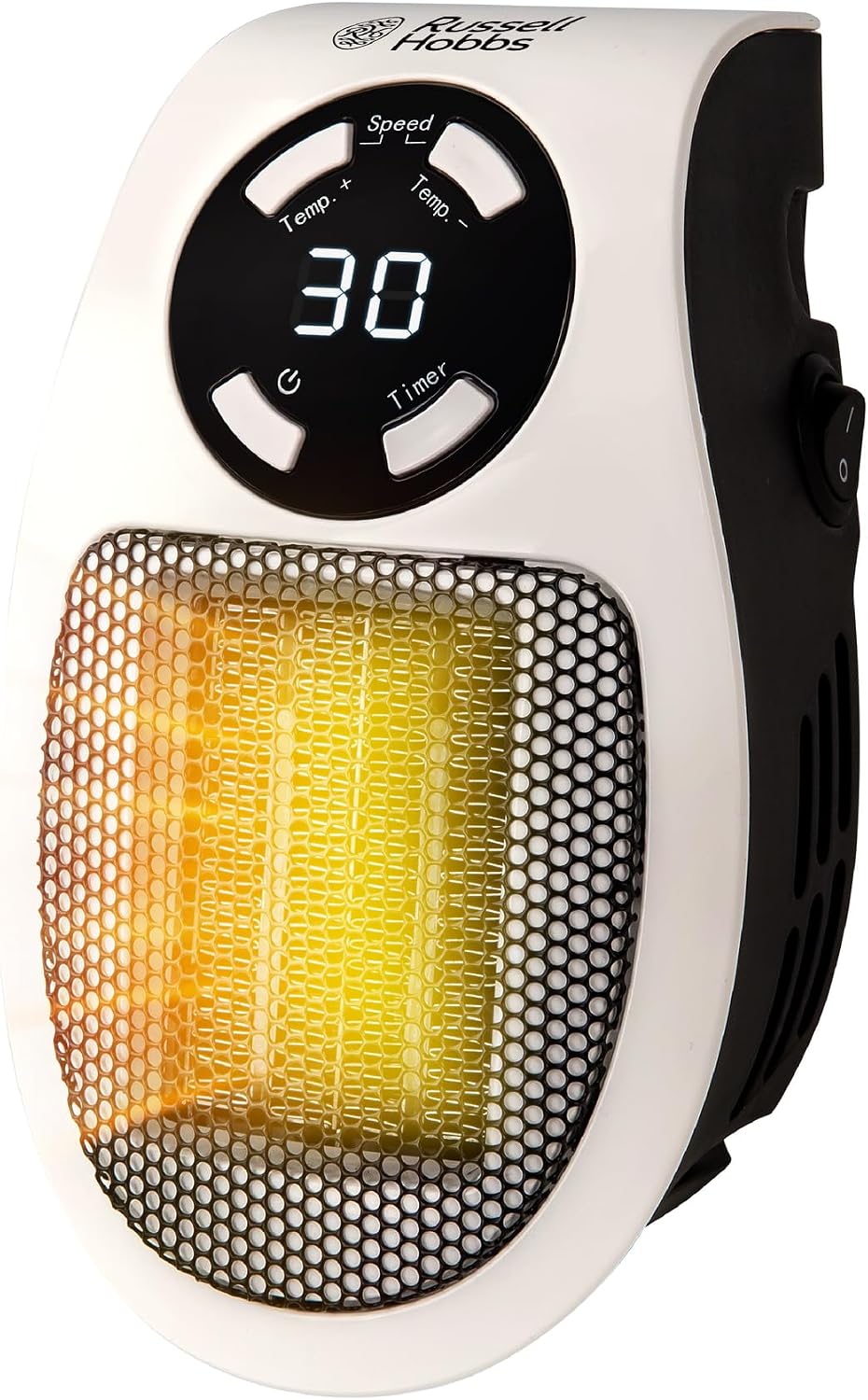
Russell Hobbs names caravans twice on this listing, in a bullet and in the product description, and then photographs the heater at a bedside, on a living-room wall and above a workbench. The number that decides whether a heater will trip a pitch bollard is its current draw, and at 500W this one comes out at roughly 2.2 amps on the Camping and Caravanning Club's own basis, inside even the 6 amp limit one Devon campsite publishes. Whether a heater built to hang off a bedroom socket can do the job in a van is a different question, and the buyers who answered it were mostly nowhere near one.
- 2.2 Amps on the Camping and Caravanning Club's Own Basis, and What a 6 Amp Pitch Leaves for the Kettle
- A Shed, a Kitchen, Hotel Rooms and One Static Caravan: Where the Eight Buyers Plugged It In
- Ten Square Metres on the Listing, Four in a Hotel Room, and Eight Hours to Warm a Shed
- It Hangs From the Socket by Its Pins, and a Van Has Fewer Sockets to Spare
- A Night Light for the Bedside, and the Guidance That Says Switch It Off Before You Sleep
- Our 3.6: The Right Draw for a Hook-Up, From a Heater That Needs the Socket to Hold Its Weight
The listing for the Russell Hobbs RHPH2001 mentions caravans twice, in a bullet about heating "the home, workshops, caravans and offices" and again in the product description. Its spec block recommends it for Home and Office, and none of its nine photographs shows a van. So the caravan case has to be made with numbers, and the numbers are good: 500W on the Camping and Caravanning Club's own basis is about 2.2 amps, which fits inside a 6 amp pitch, as long as the style selector reads 500 W: the same listing sells a 700 W version, about 3.1A on the same sum.
The eight reviews we could recover make a different case. Their buyers heated a shed, a cold kitchen, hotel rooms and one static caravan bedroom, and the two longest reviews both warn you not to expect it to heat a room. We score it 3.6.
One thing before any buy button, because two of the listing photos put this heater at a bedside with bedding in the frame: Electrical Safety First says never to leave a heater unattended while in use or while you are asleep, and asks for at least a metre between it and anything that burns. The heater's own manual says the same, at plugged in rather than in use: it must not be left unattended while it is connected to the mains supply. Our caravan heating guide carries the full guidance.
2.2 Amps on the Camping and Caravanning Club's Own Basis, and What a 6 Amp Pitch Leaves for the Kettle
Nothing on the listing states the current this heater draws, so we worked it out on the basis our caravan heating guide takes from the Camping and Caravanning Club's appliance table, which lists a domestic fan heater at 1kW and 4.4A, a 2kW one at 8.7A, and a camping fan heater at 750W. Run the same sum on 500W and you get roughly 2.2A. That is arithmetic, not a measurement, and it lands below the Club's own 750W camping fan heater.
The Caravan and Motorhome Club says nearly all of its sites supply a maximum of 16A, and that everything running at a pitch has to fit inside it. The Camping and Caravanning Club says most of its sites give 16A, some are limited to 10A, and Certificated Sites can go as low as 5A. Branscombe Campsite in Devon restricts hook-ups to 6A and names a 2kW electric heater among the appliances likely to trip it. Even on a 16A pitch, the Camping and Caravanning Club warns, the van's own sockets may sit behind a 10A breaker. A 2.2A heater fits inside every one of those numbers, but it is never the only load that has to fit: count whatever else in the van is drawing on the same supply before you add the heater to it.
The kettle is the clearest illustration. The Camping and Caravanning Club's table, as our electric blanket guide reports it, puts a domestic kettle at 2,000W and 8.7A and a high-speed one at 3,000W and 13A. So this heater plus an ordinary kettle is about 10.9A: over a 10A pitch, and on a 6A pitch the kettle is the problem on its own. The same Club says not to run heater and kettle together, and that heaters should be low powered and ideally designed for camp life. This one is the first of those and not the second.
One figure is easy to over-read: the Caravan and Motorhome Club and Practical Motorhome both suggest limiting blown-air heating and air conditioning to 500W on hook-up, this heater's maximum output to the watt. But the Caravan and Motorhome Club frames that as a request to keep electricity use down when the site is busy, not a cap on your pitch, and it concerns the van's fitted heating.
A Shed, a Kitchen, Hotel Rooms and One Static Caravan: Where the Eight Buyers Plugged It In
Eight reviews is what we could recover, from the "Top reviews from the United Kingdom" cards rather than the full review list: a curated selection, not the newest, not random. The page carried thirteen cards in all, the other five under "Top reviews from other countries", so these eight are the whole UK set as the page displayed it. They split four 5-star, two 4-star and two 3-star for a sample mean of 4.25, and all eight are UK verified purchases. The lifetime badge is 4.0 across 6,520 ratings, so the sample sits a quarter-star above it. Every card's format strip reads Style Name: 500 W, so no other wattage's experience is pooled into the sample. The benchmark is less clean: the same listing sells a 700 W style too, and that 4.0 badge pools both.
Now the split. One of the eight mentions a caravan, and it is a static: manda, four stars, "Got this for my static caravan bedroom it dose take the chill off and good on electric". A static is a mains-connected holiday home, not a tourer on a pitch bollard, so it says nothing about hook-up limits. None of the eight mention camping, a tent or a pitch.
Where the rest plugged it in is the useful part. Mr. MkK runs it in a shed where they often sit to work. Linda has a cold kitchen. Sam used it in a bigger room to top up the central heating. Marcel Geleijnse carries it to UK hotels with sparse heating, "as a survival top up heater". The other three run to a sentence each and say nothing you could act on.
Russell Hobbs RHPH2001 500W Ceramic Plug Heater
A 500W plug-in ceramic heater drawing about 2.2A on hook-up: top-up warmth for a caravan bed end with a door while you are up, from a socket that leaves it more than 30cm off the floor, 50cm clear at the sides and the 150cm the manual asks in front of the outlet. Check the style selector reads 500 W, not 700 W, before you order.
Ten Square Metres on the Listing, Four in a Hotel Room, and Eight Hours to Warm a Shed
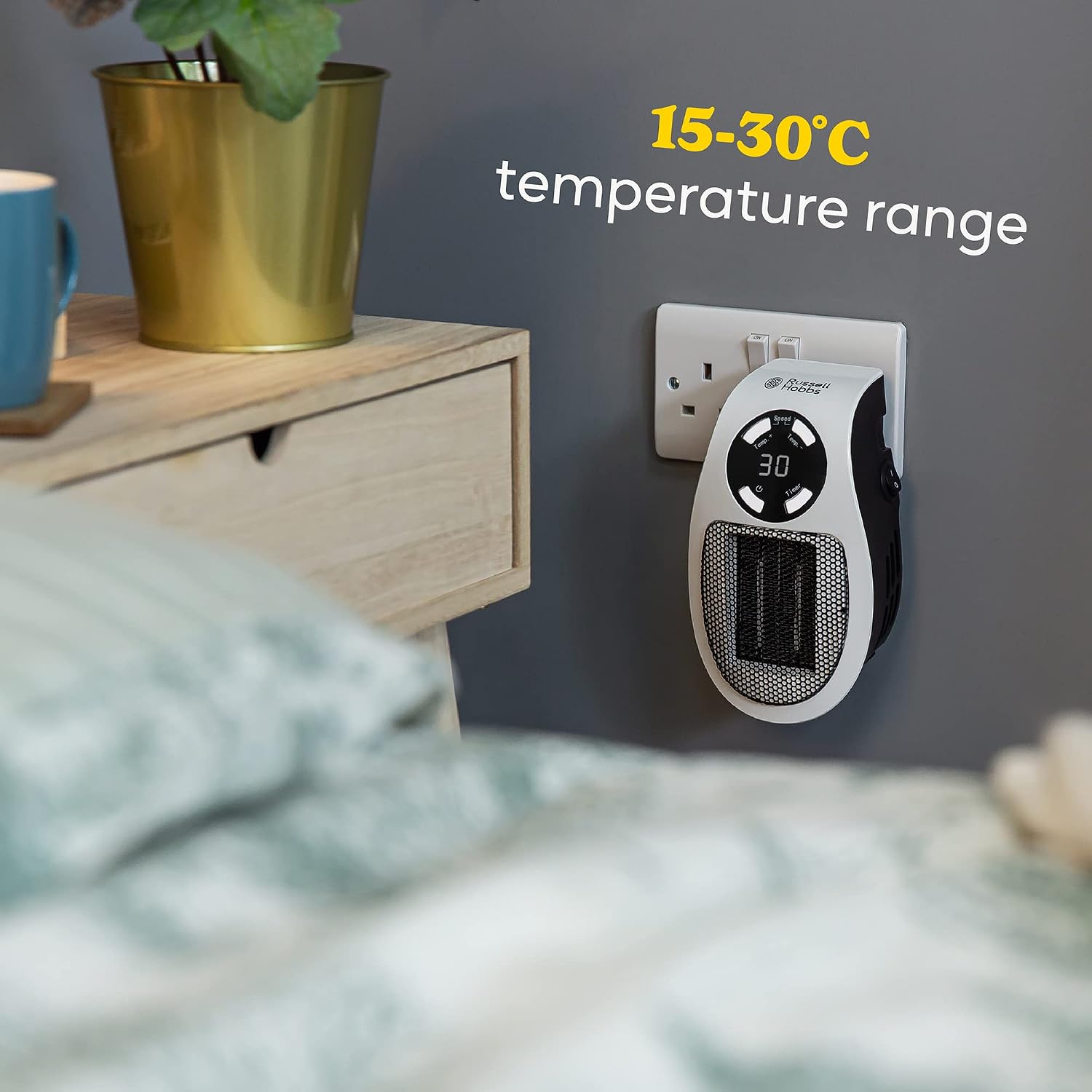
The listing's numbers: 500W maximum, two fan speeds, a ceramic element, a thermostat from 15C to 30C in the bullets and on image six, a 12-hour timer, and a room size of "up to 10m2". The description adds that it "works best in well insulated rooms". Five of the eight say something about how much heat it gives, and the two longest, at 179 and 142 words, put a number on it.
| Figure | Listing | Recovered reviews |
|---|---|---|
| Room size | Up to 10m2 | "on its own it will never heat a room more than 4 meter squared on a cold-ish day" (Marcel Geleijnse, 3 stars); a shed from 8C to 12C in "roughly 8 hours on full" (Mr. MkK, 3 stars); a kitchen "warmer in hardly anytime" (Linda, 5 stars) |
| Temperature setting | 15C to 30C on the bullets and image; 15C to 15C in the spec block, a listing error | Default 30, set to 21C, cut out at 21C (Sam, 5 stars) |
| Timer | 12 hour | "not easy to figure out" (Sam) |
| Noise | Not stated | "doesn't make too much noise" (Linda); fan loose after about two weeks, "one heck of a racket" at start-up (Mr. MkK) |
| Warm-up | Not stated | "about 30 minutes and room was nice and warm" (Sam, in a house with central heating) |
Read the two 3-star reviews as a range, not a verdict. Marcel's hotel room has heating, just "sparse" heating; Mr. MkK's shed is the cold end. The cover of the manual carries the standard efficiency statement this class of heater prints, not a Russell Hobbs verdict on caravans: "This product is only suitable for well insulated spaces or occasional use". On its own terms a touring van is the occasional-use half of that sentence, not the well insulated half. Two of the eight call it a top-up heater unprompted, and nobody claims it heated a room the size the listing names.
It Hangs From the Socket by Its Pins, and a Van Has Fewer Sockets to Spare
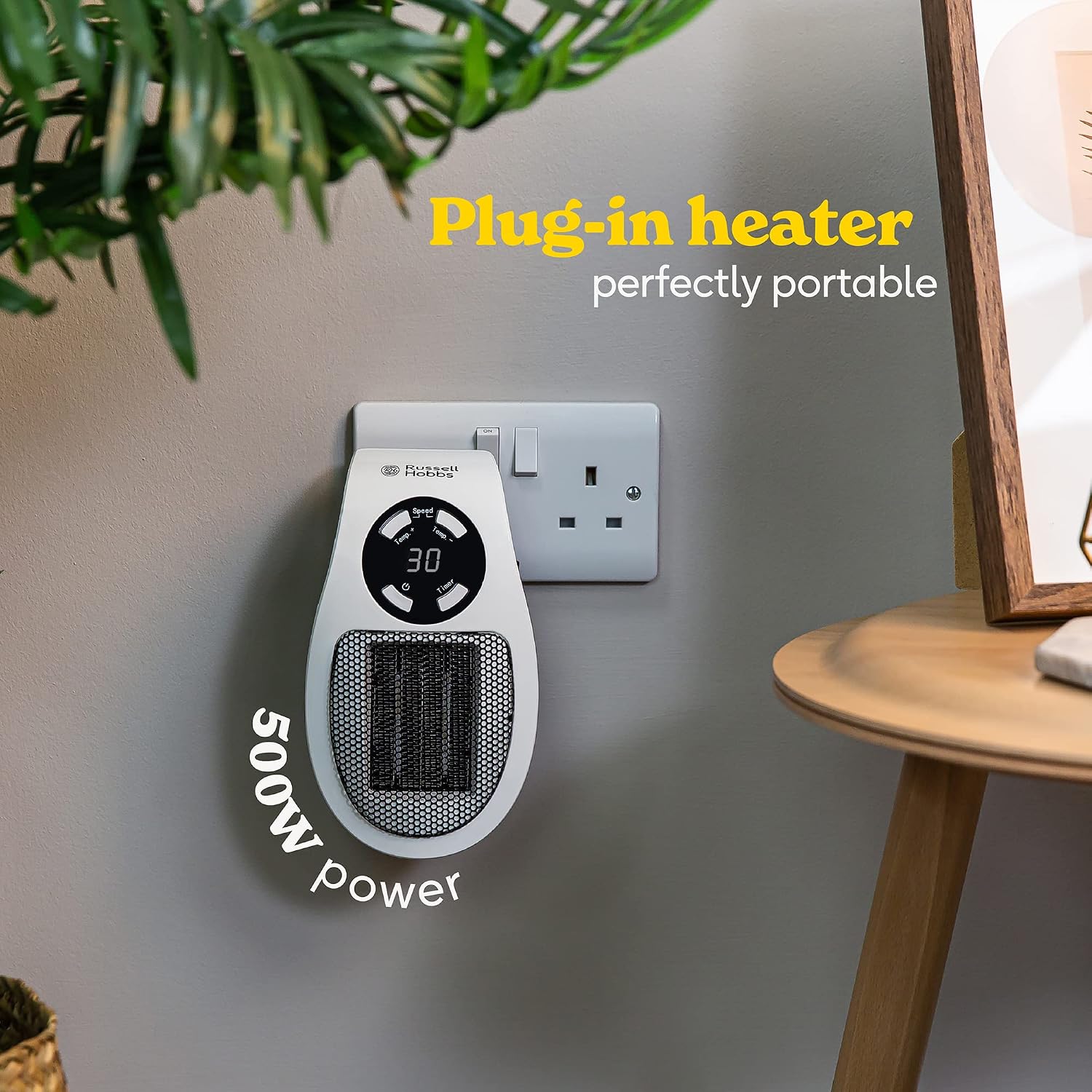
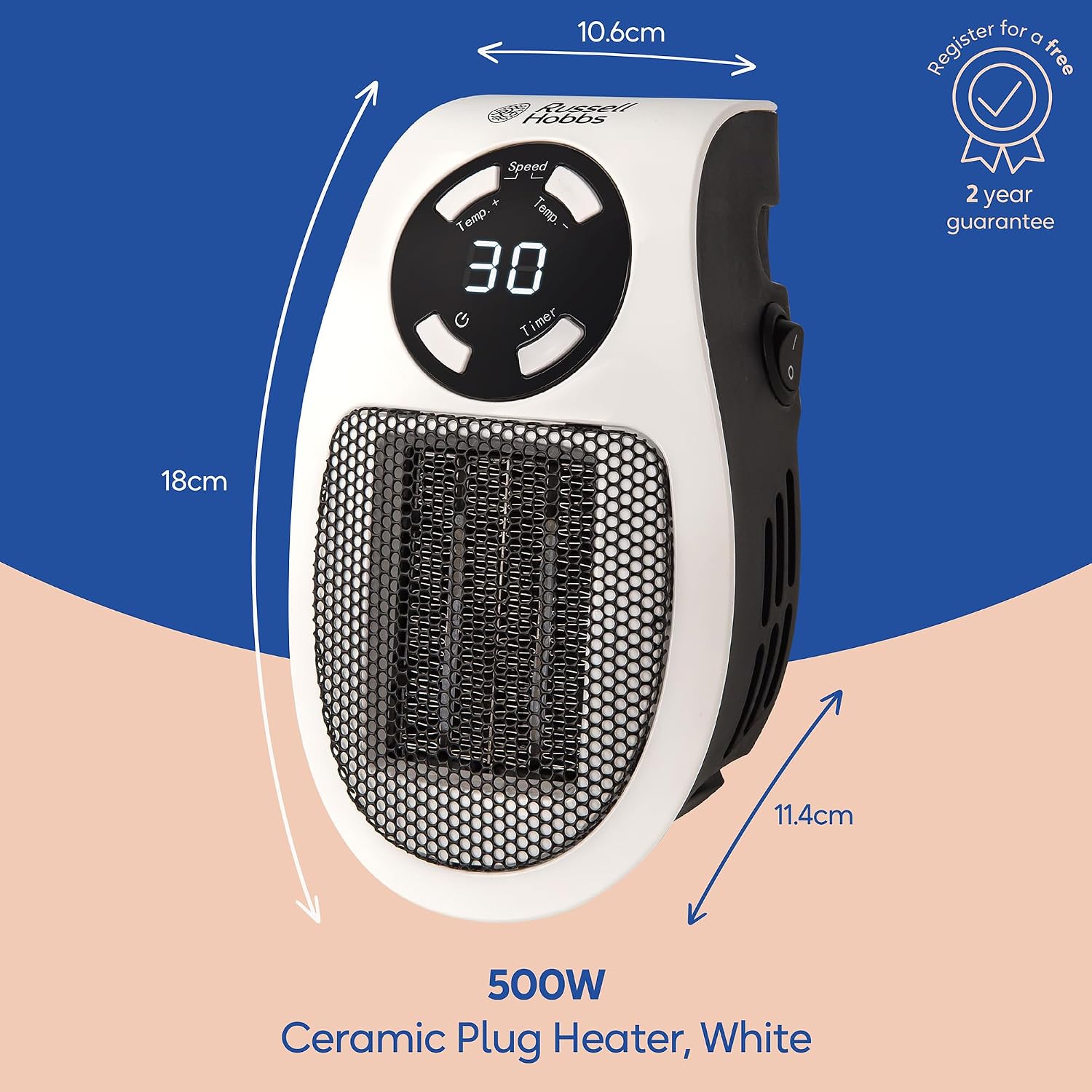
There is no cable. The heater is 18cm tall, 10.6cm wide and 11.4cm deep, and all of it hangs from the three pins of a moulded plug, which is why the description asks for 30cm of clearance below the socket. The manual asks for more: the heater's bottom more than 30cm off the ground, which with an 18cm body puts the socket itself at roughly 48cm or higher, and more than 50cm between the side of the heater and the wall or any other object. Elsewhere the same manual asks for 100cm around the top and sides and 150cm at the front, so take 50cm as the least it asks for, not its recommendation. Nobody in the eight reports whether a second plug fits alongside its 10.6cm body on a double socket.
Mr. MkK lived with the consequence: "the weight of the heater pulls it down over time and I think has started to damage the inside of my plug socket". Marcel's complaint is smaller, that the way the plug is set means it does not always fit the socket it is offered.
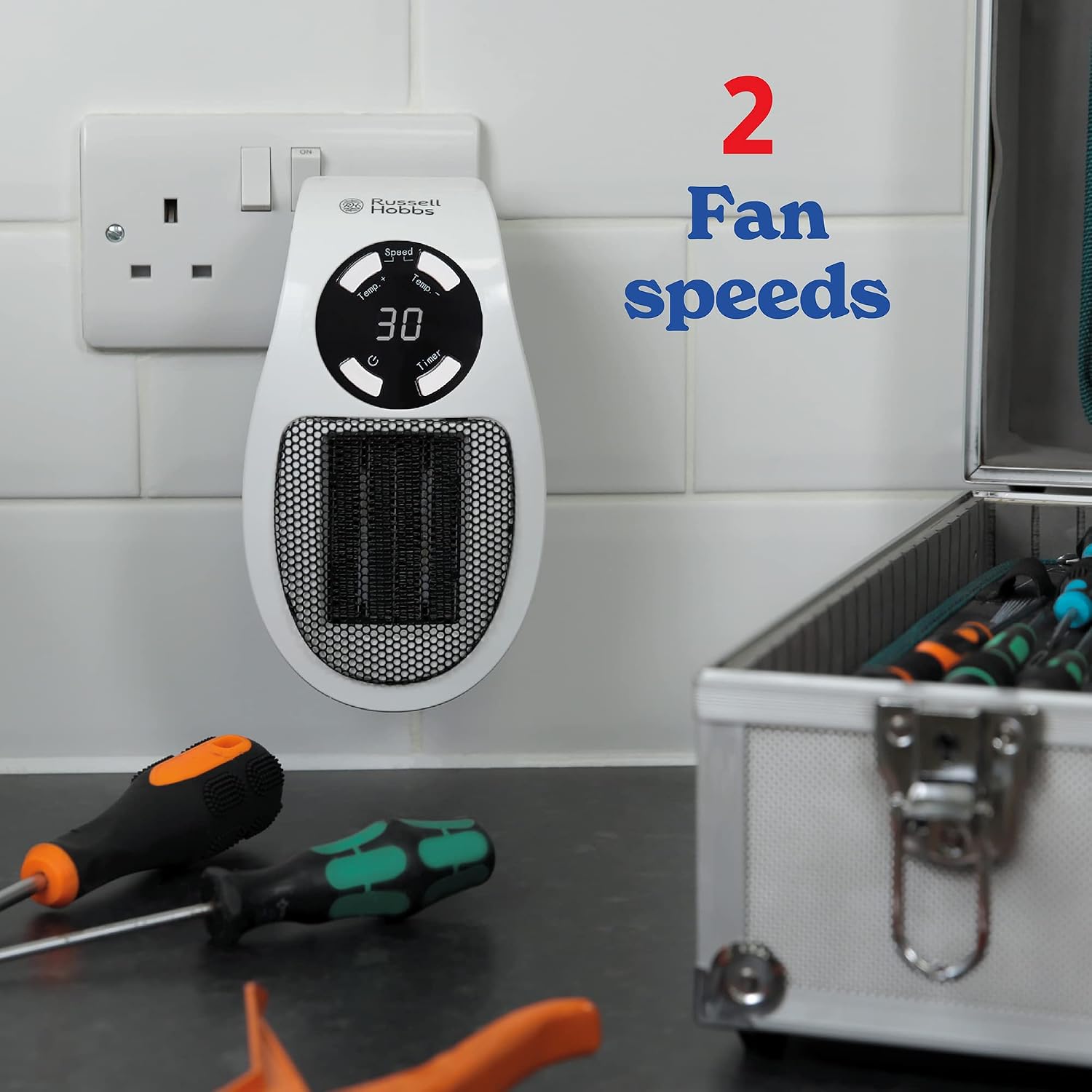
In a house you pick a different socket. In a van you have fewer to choose from, and the clearances are what bite: more than 50cm of clear air beside the heater rules out a socket in a locker recess or beside a seat base, and a worktop above it eats the manual's 100cm top clearance. An extension lead or a doubler is not the answer: Electrical Safety First says to avoid powering a heater from one, as they can easily be overloaded, and a floor-level block puts the heater below the 30cm the manual asks for. If no socket in the van passes, buy the Gaiatop 500W mini space heater instead: same 500W, so the 2.2A arithmetic holds, but it stands on a surface, so the socket carries a plug, not a heater. It is a trade, not an upgrade: you give up the thermostat and the timer, so it runs flat out until you switch it off and its buyers say it gets really hot, and you gain tip-over protection this listing never claims. If 500W is not enough heat, neither fixes that; the answer is the van's fitted heating, which the heating guide above covers.
A Night Light for the Bedside, and the Guidance That Says Switch It Off Before You Sleep
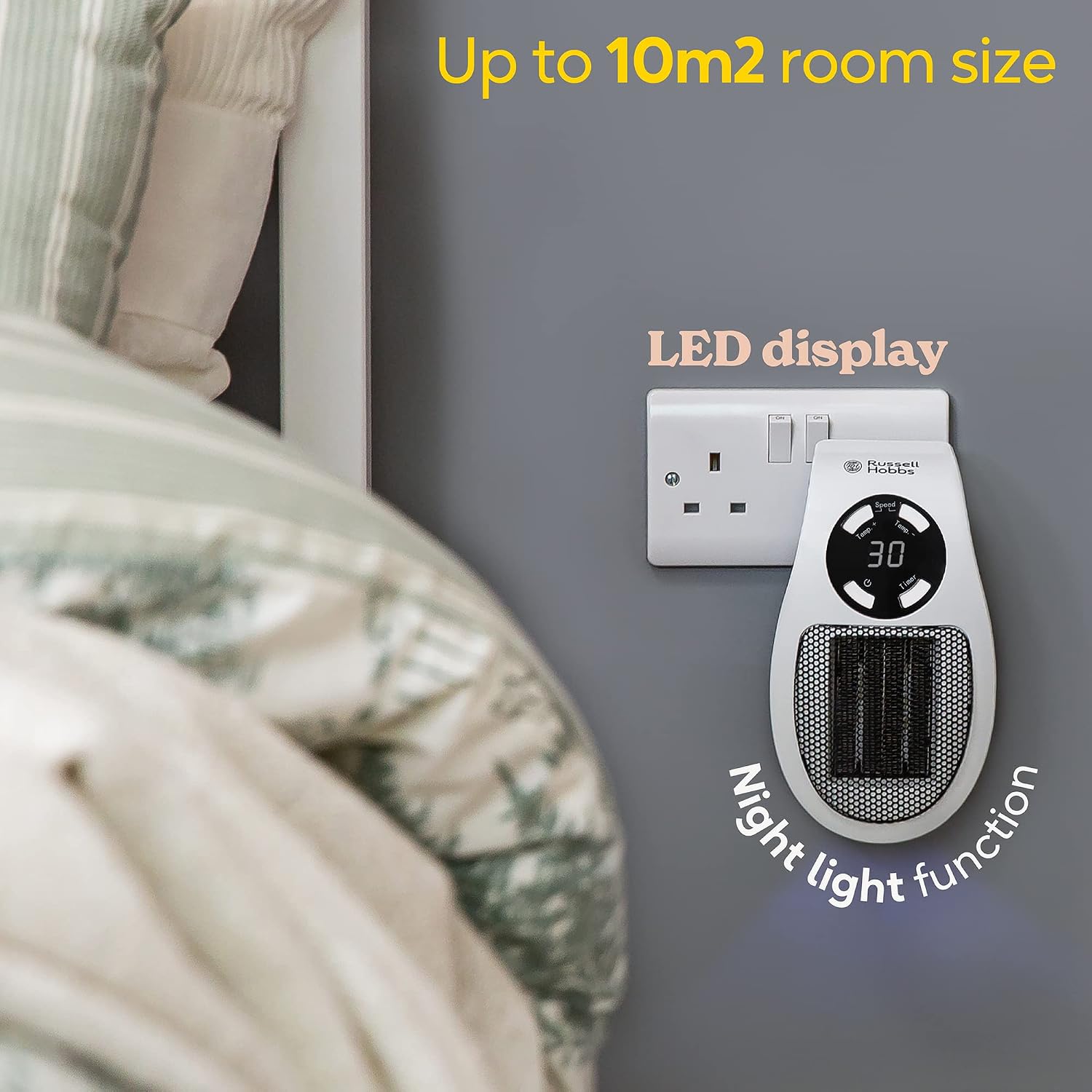
Image four, one of two bedside shots, is captioned "Night light function". The description goes further: use the timer for "heating your bedroom while you settle for the evening", and the night light is "perfect for added safety during the twilight hours". The manufacturer is selling the bedside, in the evening rather than the night.
Set that beside the guidance our caravan heating guide takes from Electrical Safety First: never leave a portable heater unattended while in use or while you are asleep, keep at least one metre between it and combustibles such as paper, furniture or curtains, and never dry clothes on or close to it. It also recommends not using one overnight. A metre is a real constraint in a caravan. A 12-hour timer is the tool for the evening, not for the sleeping hours. If the sleeping hours are what you need covered, the appliance for that job is a blanket, not a heater, and its own rule travels with it: preheat while you are up, switch it off and unplug it before you sleep, and leave it on all night only if that blanket's leaflet says so. Our electric blanket guide covers the 35W Kingavon, sold for caravan and campervan hook-up, and could not find a published leaflet for it.
The bullets say little about protection beyond the spec block's cool-touch exterior. The manufacturer's Instructions for Use, linked from the listing's safety panel, is where the protection claim lives: an overheat system that cuts power to the heating elements if they pass a set limit. Tip-over protection is claimed nowhere, listing or manual. The manual puts the unattended rule in its own words, drawn at plugged in rather than in use: "The appliance must not be left unattended while it is connected to the mains supply." It confirms Marcel's "off cool down delay" as well, a fan that runs on for about a minute after the heat stops, and Sam watched the thermostat cut out at a set 21C.
Our 3.6: The Right Draw for a Hook-Up, From a Heater That Needs the Socket to Hold Its Weight
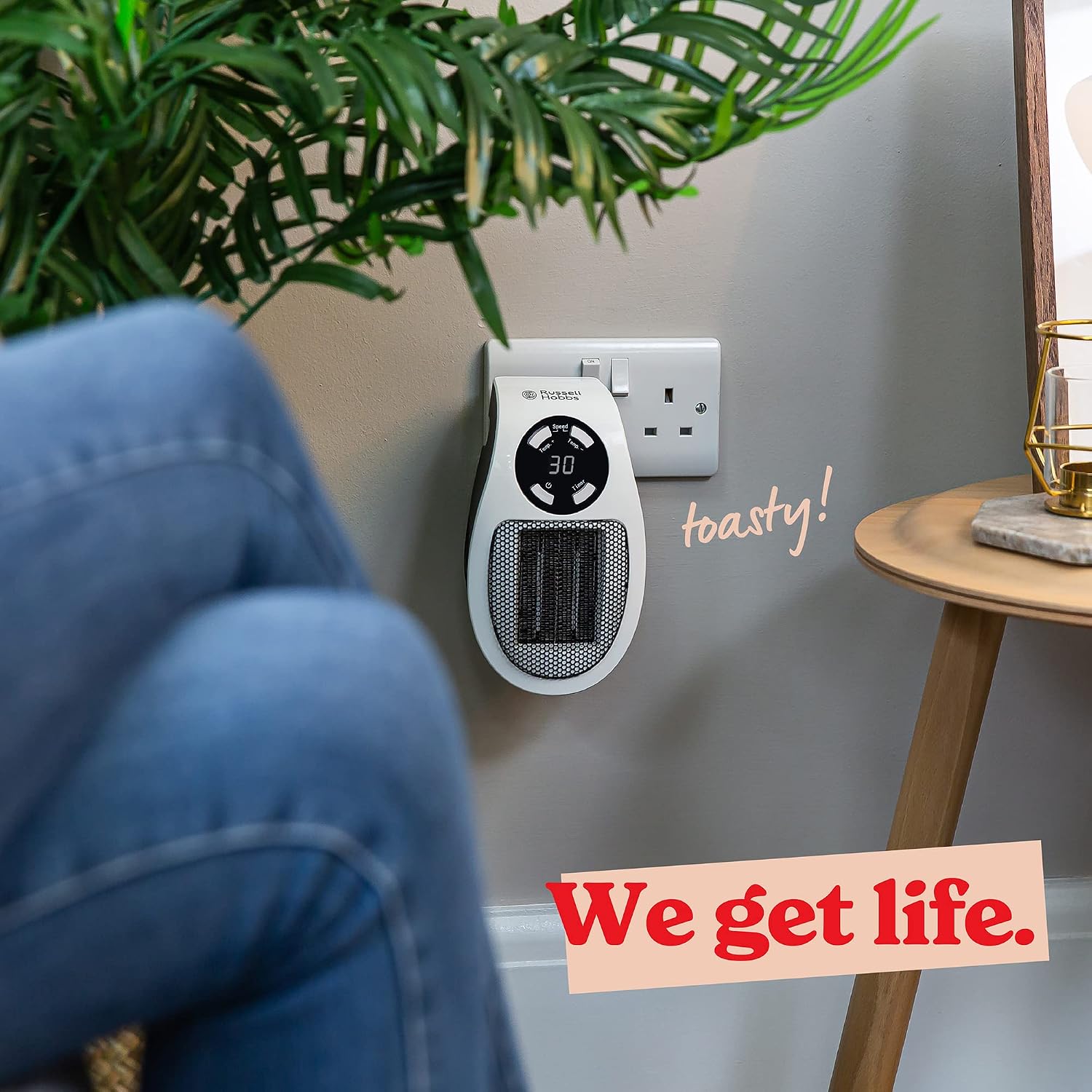
The score rests on the eight against a lifetime 4.0 across 6,520 ratings: they average 4.25 with no critical review among them, and the lifetime figure says the critical reviews exist. Take the five that describe the product and they average 4.0 exactly, and the two longest reviews by word count both gave three stars, for the shed and the four-square-metre ceiling in the table above. 3.6 is where that lands: a competent small heater whose one design choice, hanging its whole weight from the plug, matters more in a van than anywhere else.
Buy it if your pitch has 2.2A to spare once everything else drawing on the same supply is counted: the heater's own 2.2A fits even a 5A Certificated Site, but on that supply it is the headroom, not the heater, that decides. Buy it if a socket leaves the heater more than 30cm off the floor, 50cm clear at its sides and the 150cm the manual asks in front of the outlet. And buy it if the job is a cold corner, or a bed end that shuts behind a door or a solid bulkhead, while you are up: open plan or curtain-divided, that is the whole-van job the skip list rules out. The thermostat cut-out stops it running flat out once the space reaches the temperature you set, which a shed on a cold day may never do, and the only two running-cost verdicts in the eight, Linda's and manda's, are both positive with no figure behind either. At full output 500W is half a kilowatt-hour an hour, less once the thermostat starts cycling.
Skip it if you need to heat the whole van, if your sockets are low down or boxed in, or if the plan was to leave it on at the bedside overnight, which Electrical Safety First recommends against for a portable heater at an occupied bedside. A van in winter storage is a different job again, covered in our caravan damp guide. One thing our eight cannot show: across the full rating base the aspects buyers are hardest on are noise and reliability, the nearest thing to an echo of either in our sample being Mr. MkK's fan working loose after a fortnight. If the freestanding Gaiatop suits you better, buy that instead. Otherwise check today's price on Amazon and keep it for the hours you are awake.
Russell Hobbs RHPH2001 500W Ceramic Plug Heater
A 500W plug-in ceramic heater drawing about 2.2A on hook-up: top-up warmth for a caravan bed end with a door while you are up, from a socket that leaves it more than 30cm off the floor, 50cm clear at the sides and the 150cm the manual asks in front of the outlet. Check the style selector reads 500 W, not 700 W, before you order.