Merino Wool Hiking Socks for Blister Prevention UK: Danish Endurance's Strongest Evidence Isn't About Blisters
We earn commission from qualifying Amazon purchases. It costs you nothing and does not affect what we recommend.
The product title promises anti blister cushioning, but the loudest praise in Danish Endurance's UK reviews is about temperature: warm on chilly countryside hikes, cooler than cotton on warm-weather walks, dry across the West Highland Way.
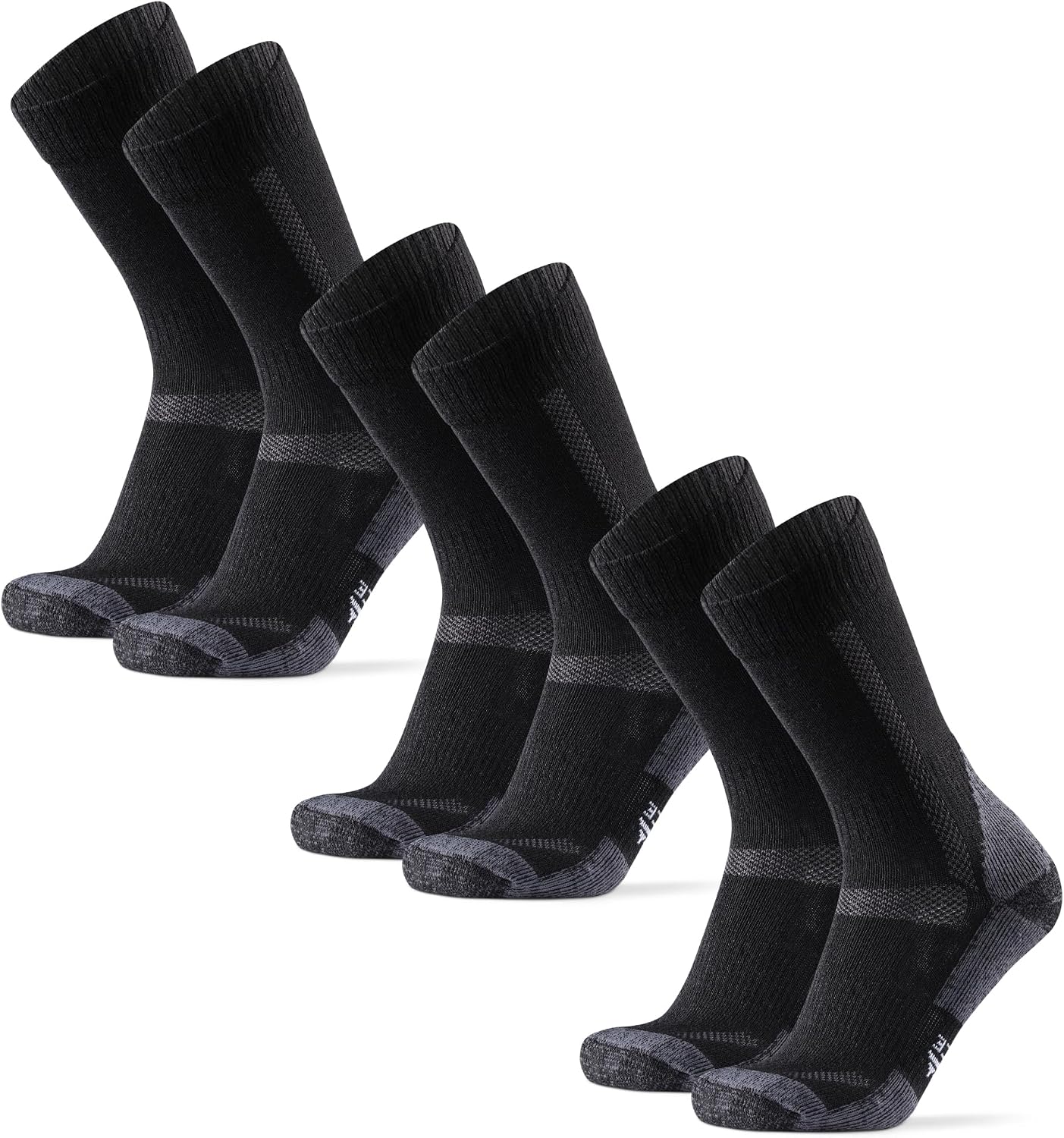
The Amazon title for these socks makes one specific promise: Anti Blister Cushioning. That is the claim a walker worried about blisters cares about most, and it is the claim the customer evidence on this listing barely touches. Danish Endurance's unisex merino 3 pack carries a 4.5-star badge across 41,285 ratings, and the reviews Amazon surfaces on the product page are full of praise, but the praise lands on temperature control, durability and all-day comfort. Blisters get a single mention. This review separates what those buyers actually back up from what only the marketing images claim, and flags two warnings, one about washing and one about calf fit, that appear nowhere on the listing itself. There is a strong case for these socks. It is not quite the case on the tin.
How Amazon Picked the Reviews We Read
First, the evidence base, because it shapes every conclusion below. We read eight reviews: the full set Amazon surfaces in the Top reviews from the United Kingdom widget on this product page. That widget is a curated selection, not the most recent reviews and not a random sample. All eight are verified UK purchases, and the widget contains no 1-star or 2-star reviews at all, so the critical end of this product's 41,285 ratings is invisible from where we sit. One more wrinkle: Amazon pools reviews across the listing's size and colour variants, so each fit or sizing report describes that buyer's variant rather than the sock in general. Keep all of that in mind as you weigh what follows.
Here is the shape of the sample. Six of the eight reviews award 5 stars, one gives 4, one gives 3. Four of the eight describe outdoor walking or hiking actually done in these socks, ranging from repeated 10 to 15km day hikes in the Peak District to the length of the West Highland Way. Of the other four, one buyer wrote his first impressions before ever wearing the socks outdoors, then returned a year and a half later with a durability update. One reviews the brand's hiking kit in glowing but generic terms, with no sock-specific detail to mine. One praises them as warm, comfortable socks and attaches a washing warning. And the single 3-star voice tried them on, found the fit wrong for her, and is returning them without having walked in them. So the outdoor evidence rests on four buyers, the spread is heavily positive, and the most critical reviewer in the set never wore them in anger. That is the base this review scores from.
One Blister Report Does Not Make a Pattern
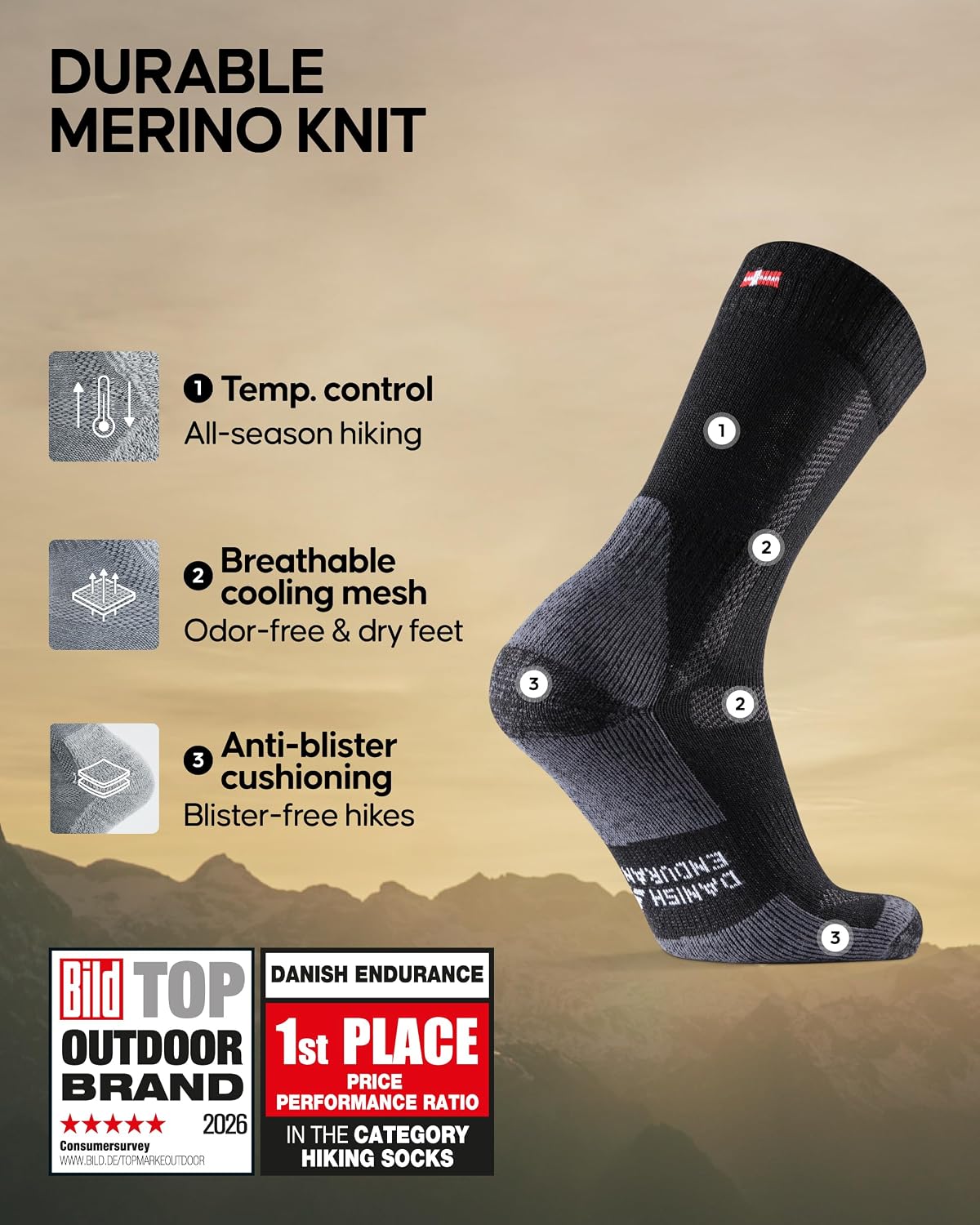
Start with the promise in the product title. The listing's infographic marks cushioning zones at the heel and toe and captions them with a promise of blister-free hikes. That is a listing claim, and this review set gives it exactly one direct data point: the buyer who took these into the Peak District for several 10 to 15km hikes in mid-weight boots and reports 'zero issues with rubbing, blisters, or sore spots'. That buyer credits the padding at heel, toe and sole, plus gentle compression around the arch and ankle. It is also the only mention of rubbing or friction across the eight reviews, so the anti-friction story begins and ends with one walker.
Two more reviews sit near the claim without quite supporting it. The walker who covered the West Highland Way, a 96-mile route, says her feet 'stayed dry and comfortable', which is relevant because damp skin blisters faster, but dry feet and blister-free feet are different claims and she only makes the first. Another buyer switched on a recommendation for hikers rash, not blisters, and reports no rash since the change. Real benefits, both, and neither one is blister prevention.
So the fair reading is this: the mechanism is plausible, since merino manages moisture and the padding sits where boots rub, and the one buyer who logged repeated day hikes in them reports exactly the outcome the label promises. One report is still one report. If you want a sock whose reviews prove an anti-blister record, this set is thin evidence. What it does prove fills the next three sections.
Danish Endurance Merino Wool Hiking Socks, 3 Pack
Buyer-backed temperature control, a 1-year anti-hole guarantee and cushioning where boots rub, for UK walking, camping and everyday wear.
The Spec Sheet Is Six Pictures
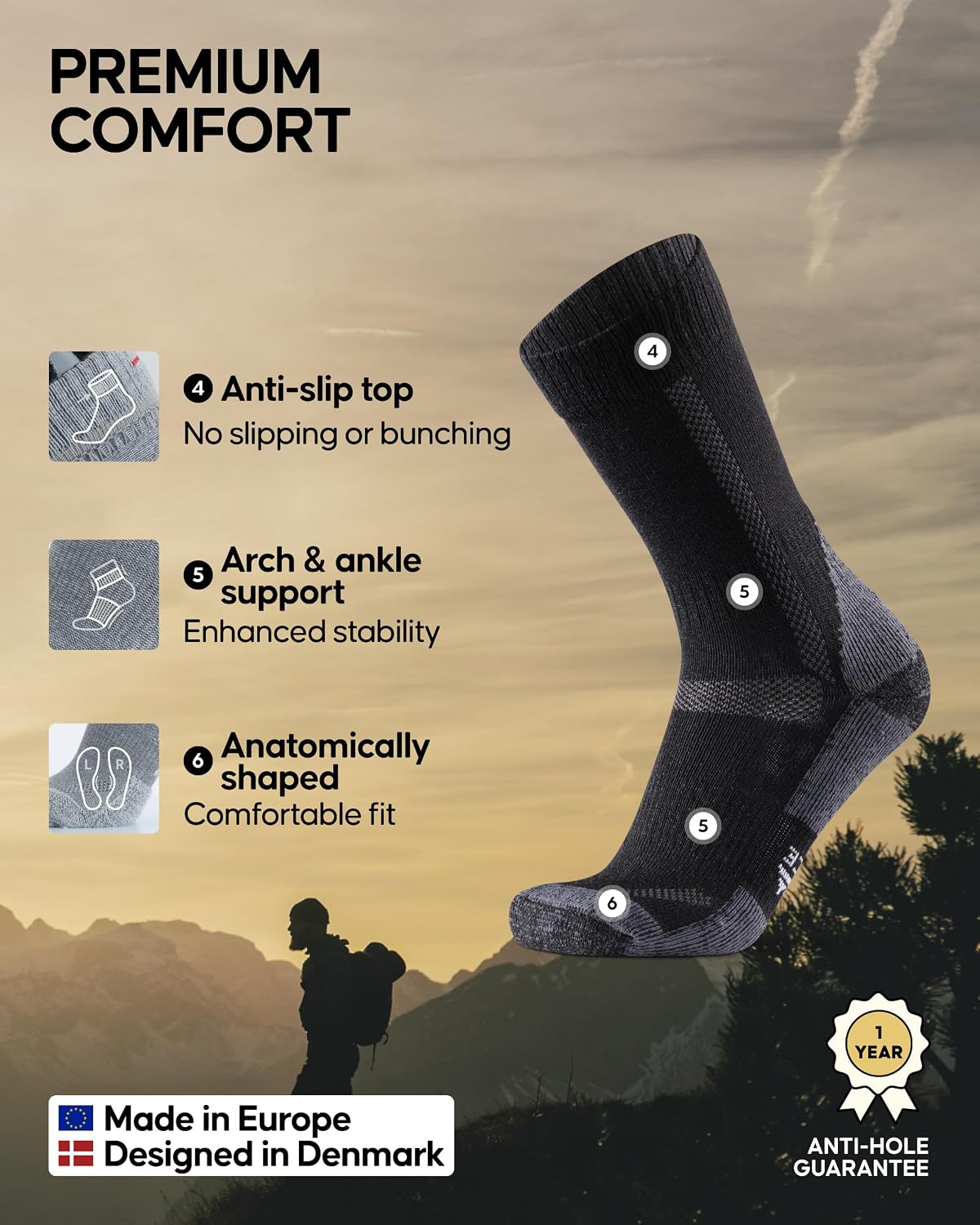
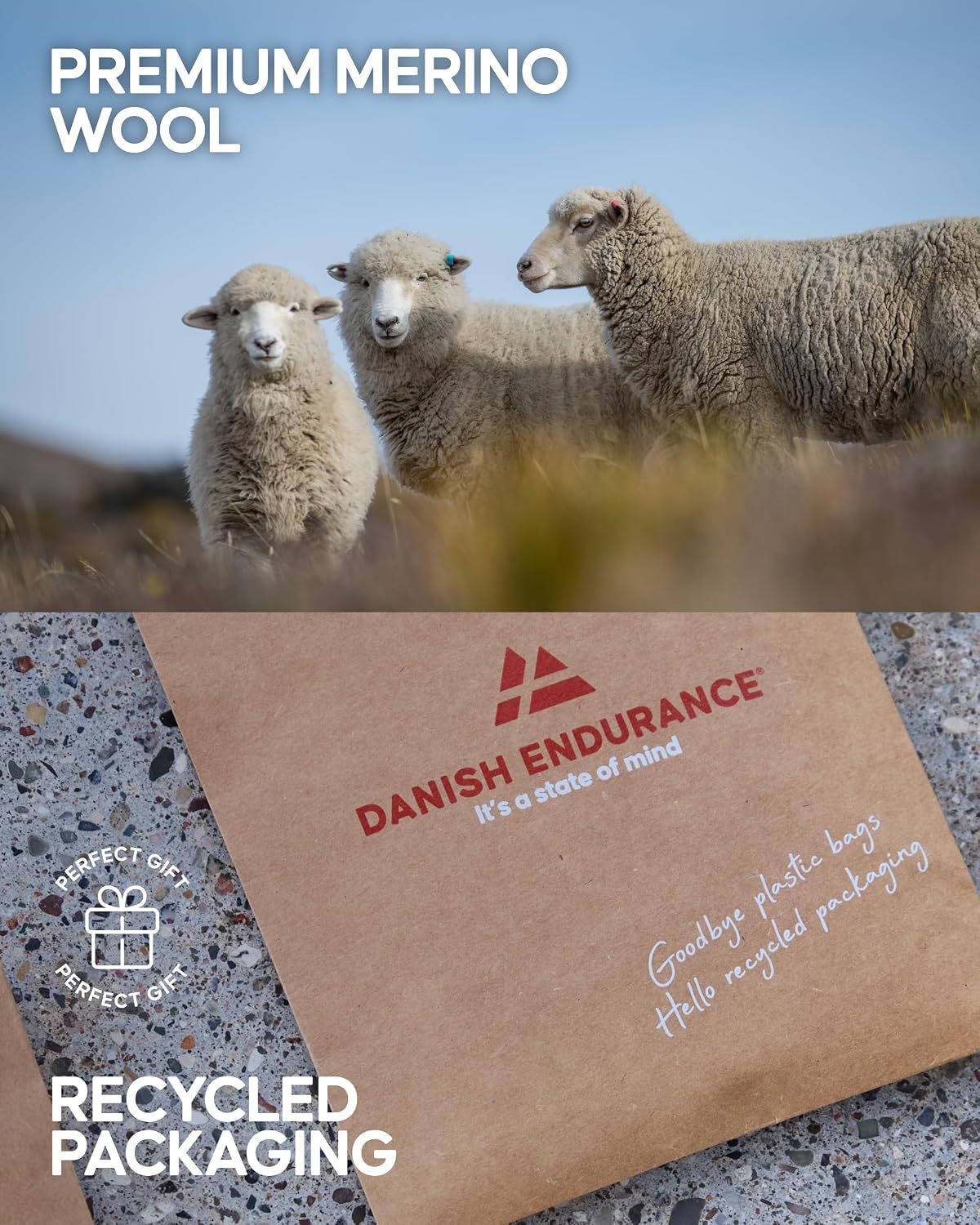
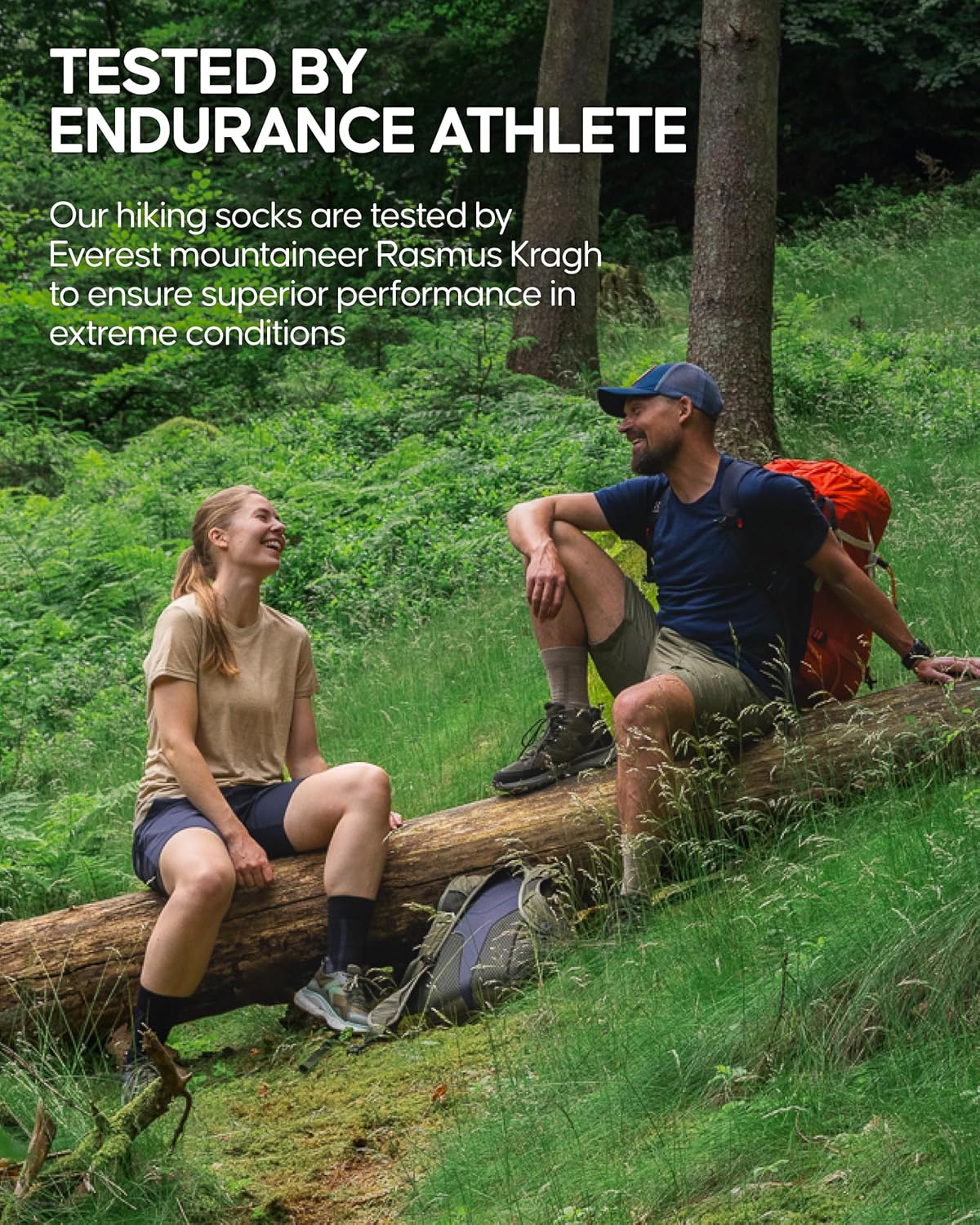
This listing has no bullet points and no text description at all. Every specification lives in six marketing images, so here is what they state and what they leave out. The knit infographic promises temperature control for all-season hiking, a breathable cooling mesh for dry, odour-free feet, and the anti-blister cushioning discussed above. A second graphic adds an anti-slip cuff to stop slipping and bunching, arch and ankle support, and an anatomically shaped fit, its icon showing separate left and right footprints. The brand states the socks are made in Europe, designed in Denmark, shipped in recycled paper packaging rather than plastic, and covered by a 1-year anti-hole guarantee. Two award badges appear: Top Outdoor Brand 2026 in a German consumer survey by Bild, and a first place for price-performance ratio in the hiking socks category. There is also a brand claim that the socks are tested by Everest mountaineer Rasmus Kragh.
Now the gaps. Nowhere in those six images, nor anywhere else we could read on the listing, is the merino percentage stated. The only blend description in the review set comes from one buyer, who describes 'a mix of merino wool, nylon, and a touch of elastane'. There is no size chart in the images either, and no washing instructions: the care advice two sections down comes from buyers, not the label. For a product whose whole pitch is the fibre, the missing wool percentage is a strange omission, and it means you cannot compare merino content against rival socks from the listing alone.
Warm on a Cold Hike, Cooler Than Cotton in June
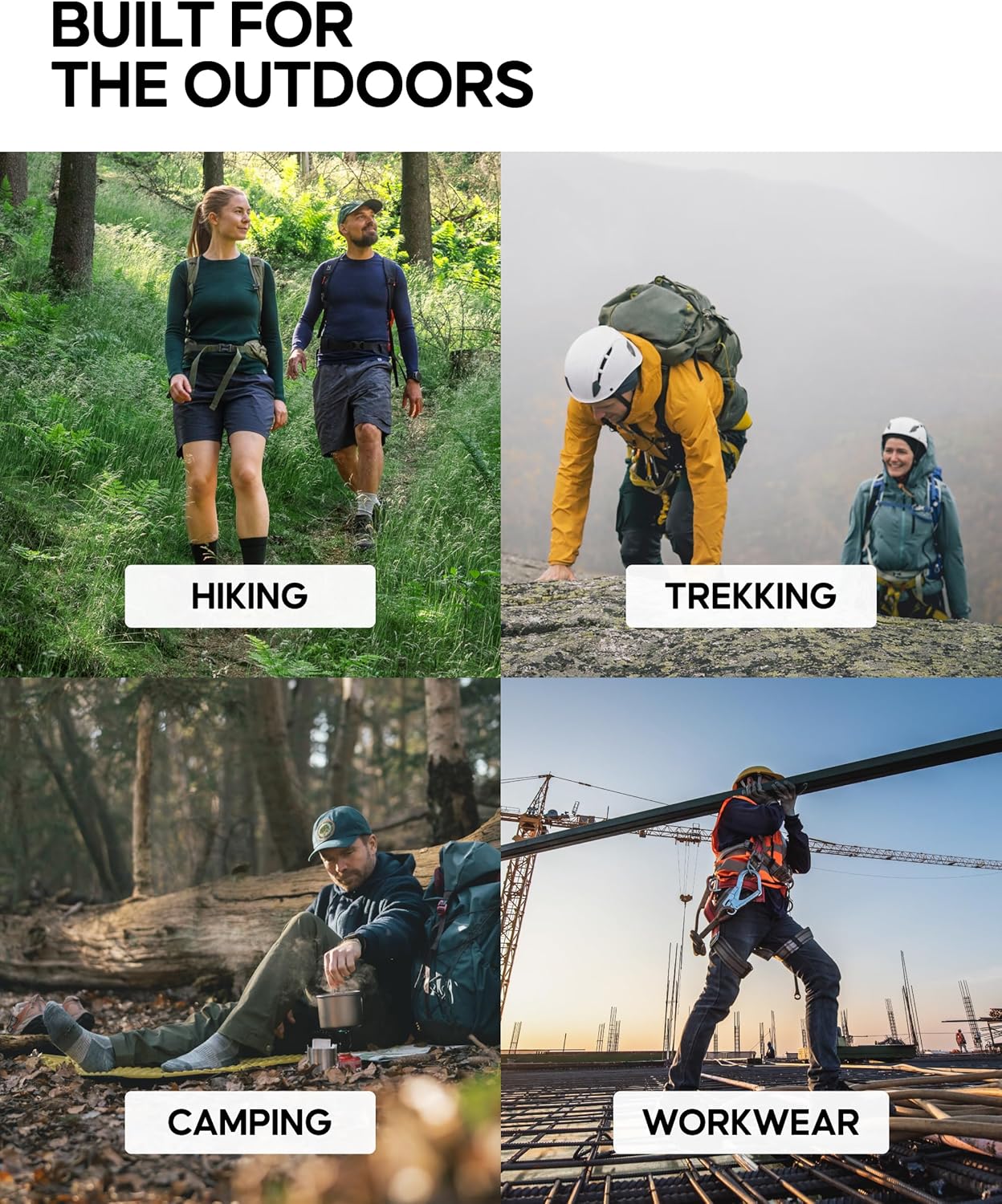
Temperature is the best-evidenced claim on the listing: five of the eight reviews touch on it, covering both ends of the thermometer. The Peak District buyer reports the socks 'kept my feet warm in the cold' yet did not overheat or turn sweaty when the sun came out mid-hike. The buyer with months of countryside hikes behind them finds them warm enough for chilly walks and breathable enough that sweaty feet never featured. The 4-star buyer rates them nice and warm. Meanwhile the walker who runs hot in summer says the merino does 'keep my feet and ankles cooler' and calls them 'an improvement on cotton socks', a surprise given they look like cold-weather kit.
One more temperature account needs framing before you weigh it: the buyer wrote his first impressions before wearing the socks outdoors at all. Indoors in winter, in a house kept between 20 and 24C, he reports feet that were never hot and never cold, and a tiled kitchen floor he used to cross in slippers that he stopped noticing entirely. Take that as indoor evidence, because that is all it claims to be. The West Highland Way walker adds the moisture half of the story: 96 miles with dry, comfortable feet. The fibre explains the pattern. Merino absorbs sweat as vapour and releases it, where cotton soaks it up and holds it against your skin, clammy in summer and cold in winter. For UK conditions, where one walk can serve you four seasons, that range is the strongest reason in these reviews to buy.
The 30 Degree Rule Buyers Wrote Themselves
No care instructions appear anywhere on the listing, so the washing rules have been written by buyers, three of whom discuss washing or shrinkage. The 4-star review is the bluntest: 'wash them at 30 degrees, and do not tumble dry them, otherwise they end up rather small'. A second buyer proved the point by accident, tumble-drying his pairs multiple times across a year and a half; they shrank a little and now fit tighter, though he still wears them. The Peak District buyer has done about six cycles the right way, cold wash and air dry, and reports no shrinking, no bobbling, intact stitching, and 'the padding remains plush'. Wool felts and tightens under heat, so none of this is unusual for merino, but with no care guidance on the listing it is the kind of thing you find out the hard way.
The durability file is more cheerful. The accidental tumble-dryer is also the longest-term owner in the set: his update after a year and a half reports 'still no holes in the socks' and, his estimate, 'Probably years left in them'. The buyer with months of hikes done says cheaper walking socks 'wear thin or go bobbly pretty quickly' while these 'still feel like new after months of wear'. The brand backs that up with the 1-year anti-hole guarantee in its listing images. Merino usually trades some durability for softness; the nylon in the blend one buyer describes is what typically holds a sock like this together.
The Best Sizing Advice Comes From the Buyer Who Returned Them
Five of the eight reviews comment on fit or sizing, and the only 3-star in the set is the one to read closely. Its writer never wore the socks on a walk; she says plainly that she cannot vouch for their performance, and she is sending them back. What she can speak to is fit. She is a UK 7.5 who says she does not have skinny calves, and she found the leg of the sock too tight to wear all day, tight enough that she worried it would restrict blood flow. Her advice for anyone near the size boundary: 'I would advise going for the bigger size' if you take a UK 7 or 8. Remember the variant pooling flagged at the top of this review: that is one buyer's experience of her size, not a verdict on every size in the range. It is still the most useful sizing note in the set, and with no size chart anywhere in the image-only listing, it is the only calf guidance a buyer gets.
The other fit reports are positive. A UK 9 buyer in the Medium reports 'no bunching or excess fabric' and describes the arch and ankle compression as a 'supportive feel without being too tight'. The 4-star buyer was pleased to find them 'unusually in a nice big size'. A third reviewer calls them well fitted and leaves it there. And the tumble-dryer buyer's pairs still fit after shrinking, just more snugly than intended. If your calves run wide or you sit between sizes, size up. Everyone else in this set found the fit unremarkable in the good sense.
Why We Land on 4.2 Rather Than 4.5
Time to weigh it all, starting with the reminder this verdict stands on: eight surfaced reviews, read against a lifetime badge of 4.5 stars across 41,285 ratings.
We score these socks 4.2 out of 5. The case upward: temperature control is corroborated across the sample in settings from a heated house to summer walking, the durability file holds a year-and-a-half no-holes report alongside a 1-year guarantee, two walkers single out the cushioning, and every buyer who actually hiked in them came back at 5 stars. The deductions: the anti-blister promise in the title rests on one buyer's report, the strict care regime of cold washes and no tumble dryer is documented by buyers rather than the label, one returner found the leg too tight for her wider calves, and a curated sample containing not a single 1- or 2-star review cannot justify a score above the lifetime average. Landing below the badge reflects scepticism about the sample, not the socks.
Who should buy: campers and walkers still in cotton socks, cold-footed types who want one pair that works in January and July, and anyone whose boots come home with damp socks inside. Who should pause: wide calves, anyone at the UK 7 to 8 boundary unwilling to size up, and households where everything goes through the tumble dryer. If you are in the first group, check the current listing on Amazon. On this evidence the difference from cotton shows up on the first long walk.
Danish Endurance Merino Wool Hiking Socks, 3 Pack
Buyer-backed temperature control, a 1-year anti-hole guarantee and cushioning where boots rub, for UK walking, camping and everyday wear.