
How to Stay Dry Camping in the Rain: UK Guide
Published 23 August 2026
Rain is not what ruins a UK camping trip, and four specific failures are. Here is the go or no-go call, the numbers behind the word waterproof, the order of operations for a soaked pitch, and the 6am test that tells a leak from condensation.
We earn commission from qualifying Amazon purchases. It costs you nothing and does not affect what we recommend.
Quick Answer
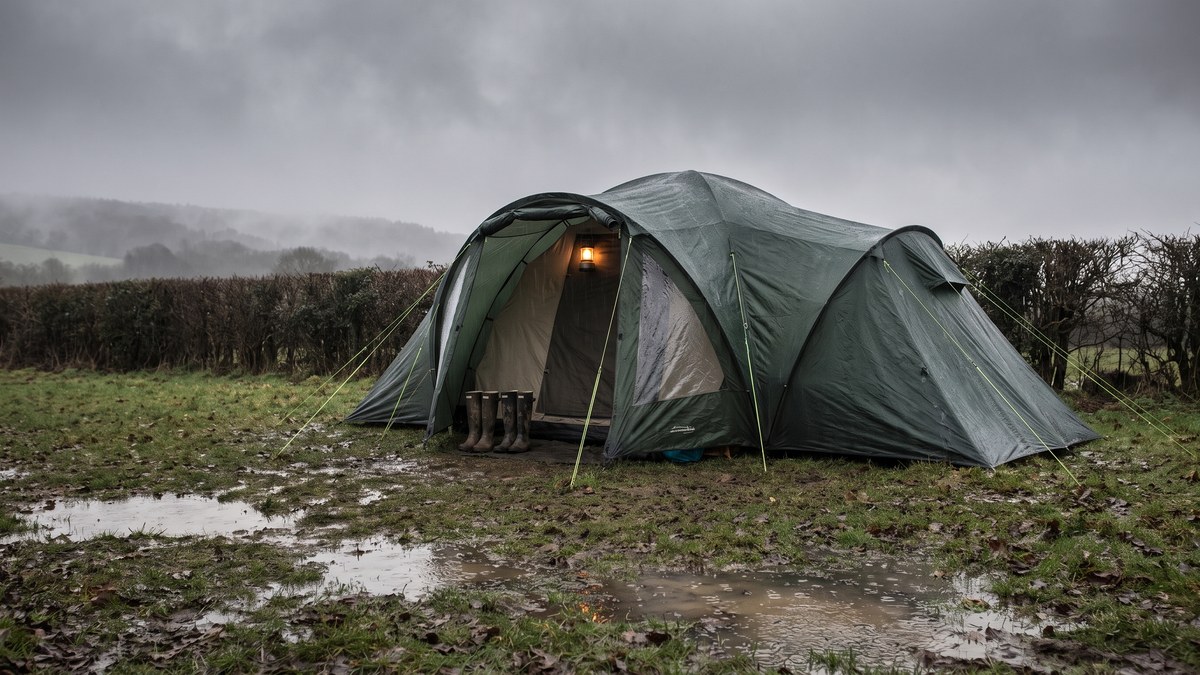
Staying dry in UK rain comes down to three things: a flysheet that is genuinely waterproof rather than water-resistant, a pitch on ground that drains, and one set of clothes per person that never gets wet because it stays sealed in a dry bag until bedtime. Before you blame the tent, work out whether you are looking at a leak or at condensation, because most reports of a leaking tent are the latter or an inner touching a wet fly. And unless there is an amber Met Office warning or your pitch sits on a flood plain, the honest answer to whether you should cancel is usually no.
- Should you cancel? An honest go or no-go check
- Check your kit is waterproof, not water-resistant
- Arriving in a downpour: the order of operations
- Leak or condensation, and the fixes that do not work
- Dry zones, cooking, power and awnings
- Dry everything within 48 hours of getting home
- Frequently Asked Questions
- Related Reading
You are standing in a field with a wet phone at 4pm on a Friday, the forecast has not improved, and the question is not which tarp to buy. It is whether this is going to be miserable. Most guides to camping in the rain are written from the shop side of the counter: check the forecast, buy a tarp, bring dry bags, dry the tent when you get home. All true, all repeated everywhere, and none of it answers what people actually want to know.
This guide takes the other side. It gives you a straight go or no-go answer on whether to keep the trip, the numbers behind the word waterproof and what they mean for a flysheet against a groundsheet, the order of operations for pulling onto a soaked pitch, and the physical test that tells you at 6am whether your tent is leaking or just condensing. It covers electric hook-up in the wet, which none of the big UK guides mention, the caravan and awning case, which they all skip, and the things people try in the rain that simply do not work. Every recommendation here comes from kit we have reviewed ourselves, honest caveats included.
Should you cancel? An honest go or no-go check
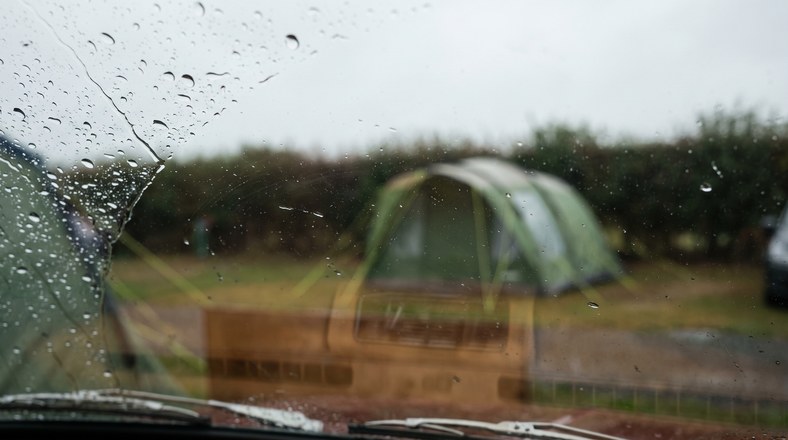
This is the question the guides skip, and the one people actually ask. A family in a UK camping group posted it almost word for word: first proper trip, a full week booked, rain forecast every day and thunder on pack-up day, should we just cancel? Every reply said go. They were right, but nobody explained where the line sits between a wet trip that becomes a good story and one that should not go ahead.
Rain on its own almost never ruins a trip
What ruins wet trips is a short list of failures the rain simply exposes. Go through it honestly before you cancel anything:
- The tent is not up to it. No taped seams, a low-rated flysheet, or a tent you have never once pitched. This is the big one, and the only item you cannot fix in a car park.
- There is no genuinely dry change of clothes. One full set per person, sealed in a dry bag or a bin liner inside another bag, not opened until bedtime. With that, a soaking at 4pm is an inconvenience. Without it, the trip is over.
- There is nowhere dry to sit except the sleeping compartment. A porch, an awning, a tarp, a gazebo or the site's covered area. Four people folded into a two-metre inner for six hours is what makes families sell the tent.
- Small children and no indoor plan. Fine if there is soft play, a museum, a farm park or a pool within half an hour. A real problem if the nearest indoor anything is an hour away.
Three of those four can be sorted this afternoon for very little, which is why most trips are worth keeping.
The genuine reasons to postpone
- An amber or red Met Office warning across your dates. Yellow warnings are common here and usually mean take care rather than stay home, so read what the warning is for. Amber is a different conversation, especially for wind.
- Wind stacked on top of the rain. Rain alone is an inconvenience. Sustained strong wind with rain snaps poles, drives water through fabric that would otherwise cope, and makes pitching or striking camp close to impossible. Gusts climbing towards 30 mph on an exposed site is a different trip, not a wet version of the same one.
- A pitch beside a river, on a flood plain, or at the bottom of a valley. Check the flood warning service for England, SEPA for Scotland or Natural Resources Wales against the postcode, then phone the site and ask which pitches drain. Reception staff know exactly which corner of the field turns into a pond.
- Thunderstorms on the day you strike camp. Not a reason to lose the week, but a reason to plan: pack everything except the tent the night before, then take it down early or sit the storm out in the car.
Everything else is negotiable. Ask whether the site has a hard-standing pitch you can move to, and if they run pods or cabins, one night mid-week is a reset that saves a holiday. If the tent is the weak link with no time to replace it, a night indoors for the children while you keep the rest of the trip beats cancelling the lot.
Check your kit is waterproof, not water-resistant
Only two of the seven guides we read mention hydrostatic head, and the one that gives a number says "at least 3,000mm" without saying where it came from. Hydrostatic head is the height of a column of water, in millimetres, that a fabric holds back before water is forced through it. A 3,000mm fabric holds back a three metre column in the test, and the higher the figure the longer the fabric resists sustained, driving rain rather than a passing shower.
The floor and the target are two different numbers
Roughly 1,500mm is the UK labelling floor: the point at which a fabric can be called waterproof at all. That is a floor, not a target, and a tent sitting on it will shrug off a shower and struggle with a wet weekend in Wales.
Our own recommendation, offered as a recommendation and not a standard, is a flysheet around 3,000mm or higher for any UK trip with a full wet day in it, and a groundsheet rated higher again. The gap matters more than the figures. A flysheet only sheds water running off it, while a groundsheet carries your body weight: knees, elbows and hips press down on saturated ground and force water up through the fabric at a pressure the roof never sees. That is how a groundsheet rated the same as the fly ends up damp under a sleeping bag while the roof above stays perfect.
Seams matter as much as the fabric number
Stitching drives thousands of needle holes through waterproof fabric, and taped or welded seams close them again. Untaped seams on a high-rated fabric leak long before taped seams on a modest one, so check construction before you compare figures. The same rule applies to what you wear:
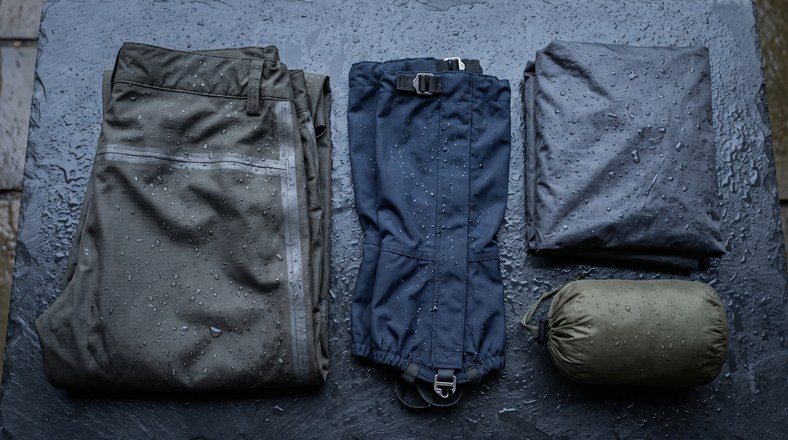
- Over trousers with numbers that stand up. The 33,000ft over trousers we reviewed are the one item in our kit list where the figures are properly good: 5,000mm, a TPU membrane, fully seam-sealed and welded. Our verdict was that they keep walkers dry while cyclists are less convinced, and the sizing runs long.
- Gaiters for the boot-to-trouser gap. Wet long grass soaks you from the ankle up. The Azarxis gaiters we reviewed are rated 6,000mm in 600D Oxford with a TPU instep strap and metal buckles. Measure your calf before ordering and read the sizing small print, because that is where buyers get caught out.
- A poncho for showers, not mountains. The Victoper poncho we reviewed is 210T ripstop polyester with a PU coating, rated PU3000mm, 217 x 143cm and 0.3kg, and its hem eyelets let it open out flat into a tarp or a groundsheet. Our review called it a budget rain layer rather than a mountain shell: right for showers and festivals, not half a day of Lake District rain. Weight the hem in wind.
- Spares with no rating at all. The CHGANG three-pack we reviewed is polyethylene with no hydrostatic head rating whatsoever, which is exactly why it belongs here. Scatter a pack through the car and the children's rucksacks. Our review is blunt that it is not a primary waterproof for anywhere with brambles, gorse or barbed wire.
The water-resistant tarpaulin trap
All seven guides say bring a tarp. Not one says which kind, and the difference decides whether you have a shelter or a puddle collector. A cheap builder's tarpaulin sold as water-resistant is not a rain shelter. Our own review of one turned up a cluster of buyers reporting leaks, including one who lost roof boards stored under it and another who watched rain come through onto a pallet of flooring. Water-resistant sheds a shower, waterproof holds a downpour, and the word on the listing is the tell.
Arriving in a downpour: the order of operations
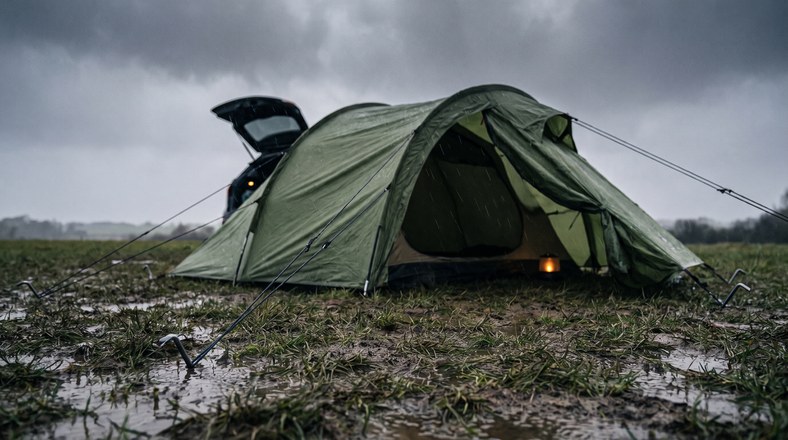
Nobody writes this bit down, so people improvise it in the rain and get it wrong. You have pulled onto a soaked pitch at 4pm on a Friday and it is hammering down. The order you do things in decides how much of your kit is still dry at bedtime.
- Stay in the car and get dressed for it. Waterproof trousers go on far more easily sitting down than standing in a gale, jacket next, hood up, boots on last with your feet outside the door.
- Walk the pitch with nothing in your hands. Two minutes, before anything leaves the boot. Find the high point, the old tyre ruts and pitch scars that channel water, and the dip that will be a puddle by 3am. On a well-used site the slightly yellowed, drier grass is usually the part that drains.
- Set the door direction now. Face it away from the prevailing wind so driving rain is not hitting the entrance every time somebody goes in or out. British weather usually arrives from the west or south-west, so east or south-east is a reasonable default.
- Put the shelter up before you unload anything else. This is the step people get backwards. Every bag stacked on wet grass while you hunt for the pegs is a bag you will be drying tomorrow.
- Peg out and tension properly the first time. A slack flysheet touching the inner wicks water straight through at the contact point, and that single fault is behind most reports of a leaking tent. Drive pegs at about 45 degrees, leaning away from the tent.
- Groundsheet or porch mat down, then bags in. Hold one back: the dry bag with sleeping kit and bedtime clothes, opened only once it is inside and you are out of your waterproofs.
- Set the boot line immediately. Boots come off at the threshold and live in the porch from the first minute. A dry zone agreed in the first five minutes holds all week; one introduced on day two never does.
- Then the tea. Stove under an open porch or a tarp, well away from fabric. A hot drink is what stops step four feeling grim, and it goes cold if you make it first.
Outer first or inner first? Check yours at home
Two of the guides tell you to pitch the outer first, as universal advice. It is not universal. It works on outer-pitch-first and all-in-one tents, which covers most tunnel tents and many family models. On an inner-first tent, where the inner clips to the poles and the fly goes over the top, it is impossible, and the person working that out in a downpour ends up with a soaked inner. Pitch your tent in the garden on a dry day before the trip and find out which you own, checking while it is up that the seam tape has not lifted, the zips run and the groundsheet has no pinholes.
Pegs and lines for softened ground
Wet ground grips a peg less, so length and quantity do the work. The KEPLIN steel alloy pegs we reviewed are 9 inch, 23cm galvanised skewers in a 50-pack, and that extra length is what holds when a pitch goes soft. Our review found they shine on soft ground and bend on stony or baked ground, so treat them as a wet-pitch peg and a bag of spares for the ones the mud swallows.
Fabric stretches once it wets out, so a flysheet drum-taut at five o'clock is slack by nine. Re-tension before bed, every night. The BHGWR guy ropes we reviewed come eight to a pack at 13 feet, about 4m each, with aluminium tensioners that take up slack in the dark without untying anything. The manufacturer admits the reflective coating is not effective in pitch black, so buy them as spare lines and tensioners visible under a head torch, not as a night-safety product.
Leak or condensation, and the fixes that do not work
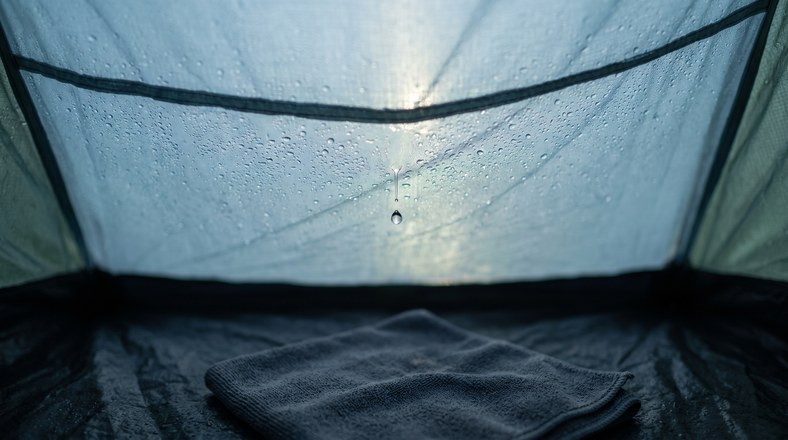
It is 6am, there is water inside the tent, and somebody is about to blame the tent. Every guide has a waterproofing section and a condensation section, and not one tells you how to tell which you are looking at. Most reports of a leaking tent turn out to be condensation, or an inner touching a wet flysheet and wicking through at the contact point. Diagnose before you spend anything.
The test, in four moves
- Look at where the water is. Fine droplets spread evenly across the whole inside face of the flysheet, heaviest on the roof and the coldest low panels, is condensation. Water concentrated in one place and running down from a specific point is a leak or a contact point.
- Do the wipe test. Wipe a patch of the inside of the fly dry. If it stays dry for several minutes and then mists over again, that is moisture coming out of the air inside. If a bead reappears in the same spot within a minute or two while it is raining, water is coming through from outside.
- Follow it to a source. Condensation has no source. A leak does: a seam, a pole sleeve, a zip, a peg-out point under tension, or a patch where the inner is pressed against the fly. Push the inner away from the fly there. If the wet patch stops growing, your problem is tension, not fabric.
- Ask whether it happened without rain. Water inside on a clear, cold night is condensation, with no exceptions. Everyone in the tent breathes out water all night, more rises from damp ground and wet kit, and the coldest surface available is the inside of the flysheet.
Check downwards too. A wet patch under your hips or where a bag sat, with a dry fly above it, is the groundsheet being pressed through or punctured, and that needs a barrier underneath rather than anything sprayed on top.
Fixes follow the diagnosis. Condensation wants airflow: high vents open all night even in rain, wet kit out of the sleeping compartment, nothing hung up to dry in there. A contact point wants tension, which is usually the entire fix. A real seam leak wants sealer on a dry seam at home, with tape as a field repair. Mop the fly before you knock the tent about in the morning, because banging a condensation-covered flysheet showers the inner and convinces everyone it leaks. The HomlyPro microfibre towel we reviewed suits that job at 180 x 90cm, packing to roughly the size of a water bottle in its carry bag, and it dries overnight on a wet pitch. Respect our review's technique note: pat, do not rub.
What does not work, whatever you have been told
- Reproofing spray on the wrong problem. Reproofing restores the water-repellent finish on the outside of a flysheet so rain beads and runs off. It does nothing for a groundsheet pressed through from below, and nothing for a leaking seam, which needs sealer on the stitching.
- An umbrella as rain gear. One source recommends one for exploring, with no caveat. On a flat, sheltered campsite walk it is fine. On exposed ground with any wind it inverts, drags you sideways, becomes a pointed object on a lever and costs you the use of a hand.
- Pitching under a tree. A tree is a windbreak, not a roof. It drips for an hour after the rain stops, harder and heavier than the rain itself, and it adds sap, bird mess and deadfall risk in wind. Pitch beside the tree line, not underneath it.
- Zipping every vent shut. It is the instinct and it makes the inside wetter. Sealing the tent traps everything you breathe out and condenses it on the fly, where it drips back on you. Rain through a vent is small, local and obvious. Condensation is the whole tent at once.
- Buying a bigger tent to stay drier. Volume is not waterproofing. Larger tents carry more seams, more zips, more panels that can touch and far more fabric to go slack when it wets out. A small tent pitched drum-taut with taped seams beats a badly pitched palace.
Dry zones, cooking, power and awnings
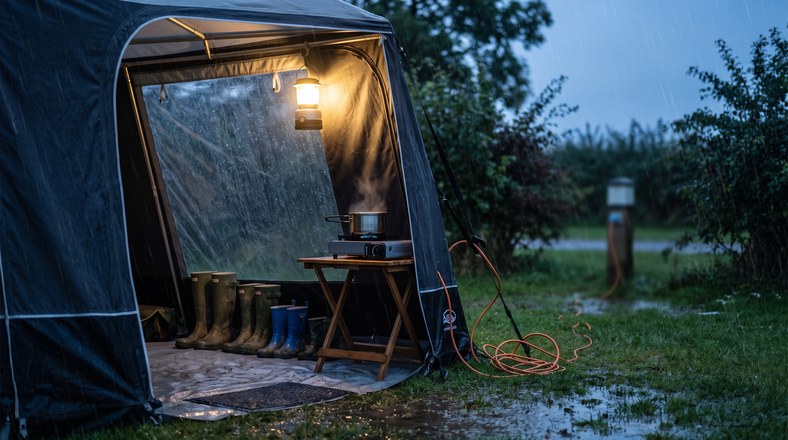
Once the tent is up, staying dry is about boundaries and airflow more than gear. Three zones, agreed out loud on the first evening: outside, the wet zone in the porch or awning, and the dry zone you sleep in. Waterproofs get hung rather than dumped, because a pile of wet kit stays wet all week, and boots never cross the line. Give the wet zone a floor. The GUSUWU ground mat we reviewed is 200 x 200cm with an Oxford-cloth top and a PVC-coated waterproof backing at 1.3kg, and our review's framing is right: a big waterproof groundsheet rather than a fluffy rug. Air it for a day first, as it arrives with a packaging smell.
Cooking, and the one rule with no exceptions
Never cook inside a tent, and that includes a zipped-up porch. Stoves produce carbon monoxide, which you cannot see or smell, and it builds fastest in the enclosed space that feels most appealing in a downpour. Cook under an open porch with real airflow to outside, or better, under a tarp away from the sleeping tent. An unshielded burner in a crosswind also takes twice as long to boil and blows out repeatedly, which is why the Odoland stove we reviewed suits a wet porch: a 3,500W foldable windproof unit in a hard case, with piezo ignition and an adapter for EN 417 butane and butane-propane canisters. Most campers rate it and a minority received a bad unit, so light it in the garden first and keep a lighter in your pocket.
Wet evenings are long and dark. The Blukar lantern we reviewed runs 116 LEDs across seven modes from a 4,800mAh USB-C battery, for 10 to 48 hours depending on mode, in a warm white 3000K with hooks and carabiners for hanging. One caution: it carries no IP or water rating at all, so treat it as an inside-the-tent or inside-the-awning light, never something to hang from a guyline in the rain. A minority report charging problems, so test it before you go.
Electric hook-up in the wet
Not one of the seven guides mentions hook-up, which is the most safety-relevant part of a wet UK pitch.
- Uncoil the whole cable. A lead left wound on its drum while carrying current heats up inside the coil. Run all 25 metres out even if the bollard is 10 metres away, in loose loops rather than a tight pile.
- Keep both ends out of standing water. The bollard end usually sits at height; the van or tent end is the one people leave lying in wet grass. Put it on a step, a crate or a box, inside the awning.
- Know what IP44 means. A typical UK hook-up lead is rated IP44: splash resistant, not submersible. A puddle is not a splash. The Xtremeauto 25m lead we reviewed is a 240V, 16A cable with EN 60309 commando connectors, 1.5mm² conductors and an IP44 rating. Our review is blunt that 1.5mm² is thin over 25 metres: fine for modest loads, but pay the premium for a 2.5mm² lead if you want to run heavy appliances.
- Respect the pitch supply. Plenty of UK sites give 6A or 10A rather than 16A. Six amps is roughly 1,400W for everything you own, which a single fan heater swallows whole before tripping the bollard, usually in the dark. Kettle or heater, not both.
- Make the judgement call. A churned, muddy pitch with water standing on it is the wrong place to improvise a heater setup. If you cannot keep the connections dry and off the ground, do not run one.
Caravans, campervans and awnings
All seven guides are tent-only, which leaves out a large slice of wet-weather UK camping. With a hard shell the picture changes:
- The awning is an airlock, and your biggest advantage. It gives you a room you are allowed to be wet in. Waterproofs, boots and the dog stop there, and nothing wet goes through the inner door.
- Put a floor down. Many UK sites require breathable awning groundsheets to protect the grass, and bare turf under an awning turns to mud within a day of steady rain.
- Condensation is worse in a hard shell, not better. Metal and fibreglass are cold surfaces with no breathable inner between you and them, so moisture collects on windows, in lockers, behind cushions and under mattresses. Prop the mattress up each morning, keep a roof vent open even in rain, and run the extractor when you cook.
- Use the 230V properly. A dehumidifier or a low fan heater running while you are out does more than any amount of wiping, and it is the one thing tent campers cannot do. Dry kit in the awning, not the living space, or you are moving water out of your coat and into your bedding.
Dry everything within 48 hours of getting home
Wet packing is unavoidable. Wet storage is a choice, and it is the one that ends tents. The club guide tells you to dry your kit and stops there, so here is what is actually happening and how long you have.
Two things happen to a tent packed away wet
- Mould. The spores are already on the fabric. Give them warmth, darkness and moisture and they colonise it. The black speckling that results does not wash out, it stains permanently, and the growth degrades the coating underneath as it spreads.
- Hydrolysis. The polyurethane coating on the inside of a flysheet and on a groundsheet breaks down in the presence of water, going tacky and sticky before it flakes off. Once a coating has gone tacky it is finished, and no reproofing spray brings it back. This is what turns a good tent into a bin job in one wet summer.
The timeline is days, not weeks. In warm weather a wet tent rolled in its bag can smell musty within about 48 hours, and visible growth can appear inside a few days. Treat 48 hours as the deadline and 24 as the target.
Pack up so the drying is easier
If your tent separates, get the inner out and bagged while it is still the driest thing there. Shake and sweep as much surface water off the flysheet as you can before rolling it, and bag the wet fly separately rather than letting one wet item soak three dry ones. Muddy pegs go in their own bag, never loose with fabric.
What to do when you cannot pitch it in a garden
This is the part every guide leaves out, and it is the situation most people are in. You do not need a lawn:
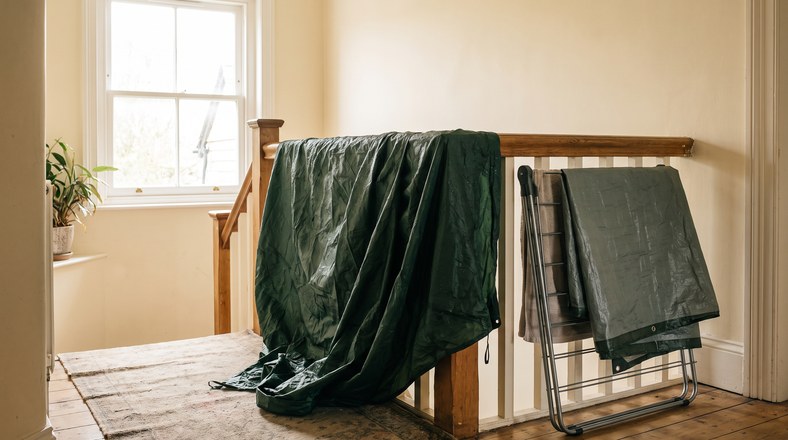
- Over the bannister. The best indoor drying frame most houses have. Flysheet over the rail, inner over the landing rail, turned after a few hours so the folded edge gets its turn.
- Over a clothes airer, or two pushed together in a spare room with the door shut and the window on its vent setting so the moisture has somewhere to go.
- In a garage or car port, hung over a rafter or a beam. Cold air is fine. Still, enclosed and damp is not, so leave the door open a few inches or run a fan on low.
- One component at a time. This is the answer for a flat with no outdoor space, and it is why the job feels impossible when it is not. Dry the flysheet first, because it carries the coating that matters most, then the groundsheet, then the inner, then the bags and pegs. Three evenings of one item each beats a tent that sits rolled up for a fortnight while you wait for a free Saturday.
- Pitch it in the garden on the first dry, breezy day even if that is weeks later. Moving air does far more than sunshine.
Put nothing away until every panel is dry to the touch on both sides, including guy lines, the peg bag and the pole ends, because the piece still holding water is always the one rolled in the middle. Store the tent in a breathable bag rather than a sealed plastic box, somewhere that does not freeze and is not a baking loft.
Frequently Asked Questions
Should we cancel our camping trip if it is forecast to rain all week?
Almost always no. Rain on its own is an inconvenience rather than a trip-ender, and a British forecast a week out is rarely accurate enough to cancel on. Postpone for an amber or red Met Office warning across your dates, for sustained strong wind stacked on top of the rain, or for a pitch on a flood plain or beside a river. Otherwise the honest checklist is short: is the tent genuinely up to it, does every person have one dry set of clothes sealed away, is there somewhere dry to sit that is not the sleeping compartment, and is there an indoor option within half an hour for the children? Three of those four can be fixed the afternoon before you leave.
What hydrostatic head do I need for camping in UK rain?
Roughly 1,500mm is the labelling floor in the UK, the point at which a fabric can be called waterproof at all. That is a minimum, not a target. Our own recommendation for British conditions is a flysheet around 3,000mm or higher with a groundsheet rated higher again, because a flysheet only sheds water while a groundsheet has your body weight forcing water up through it. Check the seams as carefully as the number: stitching puts thousands of needle holes through waterproof fabric, so untaped seams on a high-rated fabric will leak before taped seams on a modest one.
Why is the inside of my tent wet when it has not rained?
That is condensation, and it is not a fault. Everyone in the tent breathes out water overnight, more rises from damp ground and off wet kit, and it condenses on the coldest surface available, which is the inside of the flysheet. Tell it apart from a leak by the pattern: condensation forms an even film of fine droplets across whole panels, while a leak concentrates in one place and tracks down from a seam, a zip, or a point where the inner is touching the fly. The fix is airflow, not waterproofing. Keep high vents open all night even in rain, keep wet kit and cooking out of the sleeping area, and wipe the fly down with a microfibre towel before you start moving the tent about in the morning.
What happens if I pack my tent away wet?
Two things, and both are expensive. Mould colonises the damp fabric in the dark, leaving black speckling that stains permanently and degrades the coating as it spreads. More seriously, the polyurethane coating on the flysheet and groundsheet hydrolyses in the presence of water and goes sticky and tacky before flaking away, at which point the tent is beyond saving. The timeline is days rather than weeks: a wet tent left rolled in warm weather can smell musty within about 48 hours. If you have no garden, dry it indoors over a bannister, over a clothes airer in a room with the window vented, or from a garage rafter, and do it one component at a time if you have to.
Related Reading
- How to Pitch a Tent in Strong Wind: UK Step-by-Step
- How to Stay Warm in a Tent UK: 6 Steps
- What to Pack for Festival Camping: The UK Checklist That Survives a Muddy Weekend
- 33,000ft Waterproof Over Trousers review
- KEPLIN 9-Inch Tent Pegs review
- Xtremeauto 25m Hook Up Cable review
Disclaimer: This article contains Amazon affiliate links. We may earn a small commission from qualifying purchases at no extra cost to you.