
Portable Power Station for Campervan UK: The 500W Line That Decides It
We earn commission from qualifying Amazon purchases. It costs you nothing and does not affect what we recommend.
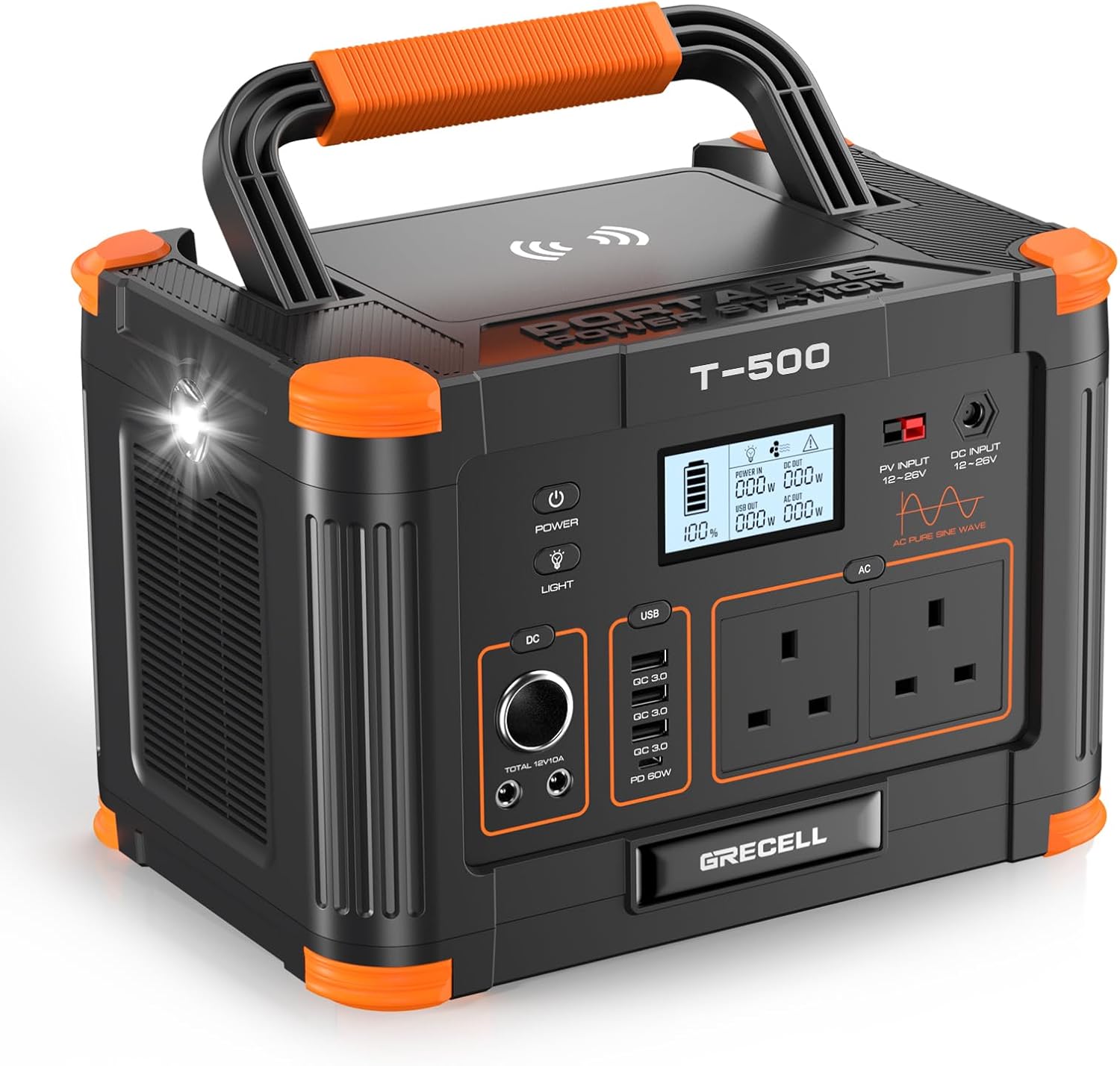
It weighs 6.4kg, fills two UK three-pin sockets and vanishes under a van seat. The catch is a number GRECELL prints on its own warning label: 500 watts. Cross that line and this power station taps out, whatever the box says about a 1000W peak.
- What 519Wh Actually Runs on a Weekend Off Grid
- The 500-Watt Rule, and the Reviews Written for a Bigger Battery
- Solar, Car or Mains, Plus Charging While You Use It
- Left in the Garage for Months, Still Reads 100%
- The Light, the Fan, and One Review Warning Worth Reading
- The Verdict: Strong Value, One Firm Ceiling
Ask which portable power station suits a campervan and most van-life blogs hand you a lifestyle photo and a shopping list. The more useful answer is a single number. The GRECELL T-500 is rated for 500 watts of continuous output, and that figure decides whether it belongs in your van or wastes your money. Stay under it and you get a 6.4kg box that runs a compressor fridge, a CPAP machine, lights and every device you own across a weekend off grid. Reach past it for a kettle or a coffee machine and it cuts out, whatever the box says about a 1000W peak.
The listing wears a 4.6-star badge from 198 ratings. We do not test these units ourselves; we read the 100 most recent reviews, and those average 4.78. Two caveats sit behind that number. Only 23 of the 100 came from UK buyers, and that British slice averages a steadier 4.6. And Amazon pools this page with the larger GRECELL T-1000 (999Wh, 1000W), so many of the glowing "runs my coffee machine" write-ups describe a bigger battery than the one you would be buying. Filter for the T-500 owners and it still holds up, with one clear ceiling. Our score: 4.4 out of 5.
What 519Wh Actually Runs on a Weekend Off Grid
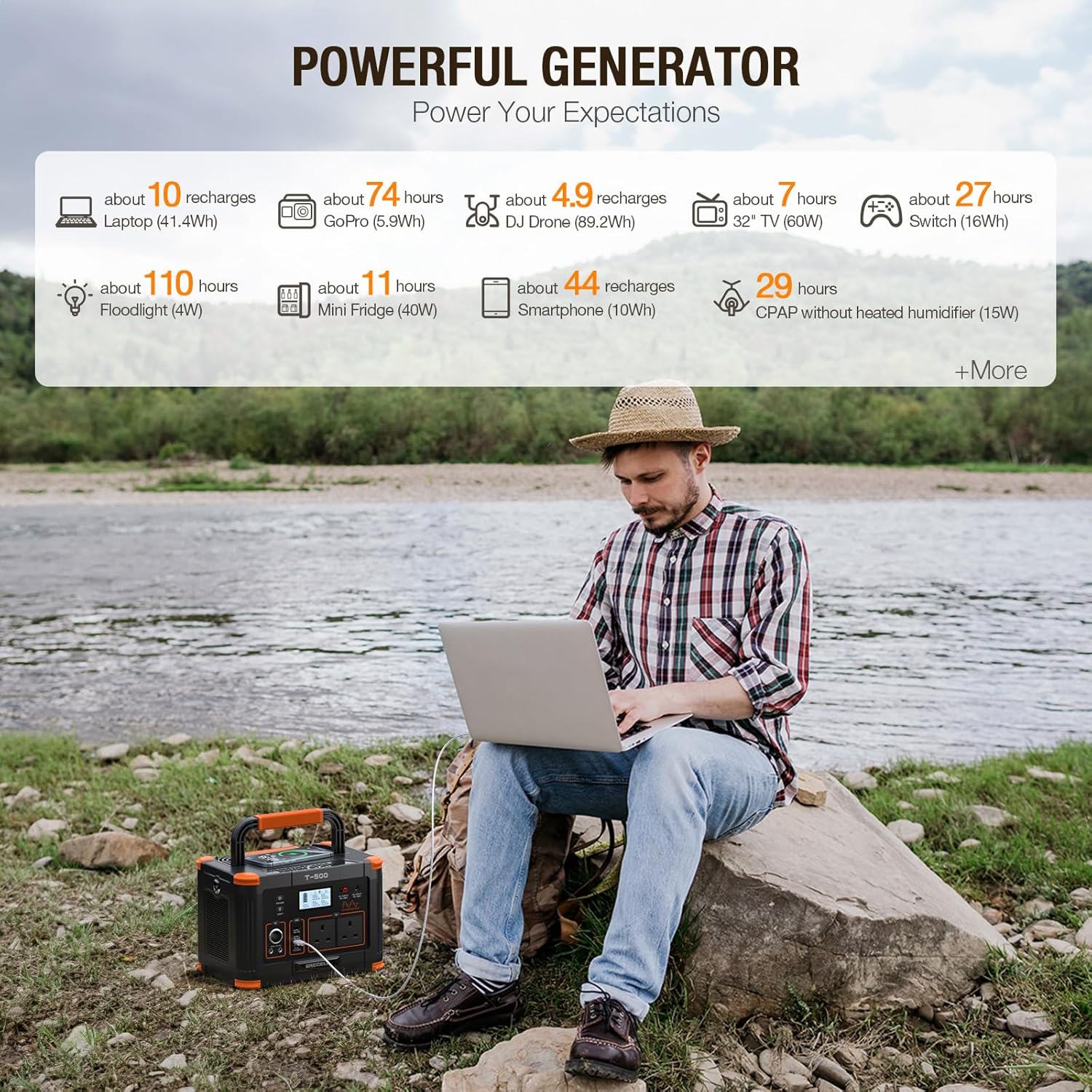
Capacity is 519Wh, or 140400mAh, which is the figure that sets how long a real campervan load lasts. GRECELL's own runtime chart puts that in plain terms: about 44 phone recharges, roughly 10 laptop recharges, around 11 hours for a 40W mini fridge, about 7 hours on a 32-inch TV, and about 29 hours running a 15W CPAP machine without its heated humidifier. A 4W floodlight will idle along for something like 110 hours. Those are the numbers that matter more than the wattage on the lid.
The port count is what makes it useful in a van. You get two UK three-pin pure sine wave AC sockets (230V, 500W total), three USB-A QC3.0 ports at 18W, one USB-C PD port at 60W, two 12V/5A DC outputs, a 12V/10A car port and a 10W wireless charging pad on the top, up to 10 devices at once. UK buyers use it exactly as you would expect. Robert Hood (5 stars) runs a compressor fridge in his motorhome; Jamie-lee King (5 stars) reports "charging my phone and powering my tv and xbox at the same time"; and judith (5 stars) keeps it for the TV in her motor home. Stringer G (5 stars) sums up the appeal: "good battery life and compact design plenty of ports."
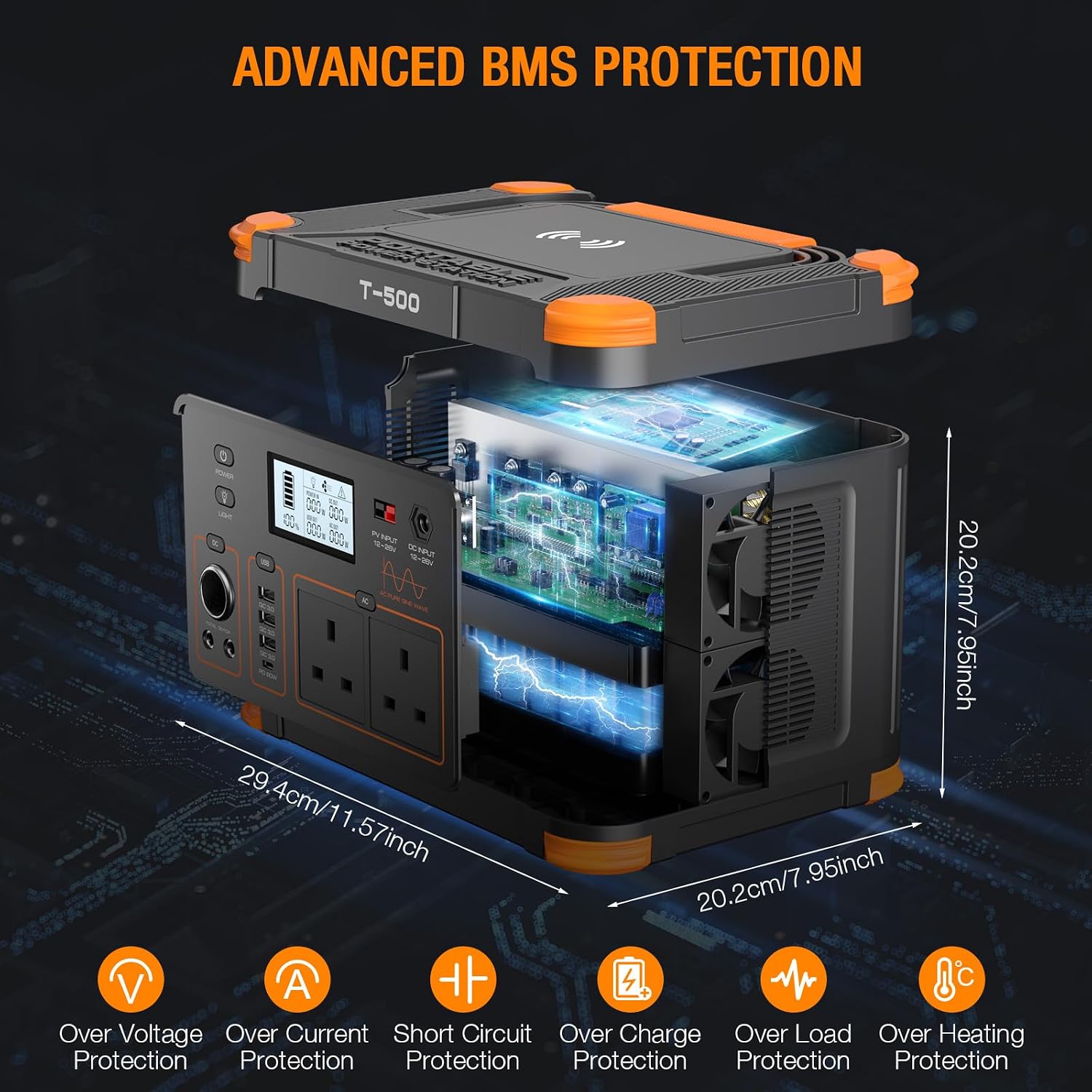
Physically it is easy to live with. It measures 29.4 x 20.2 x 20.2cm and weighs 14.1 lbs, about 6.4kg, so it slides under a van seat and lifts with one hand. Two internal fans handle cooling.
The 500-Watt Rule, and the Reviews Written for a Bigger Battery
Here is the line that decides everything. The T-500 is rated at 500W continuous with a 1000W peak for surge, and GRECELL prints the warning itself: do not power devices rated above 500 watts, and switch the AC output off when idle or it will slowly flatten the battery. Cross the line and the unit protects itself and shuts down.
This is exactly where the pooled reviews mislead. The buyers raving about running a 750W water pump, an 800W kettle or a 900W coffee machine are almost all describing the 999Wh T-1000, not this 519Wh model. Read them as evidence for a different battery. The UK reviewer who got the T-500 right is Mr B. (5 stars), who lists what actually fits inside 500W: "a small low wattage kettle cup, a heated lunch box and even an electric blanket" alongside USB charging. One German owner of the bigger unit found even a 760W coffee machine cut out after a minute or two on startup surge, and another had a 1300W-surge machine trip the cutoff. Marco (1 star, Germany) goes further and calls the gap between the 1000W headline and the 500W usable limit misleading. For the T-500 there is no ambiguity to argue about: plan for 500W of continuous draw and you will be fine.
Protection is handled by the BMS, which covers over-voltage, over-current, short circuit, over-charge, over-load and over-heating, the six guards GRECELL lists on the case cutaway. That is why an overload trips a clean shutdown rather than damaging anything.
GRECELL T-500 Portable Power Station (519Wh)
Light, quiet, UK three-pin power for a weekend off grid, as long as your loads stay under 500 watts.
Solar, Car or Mains, Plus Charging While You Use It
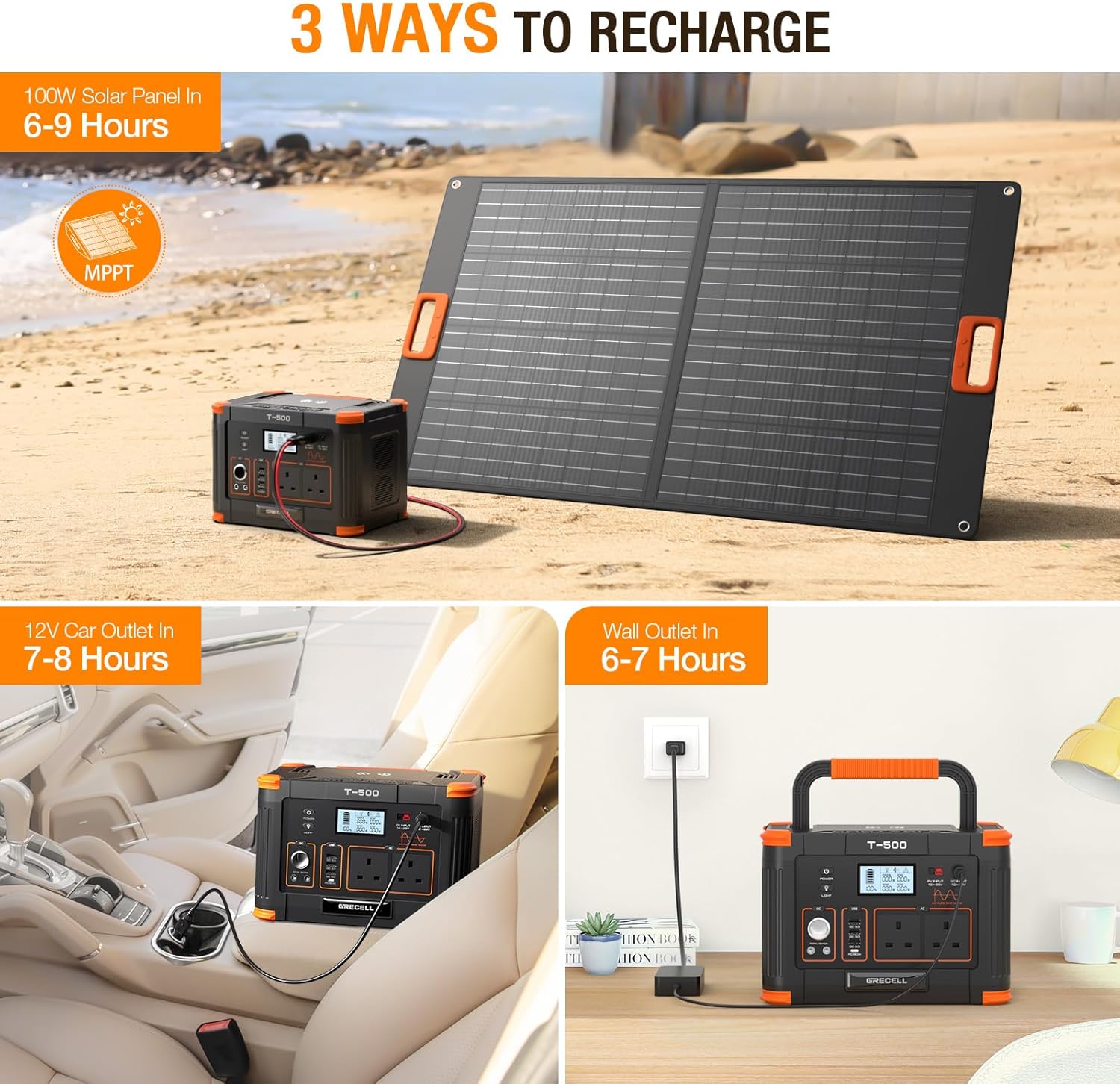
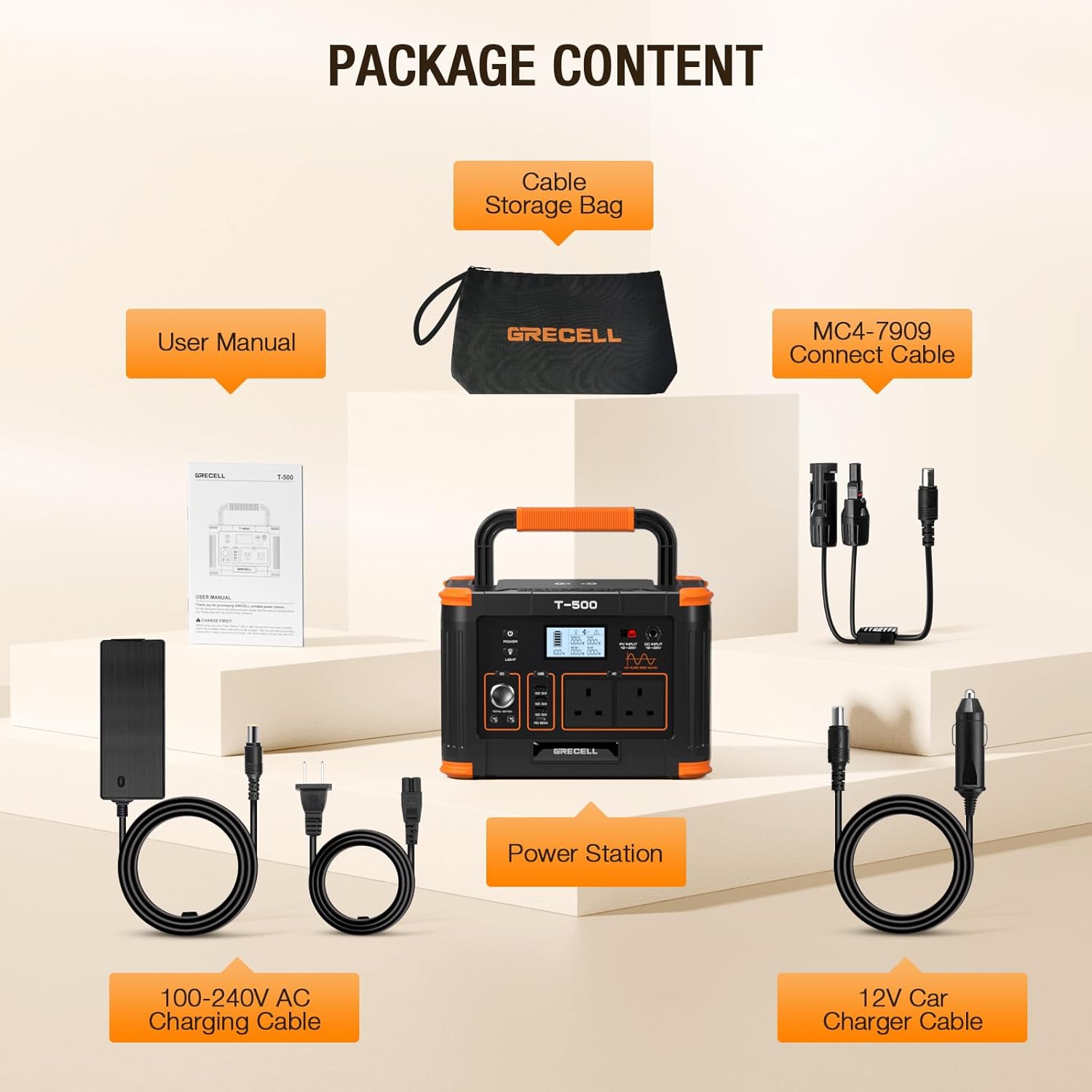
There are three ways to refill it, and the listing images give the times. A 100W solar panel takes 6 to 9 hours through the built-in MPPT controller, a 12V car outlet takes 7 to 8 hours, and a wall socket takes 6 to 7 hours. It also supports pass-through charging, so you can top it up while it powers your gear, useful when a fridge needs to stay on while the sun does the work. The panel is not included, and the AC lead, a 12V car lead and an MC4-7909 solar connector cable are.
Recharge speed is the most repeated gripe in the recent reviews. Around five of the 100 single it out. Christian Scholz (4 stars) measured 8 hours on a 150W panel and said he would not buy again for that reason, and even norge717 (5 stars), happy with the unit overall, lists the longer charge time as a con. For a van the fix is the one Lorna (5 stars) spells out: "if your going for long long get the solar panel as well."
One caveat for British trips: those solar times assume full sun. Under UK cloud you should expect noticeably less. One German buyer reported pulling only 70 to 80W from a 100W panel even in good light, so a realistic day of patchy spring sun will not deliver a full charge on solar alone. Treat solar as a top-up and the car or mains lead as your real refill on a weekend away.
Left in the Garage for Months, Still Reads 100%

The single best trait for a van that sits between trips is how little charge it loses doing nothing. bambigirl (5 stars) bought hers as a campervan backup and left it in the garage: "It's been sat in the garage for a couple of months and has retained its full 100% power." A German owner went much further, storing his for 17 months and finding it still showed 100%. If your van only comes out on weekends, that matters more than a headline wattage.
The reason for both the low standby drain and the keen price is the chemistry. This is an NMC lithium pack rather than the LiFePO4 cells the premium brands now fit, and reviewers notice the knock-on effects: no app, no Bluetooth, a simpler unit. The trade-off is real and worth understanding. NMC is lighter and cheaper and it is proven, but it is generally rated for fewer charge cycles, broadly 500 to 800, against the 3000-plus often quoted for LiFePO4. The counterpoint is in the reviews too: one German buyer's unit degraded and became unusable after about two years and only 50 to 60 charge cycles, which is an early death by any measure. Three of the 100 recent reviews describe a unit that failed or died early, so it is not the common outcome, but it is not nothing either.
For its intended job, an off-grid backup and a weekend leisure battery, that balance leans in the buyer's favour. Jan Nott (5 stars) calls it "perfect for our campervan," and the use cases GRECELL leans on, RV travel, camping, CPAP and home blackouts, line up with how UK owners actually use it.
The Light, the Fan, and One Review Warning Worth Reading
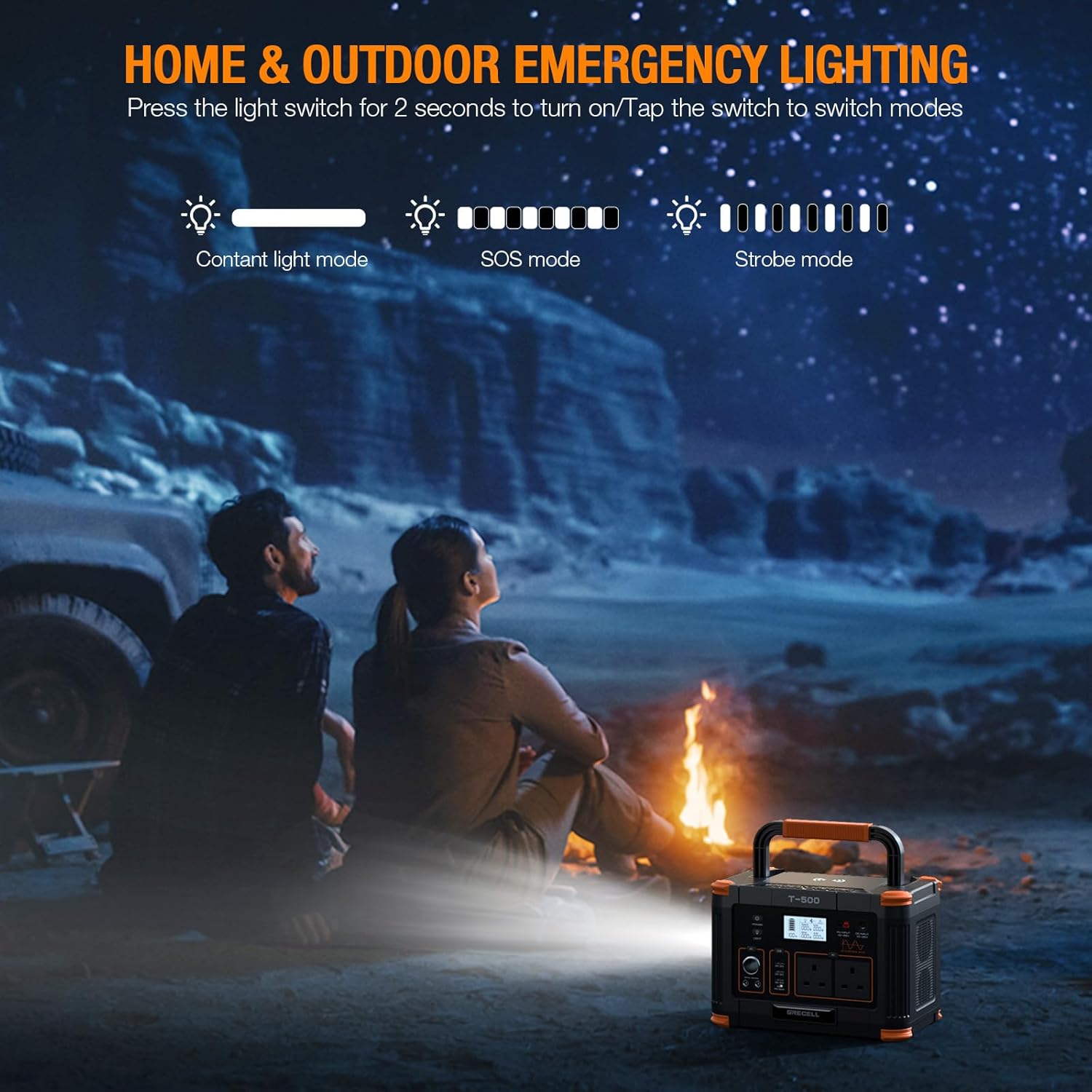
A few smaller things are worth knowing before you buy. In the plus column, there is a built-in LED flashlight on the side with constant, SOS and strobe modes, the sort of detail you appreciate at 2am hunting for the fridge switch in a dark van.
The fan splits opinion. A handful of German owners find it loud, one comparing it to the hum of a fridge and Marco calling it too noisy for a bedroom, while a larger group describe it as very quiet or, in one case, silent, noting it only spins up under heavier draw and often stays off while charging. Expect a low hum when you pull real power and near silence for phones and lights. The battery gauge is the other quirk: several owners say the percentage gets vague below 30% and the last stretch drops quickly, and the screen dims until you press a button. On controls, J. R. Gibson (5 stars) notes the buttons "need... to try... once or twice and hold down," then work smoothly.
One review deserves a flag. Marco (1 star, Germany) alleges the seller posted a note offering a 30 euro Amazon voucher in exchange for a five-star review. We cannot verify that, and it is a single claim, but with 90 of the 100 recent reviews sitting at five stars it is worth weighing. So are the failures UK buyers report: Wobijo (1 star) had a unit that "repeatedly turned itself off" powering a 60W coolbox before draining flat in hours, and Thomas Phillips (2 stars) found the AC ports dead after a single use. A small number, but real.
The Verdict: Strong Value, One Firm Ceiling
For the right buyer, yes, and comfortably. The 100 most recent reviews average 4.78, the 23 UK reviews land at 4.6 in line with the lifetime badge, the biggest single complaint (recharge speed) shows up about five times in 100, and clear failures three times. That is a strong record with one firm boundary. Our verdict is 4.4 out of 5.
Buy it if your off-grid loads stay under 500W: a compressor fridge, lights, phones, laptops and tablets, a TV, a CPAP machine and the wireless pad, all covered by 519Wh and two UK three-pin sockets. You are paying well below the big names for pure sine output and a unit that holds its charge between trips. joyous (5 stars) researched it against a Jackery and found this came out ahead in "not scientific tests just everyday tests by normal people" for less money, and bambigirl says it gives the big names a run for their money at a fraction of the price. Worth noting from the box shot: it now ships with a GRECELL storage bag for the leads, the one thing an earlier UK buyer wished it had. You can check today's price on Amazon before you decide.
Look elsewhere if you want to run a kettle, a coffee machine or a hairdryer, or if you want LiFePO4 longevity and an app. That is a different class of unit: step up to a 1000W-plus model such as GRECELL's own T-1000 or a Bluetti, Jackery or EcoFlow at higher cost. But for a campervan owner who respects the 500-watt line, the T-500 is a lot of usable power for the money.
GRECELL T-500 Portable Power Station (519Wh)
Light, quiet, UK three-pin power for a weekend off grid, as long as your loads stay under 500 watts.