Can I pitch a tent after dark in October UK: yes, if three things line up
Once the clocks go back on 25 October, anyone leaving work at five and driving to a campsite arrives in the dark for the first time that year. Whether that is fine or a bad idea comes down to three checks you can make before you leave the car park.
We earn commission from qualifying Amazon purchases. It costs you nothing and does not affect what we recommend.
Quick answer
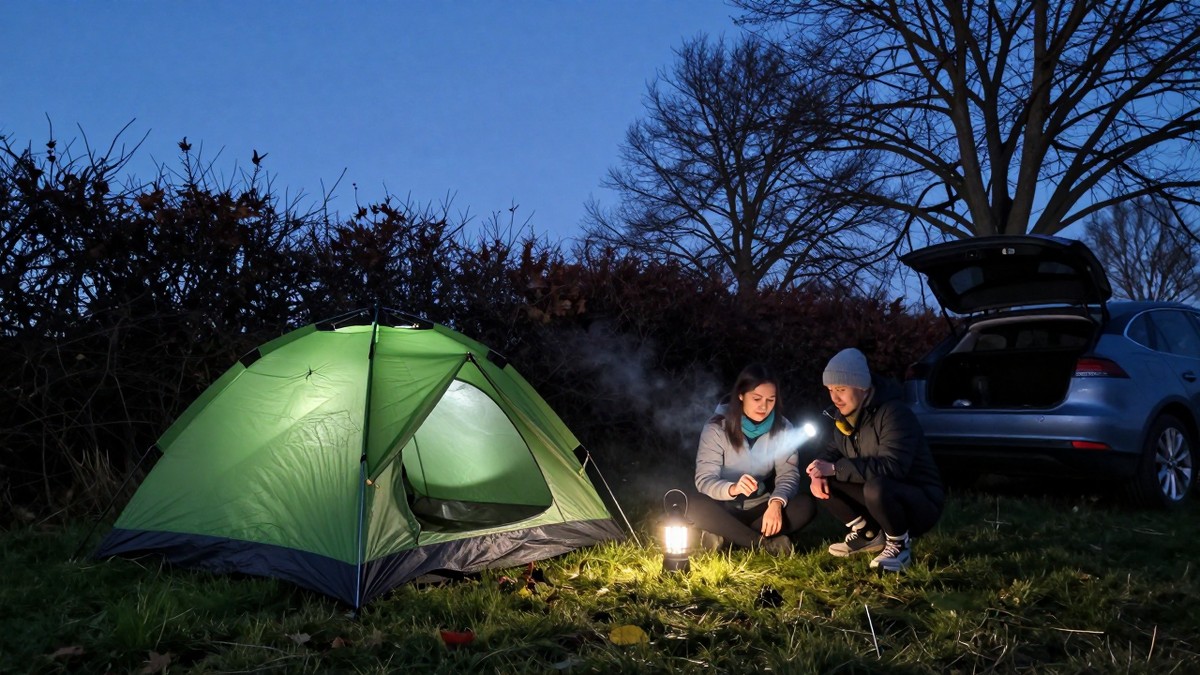
Can I pitch a tent after dark in October UK? Yes, usually, if three things line up: the campsite takes late arrivals and you have phoned to confirm, you have pitched this particular tent before in daylight, and you have a head torch plus a second light. From the clock change on 25 October, an after-work arrival means pitching in the dark.
What decides it before you leave the office
It is ten to five on a Friday in late October, the site is two hours away, and the choice is between pitching by torchlight tonight or losing Saturday morning to the motorway. The date does not settle that. Three conditions and two forecasts do.
The site will let you in. This is the one that catches people, and it has nothing to do with skill. Some UK sites close reception at six and lock a barrier, some leave your pitch number and a code in a late-arrivals box, and a few refuse anyone after nine or ten. Nearly all have quiet hours from ten or eleven. Websites go stale once the season winds down, so phone and ask: latest arrival time, how you get through the barrier, which pitch you are on.
You know this tent. Pitching after dark is pitching in daylight with no way to check anything by looking. Fine when your hands know which pole goes in which sleeve; miserable if the tent is new, borrowed, or has not left its bag since June. If you cannot picture the sequence from memory, put it up in the garden this week or leave at dawn.
Hands-free light and a second source. Every step of a pitch needs both hands, so a head torch is the minimum. The second source is a lantern, or the car with the boot open and the interior light on: a lit working area rather than one moving beam.
How much light you will actually have on arrival
These times are approximate, rounded to five minutes. West is later than east: Cornwall and west Wales see sunset fifteen to twenty minutes after London. Latitude barely matters in October; Edinburgh and London stay within ten minutes of each other all month.
| Date | London sunset | Edinburgh sunset | Usable light ends |
|---|---|---|---|
| 1 October | about 18:40 | about 18:45 | about 19:15 |
| 15 October | about 18:10 | about 18:15 | about 18:45 |
| Sat 24 October | about 17:50 | about 17:55 | about 18:25 |
| Sun 25 October (clocks go back) | about 16:45 | about 16:50 | about 17:20 |
| 31 October | about 16:35 | about 16:40 | about 17:15 |
The last column is the end of civil twilight, roughly 30 to 40 minutes after sunset in October and longer further north. Up to that point you can still read a slope and spot a puddle; after it the pitch is a torch job. Heavy cloud, a valley floor or a tree line brings it forward by ten or fifteen minutes, so on a grey evening treat sunset as the deadline.
The arithmetic is the same as working out how late you can finish a hike before sunset: the time you will honestly leave, plus the drive and one stop, against the usable-light column. Arrive after it and you plan for a dark pitch. Within twenty minutes either way, the cloud decides, and it usually decides against you.
Weather and the ground
Wind changes this decision more than darkness does. Pitching in a strong wind is hard when you can see the fly filling; doing it blind, with guy lines you cannot find, is the worst version of the job. If the forecast for arrival time shows gusts well into the thirties, read our guide to pitching a tent in strong wind and be honest about whether dawn is the better call. Rain alone is manageable; with an inner-first dome the inner gets wet while you fit the fly, unpleasant rather than dangerous.
Then the ground. By seven on an October evening the grass is soaked with dew. After a wet week the lowest corner of a grass pitch is where water sits, and in the dark a dip reads as flat; after a dry spell on a stony site, wire pegs stop dead or bend. When you phone, ask whether the pitch is grass or hardstanding and whether they have had much rain. The answer tells you which pegs go on top of the bag.
September to November, month by month
September: the practice month
London sunset falls from about 19:45 to about 18:40 across September, roughly a quarter of an hour a week, so a five o'clock start and a two-hour drive still lands in daylight until the last week. If you have never pitched your tent in the dark, do it on purpose now, while a mistake costs nothing.
Early October: dusk arrivals
Up to the clock change, sunset drifts from about 18:40 down to 17:50. A seven o'clock arrival is a dusk pitch at the start of the month and a full torch pitch from the middle. Many sites move to off-season reception hours around now, often earlier than their website says, so the phone call matters more than it did in August.
The clock change weekend: the whole story
The clocks go back at 02:00 on Sunday 25 October 2026. Saturday's sunset is about 17:50 in London; Sunday's is about 16:45. Nothing else in the year moves the evening by an hour overnight, which is why the Friday drive that was fine on 16 October is fully dark on 30 October. It is also half-term week for many English and Welsh schools, so sites that stay open are busier and quiet hours are enforced. From here on an after-work arrival is a dark pitch; our head torch timing guide covers what that does to the rest of your kit.
November: dark before you leave work
Sunset is about 16:30 at the start of November and around 15:55 by the end, so it is dark before most people have left their desk. Many sites close for the season at the end of October, and those that stay open often run on a code at the gate. A dark pitch in November is doable, but if you are not already fluent at it, book hardstanding with 24-hour access or drive on Saturday morning. The long evenings return when the clocks go forward on 28 March 2027; by mid-April London sunset is around 20:00.
Pitching by torchlight, step by step
Expect this to take about ten minutes longer than a daylight pitch for a two-person tent, and more for a family tunnel.
- Phone the site that afternoon. Confirm the late arrival, get the barrier code, pitch number and where to park, and ask when quiet hours start. If the barrier shuts before you can make it, stop here and switch to the dawn plan.
- Pack so the tent comes out first. Tent, poles, pegs, mallet and footprint go in the boot last. Before you leave home, open the pole bag and count; a missing pole at nine at night has no fix in a field.
- Head torch on before you open the car door. Lowest white setting or red mode for walking through the site, full white for the pitch. A rechargeable model with a usable low mode, such as the Blukar rechargeable head torch, is the sort of thing that lives in the door pocket from October onwards. Park so that neither headlights nor open boot point at anyone else's tent.
- Walk the pitch first. Cross it slowly with the torch angled low, which throws dips and stones into shadow. Look for standing water, holes and your neighbours' guy lines, which will be closer than you expect. On a slope, lay a water bottle on its side: it rolls downhill and tells you where your feet go.
- Footprint down, door away from the wind. Face the wind to find it, then lay the footprint so the door sits on the sheltered side, low end of any slope at the feet. Weight it with the peg bag while you unroll the tent.
- Peg the corners first, then poles. Inner-first dome: peg the inner corners, fit the poles, throw the fly over. Tunnel or all-in-one: peg the windward end, feed the poles, then work away from the wind. Pegs go in at about 45 degrees leaning away from the tent. If one stops dead in the first few centimetres, move it a hand's width rather than hammering, and on stony ground swap to steel pegs like the Blue Diamond hard ground pegs before you bend the set.
- Guy out every line, and make them visible. All of them, not just the windward side, because you will not see the wind swing round at two in the morning. Tension until the fly is taut, not straining. Guy lines are the trip hazard of any dark campsite, so reflective guy ropes earn their place here more than anywhere.
- Check before bed and again at first light. Bedtime is a walk round with the torch: pegs in, lines tight, vents open. Dawn is the one that matters, because that is when you see what you pitched on; reseat pegs that went in badly and re-tension anything that sagged with the dew.
- Keep the noise and the light down. Mallet strikes carry across a quiet field, so press pegs in by hand where the ground allows, keep the beam below head height and do not slam car doors. Cook in the porch with the door open, never inside the inner, and leave anything non-essential until morning.
Where late arrivals go wrong, and how to recover
You pitched in a dip and it is raining. If you notice before you sleep, move: a pitched dome can be lifted by two people once the pegs are out, and repitching on higher ground takes a quarter of an hour. At two in the morning, do not dig a trench, which most sites forbid; lift bags and boots onto the mats and move at first light.
The tent is dripping inside. A kettle in the porch with the door shut, or two people breathing in a cold, still tent. Open the vents at both ends and unzip the top of the door a hand's width.
The pegs will not go in. Move each one a hand's width and try again; stony ground has gaps. If the whole pitch is like that, use steel pegs, or loop a guy line round a rock if the site allows. Never keep hammering a bent peg: it will not hold.
You arrived after the barrier closed. Ring the late-arrival number on the gate. If there is none, most sites have a lay-by or late-arrivals area outside the barrier and expect you to walk in or sleep in the car until morning. Do not climb the barrier or squeeze the car round it.
Quiet hours started before you finished. They begin at the same time whether you arrived at six or half past ten. With twenty minutes in hand, put up the tent and only the tent: no cooking, no sorting the boot, no mallet after the hour. On the way in, drop to sidelights; headlights swept across a row of tents wake everyone in them.
Frequently asked questions
Is it legal to pitch a tent after dark in the UK?
On a campsite, yes: you have the site's permission and the time of day makes no legal difference. Away from campsites the law depends on the nation, not the clock. In Scotland, the Land Reform (Scotland) Act 2003 gives a right of responsible access that includes wild camping under the Scottish Outdoor Access Code, with seasonal byelaw zones around Loch Lomond. In England and Wales you generally need the landowner's permission, except on Dartmoor, where backpack camping in designated areas is allowed under the Dartmoor Commons Act, confirmed by the Supreme Court in 2025.
What time do UK campsites stop letting you in?
There is no standard, which is why you phone. Out of season, reception commonly closes between six and eight, and after that sites split into three types: a barrier code or late-arrivals box, a late-arrivals area outside the barrier, or no entry until morning. Quiet hours from ten or eleven are near universal.
Is it better to leave at dawn instead?
If the site takes late arrivals and it is a tent you know, drive on the Friday: a dark pitch takes forty minutes and buys you the whole of Saturday. Leave at dawn when the tent is new, the forecast has strong wind at arrival time, or the site's cut-off is before you can get there.
Do I need a red light mode?
Not for the pitch itself, where you want low white light to see colours and read the ground. Red is useful for walking through the site without waking people and for keeping your night vision. Without it, the lowest white setting pointed at your feet does most of the same job.
Is October too cold to camp in a tent?
Not for most people with a sleeping bag matched to the night. Inland overnight lows in October are commonly in low single figures, and a ground frost becomes possible from mid-month, earlier in Scotland and in valleys. Take a bag with a comfort rating around freezing, put an insulated mat under it, and check the overnight forecast for the site rather than the nearest city.