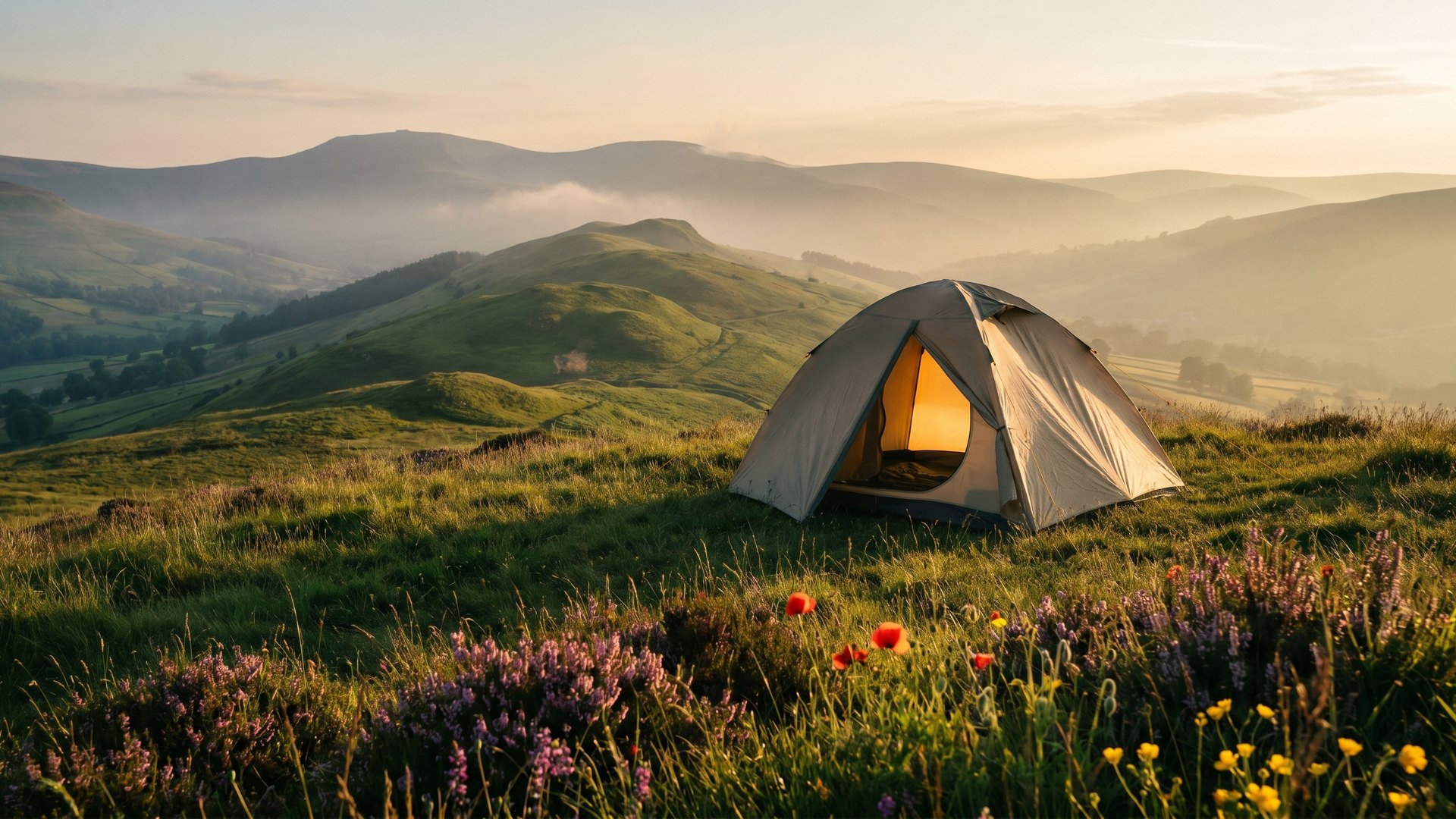
How long before sunset should you finish a hike UK: turnaround times after the clocks go back
The clocks go back on 25 October 2026 and the afternoon loses an hour overnight. The default margin for finishing a hill walk before dark, the signals on the route that override it, and how to set a turnaround time you will keep.
We earn commission from qualifying Amazon purchases. It costs you nothing and does not affect what we recommend.
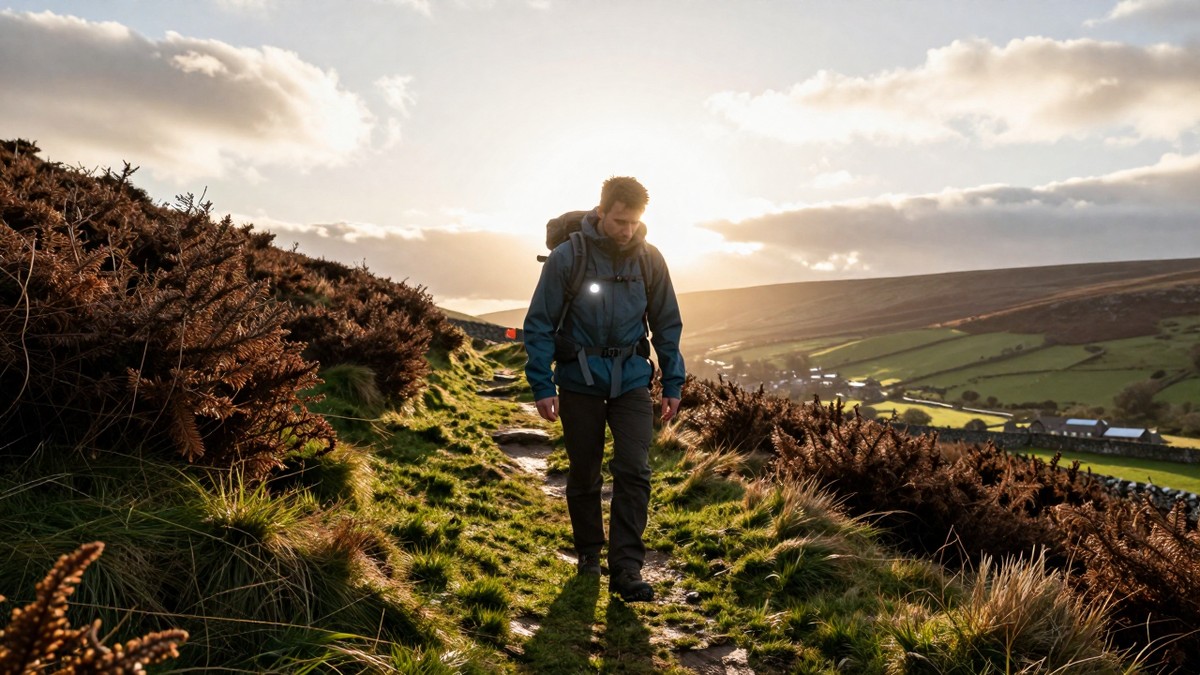
Quick answer
In autumn, plan to be back at the car or on a lit road at least an hour before sunset. From November to February make that 90 minutes, and more with children, a dog or an unfamiliar descent. Steep valleys, woodland, low cloud and hill fog all bring effective darkness forward, so let what you can see override the clock.
"How long before sunset should you finish a hike UK?" gets typed every October, usually in the week the clocks go back and the afternoon suddenly ends at quarter to five. The honest answer has two parts: a default margin, in the box above, and a set of things you can see from the path that tell you whether that margin is enough today.
This guide is built around the second part, because a fixed number of minutes is exactly what fails on the east side of a Lakeland fell under a low cloud base. The advice is mainstream UK hillwalking and mountain rescue guidance adjusted for region and weather.
Read the hill before you read the clock
Official sunset assumes a flat horizon, and almost nowhere you walk in Britain has one. The light you actually get is decided by the ground around you and the sky above.
The sun's height above the horizon
Hold your arm straight out, fingers together, and count the hand-widths between the sun and the horizon it will set behind. As a rule of thumb, each hand-width is roughly an hour of sun. It is crude, but it uses the real horizon: if there is a ridge to the west, the sun goes behind it early and your sunset is whenever it does.
Shadows and the valley floor
Look down. If the valley floor is already in shade while the tops are still lit, you are watching the light leave the ground you have to walk back through. Steep-sided valleys and the east side of any hill lose direct sun well before official sunset, sometimes by an hour or more in the Lake District and the Highlands. A shadow longer than you are tall and stretching fast is the same warning.
Temperature and the cloud base
The air cools noticeably in the last hour before sunset, a useful prompt on its own. Add the cloud base to it. If cloud is sitting on the tops and you are heading into it, the hour before sunset is effectively dark on open ground, because hill fog takes the horizon, the shadows and the path edges away at once. Even without fog, rain and a low grey sky can take an hour off usable daylight, and civil twilight, normally 30 to 40 minutes of workable light after sunset, shrinks to very little.
Where the route changes character
Find the point on the way down where the path leaves open ground for woodland, a gorge or a steep-sided valley, and aim to still have daylight there. Open moorland with a wide horizon gives you the full civil twilight, often half an hour of comfortable walking after sunset on a clear evening. Woodland under a canopy goes dark well before the open hill above it. Plan the descent for the darkest stretch, not the average; it is often the last kilometre or two, where tired walkers assume the hard part is over.
South coast, Lake District and Highlands
The far north of Scotland loses daylight faster through the autumn than the south coast, and by December sunset differs by up to 40 minutes between the two. A sunset table for London is wrong by 20 to 40 minutes for the Lake District, Snowdonia (Eryri) and the Highlands, and those hills also have higher, steeper horizons.
A family party versus a fit solo walker
A fit solo walker on a known path can keep the default hour. A group with children or a dog moves at the pace of its slowest member and descends far more slowly on rock, so the margin should be 90 minutes even in October and two hours in midwinter. If nobody has done the descent before, widen it again.
Month by month from September to March
All sunset times below are approximate. Check your own location and date on a sunset table, because your hill will differ.
September
London sunset slides from roughly 7:45pm to about 6:45pm over the month, and Edinburgh loses slightly more. The summer habit of setting off after lunch stops working. Keep the hour margin, but start noticing how early the valleys go into shade.
October
The clocks go back on Sunday 25 October 2026 and British Summer Time gives way to GMT. London sunset drops from roughly 5:45pm on the Saturday to about 4:45pm on the Sunday; Edinburgh goes from about 5:50pm to 4:50pm. Mountain rescue teams in England, Wales and Scotland consistently report a spike in callouts for walkers caught out by darkness in the weeks that follow. Move the turnaround an hour earlier that weekend and widen the margin if the forecast is grey.
November
London sunset falls from about 4:30pm to just before 4pm, earlier in Scotland. This month catches out people who adjusted for the clock change but not for the continuing slide. Use a 90-minute margin and start long walks by 9am.
December
The shortest day is 21 December. By mid-month sunset is around 3:50pm in London and 3:40pm in Edinburgh, earlier still on Skye and in the far north, and under cloud the usable afternoon can end before 3pm. Plan short routes, turn round by early afternoon and treat the head torch as kit you expect to use.
January
Days are lengthening but you will not feel it until the end of the month, when London sunset is back to about 4:45pm. Keep the December discipline.
February
London sunset moves from roughly 4:50pm to 5:35pm over the month. The margin can come back to an hour on clear days on familiar ground, but hill fog and wet snow are common and 90 minutes is still the right default on unfamiliar routes.
March
The clocks go forward on Sunday 28 March 2027 and London sunset jumps from about 6:20pm to 7:20pm. The hour margin is fine for most of the month, but do not let the longer evening tempt you into a late start on a long northern route in the first fortnight.
Working out your turnaround time
Do this the night before. It takes five minutes.
- Look up sunset for your location and date. Use timeanddate.com, the Met Office app or the OS Maps app, entering the nearest village to the hill rather than your home town.
- Estimate the route time with Naismith's rule. Allow one hour per 5km plus one hour per 600m of ascent, then add 25 percent for a fit pair on good paths or 50 percent for a group, rough ground, short days or an unfamiliar descent. Descent in poor light is slower than ascent in daylight.
- Work backwards. Sunset minus your margin (an hour in autumn, 90 minutes or more in winter, on unfamiliar ground or with children or a dog) is your latest time back at the car. Subtract the descent time for the turnaround, and the ascent time for the latest set-off.
- Write it down and tell someone. Put the turnaround time on your phone lock screen or the map, and leave the route and expected return with someone who will notice if you are late.
- Carry the head torch anyway. Charged, with spare power, in a pocket you can reach with gloves on. Our guide to when to start carrying a head torch in the UK covers the dates and signals; a rechargeable head torch like the Blukar two-pack gives you a spare for the second person.
- Check progress at fixed points. Pick two or three named features on the way up and note when you planned to reach each. If you are 20 minutes down at the first one, you will be an hour down at the car.
- Keep the turnaround. If the turnaround time arrives before the summit, turn round. The summit does not move; the sun does. This is the discipline mountain rescue teams keep asking walkers to adopt.
A worked example: a November Lake District walk, 4:10pm sunset, 12km and 800m of ascent. Naismith gives about 3 hours 45 minutes, or 4 hours 40 minutes with a 25 percent add-on. A 90-minute margin puts you at the car by 2:40pm, so the turnaround is around 12:30pm and the latest set-off around 10am. Most people would guess later on all three.
What goes wrong and how to recover
Pushing on past the turnaround
The summit is "just there", the turnaround passes, and everyone silently agrees to ignore it. The fix is to agree beforehand that the turnaround is not a discussion, and to give the watch to whoever is best at saying no.
Descending an unfamiliar route in the dark
Stop while you can still see the ground and read the map properly. Choose the route with the most obvious handrails, a wall, a stream, a track, rather than the shortest one. A baseplate compass earns its place here, because in the dark a bearing to a known point is the safest way off.
The valley going dark an hour early
You planned by official sunset and the valley is in deep shade at 3pm. Torch on early rather than late, slow down, and accept that the last stretch takes twice as long as it did going up.
No torch, or a phone as the torch
A phone torch gets you a few hundred metres and then leaves you with a dead phone and no light, the worst combination available. With no torch at all, stop before the last of the light goes, put on everything warm, and decide whether you can safely reach a track or road, or whether to call. The fix in advance is a small COB head torch like the Gritin two-pack living in the rucksack lid all winter.
Hill fog
Fog on open moor makes the hour before sunset dark in practical terms and removes the horizon and shadows you were using as signals. Navigate by compass and pacing to a linear feature, going down rather than along. If you are not confident doing that, stay put, get warm, and call.
When to call for help
If someone is injured, you cannot find a safe way down, or you are getting cold and not making progress, call 999, ask for the police and then mountain rescue. Give a grid reference and the size of the party, then stay put and save the phone battery for the callback.
Frequently asked questions
Is it safe to hike after sunset in the UK?
It can be, on a path you know, with a head torch, warm layers and a plan, but it is not something to drift into. Walking in the dark by choice on a familiar route is a different activity from being caught out on an unfamiliar descent with no light.
How long is twilight after sunset in the UK?
Civil twilight, with the sun up to six degrees below the horizon, gives roughly 30 to 40 minutes of usable light after sunset in the UK autumn and winter. You get less under heavy cloud, in woodland, in a steep valley or on the east side of a hill. Nautical twilight after that is not enough to navigate by without a torch.
What time do the clocks go back in 2026?
UK clocks go back one hour at 2am on Sunday 25 October 2026, returning from British Summer Time to GMT. Sunset moves from roughly 5:45pm to 4:45pm in London overnight. They go forward again on Sunday 28 March 2027.
Do I need a head torch for a day walk?
From October to March, yes, on any walk that finishes in the afternoon. A twisted ankle, a wrong turn or a slow group can push a four-hour walk into darkness, and mountain rescue teams consistently describe the head torch as the item that separates a late walker from a benighted one.
What should I do if I get caught out by darkness on a hill?
Stop while you can still see, put the torch on and add a warm layer before you get cold. Work out where you are, pick a known feature such as a wall, track or stream junction, and navigate to it deliberately. If you cannot find a safe way down, or someone is hurt, call 999, ask for the police and then mountain rescue, and stay where you are.