When to start wearing thermal socks hiking UK: the cold-toe signals and the months that trigger them
Toes do not go cold on a date, they go cold at a temperature the car park forecast does not show. Here are the checks you can do on the walk itself, a month-by-month frame from September to March, and how to fit a thick sock without making your feet colder.
We earn commission from qualifying Amazon purchases. It costs you nothing and does not affect what we recommend.
Quick answer
When to start wearing thermal socks hiking UK depends on your feet more than the calendar: late October on the high tops, mid November on lowland paths, and any earlier day when your toes go numb at the first rest stop or cold on the descent. Damp socks at the end of a walk mean wool first, then thicker.
The signals your feet are giving you
Feet go cold when the heat leaking out through the boot beats the heat arriving in the blood. That balance shifts with air temperature, wind, wet ground, how hard you are working and how tightly the boot is laced. None of those sit on a calendar, which is why the sock that was fine on a still November morning is useless on a windy October ridge.
Numb toes at the first rest stop
Walking uphill, your feet make their own heat and most socks cope. The test is the first proper stop. Sit for ten minutes with a flask, and if your toes are numb or tingling when you stand up, the sock is not holding enough heat for the still moments. It is the earliest and most reliable signal, and it shows up on summit lunch stops weeks before anything on the move.
Cold toes ten minutes into the descent
Descending works the legs less, so less blood is pushed to the feet, and most of us lace tighter for the way down. If the toes were fine on the climb and cold within ten minutes of turning round, you are on a marginal-sock day. Next time out, wear the thicker pair from the start.
Damp socks when you peel them off
Take the socks off at the car and feel them. Damp means sweat that has not moved through, or water that has come in. A damp sock insulates badly whatever its thickness. This signal says change the material before the weight: wool keeps some warmth when moist, cotton does not.
Frost on the grass, water on the path, wind on the top
Frost at the start is a thermal socks day whatever the forecast high; the ground stays cold underfoot long after the air warms. Standing water and saturated moorland call for a waterproof layer at the sock or gaiter, since wet feet lose heat far faster than dry ones. Wind matters most at the top: as a working rule the air cools by around one degree for every hundred metres climbed, so eight degrees at a sea-level car park is close to freezing on an 800 metre summit before the wind has any say.
Boot type and how snug it already is
Mesh trail shoes let wind straight through, so they need the thermal sock a month before leather boots do. The other way round, a boot that is already snug with a summer sock will squash a thick one, restrict blood flow and make the foot colder, not warmer. The fitting section below deals with that.
Anyone with Raynaud's, poor circulation or a history of chilblains crosses the line weeks before the average walker, and so do children. If you are already reaching for a fleece on the walk in, your feet want the thicker sock too.
September to March on UK paths, month by month
Where you walk moves all of this by a month. Scottish uplands, the Pennines and Snowdonia run three or four weeks colder than lowland southern England, and a cold year runs a fortnight ahead of a mild one. Treat the months as a frame and let the signals above make the call.
September
Nothing yet for most people. A mid-weight merino walking sock handles the month on lowland and most hill routes. The exceptions are dawn starts on the Cairngorm plateau and the high Lakeland fells, where dew and wind can make a still morning feel like November. Watch for the first evening you peel off a damp sock; that is the cue to start packing a thicker spare.
October
The shoulder month. Inland Scotland and the northern hills usually see their first air frosts by mid month, and the tops of the Lake District, Snowdonia and the Highlands cross the cold-toe line around then. In the lowland south you are still on standard socks, but the thicker pair goes in the bag for the summit stop, and anyone who runs cold switches now.
November
Demand for thermal socks peaks in November, and this is when most UK hill walkers make the switch for the season. Frosty mornings become normal outside the far south west, you finish walks in the cold, and moorland is saturated. On the hills they go on for every walk. On lowland paths, wear them on any frosty morning and any walk over about four hours, and consider a waterproof sock where the path is more bog than track.
December
Everything is on. Walks start and finish in the cold and north-facing slopes never thaw. Pair a thin liner with the thermal sock for long days if your boots have the room, and carry a dry spare on every walk. Sleet and cold rain make it the month waterproof socks or gaiters earn their weight.
January
On average the coldest month across the UK, with snow and hard frost on the tops and ice on lowland paths at dawn. Thermal socks are not optional on any hill route. Wear the thickest pair your boots take without squeezing, and if that is not enough, look at the boot rather than the sock.
February
Often as cold as January, with the ground saturated after months of rain and the first thaws turning frozen paths into standing water. Keep the thermal socks on and lean on the waterproof layer. Longer days tempt people into downgrading; do not, especially on the hills.
March
The other shoulder. On lowland southern walks a mild afternoon can go back to a mid-weight wool sock, but early starts and anything with height still want the thermal pair. On Scottish and Pennine tops it is still winter, and thermal socks stay on until well into April.
Choosing, layering and fitting the socks
A thick sock is only half the job. How it sits inside the boot decides whether it warms you or cuts off the blood supply that was keeping your toes alive. Work through these in order.
1. Start with wool, never cotton
Merino or a merino and nylon blend is the base for every option below: it holds warmth when damp, moves sweat off the skin and does not smell after two days. A cushioned merino walking sock, such as this three pack of breathable merino hiking socks with anti-blister cushioning, is the right layer for most autumn days on its own and the right inner layer once winter arrives. Our review of merino hiking socks for blister prevention covers how the cushioning sits in a boot and where the heel wears.
2. Match thickness to the boot, not the weather
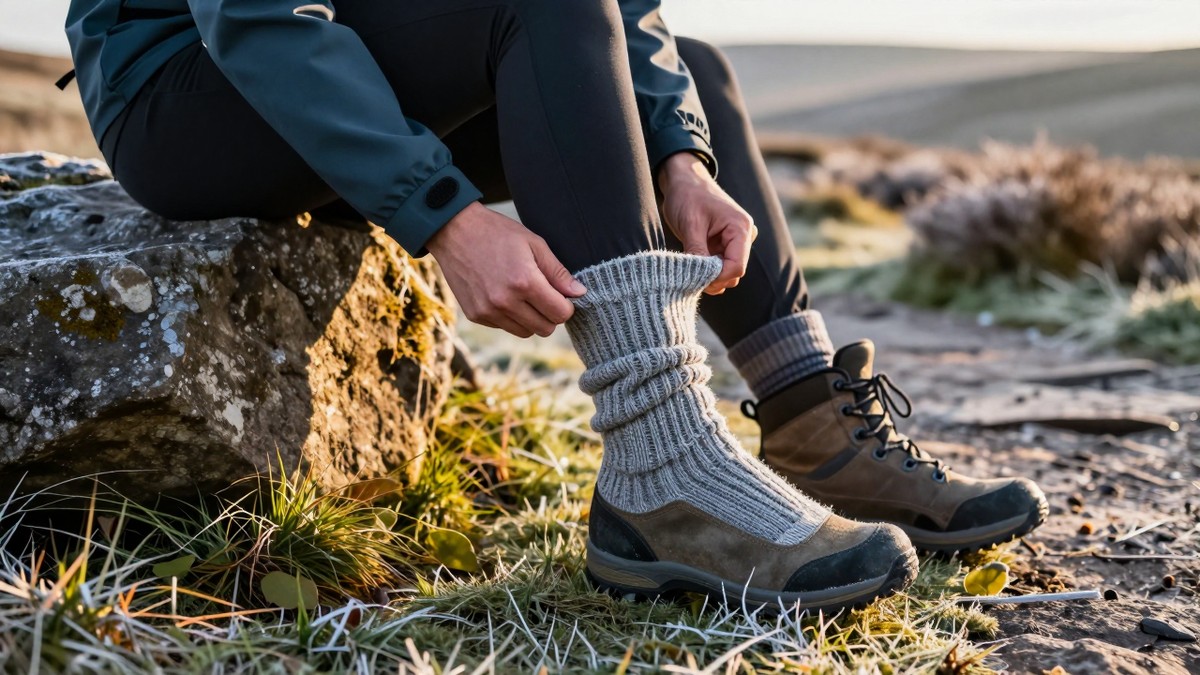
Put the thick sock on, lace the boot as you would for a walk and stand up. You want a thumb's width in front of the longest toe, room to wiggle every toe, and no pinch across the top of the foot when the laces are snug. Fail any one of those and the sock is too thick for that boot. With only one pair of boots, drop to a thinner thermal or a mid-weight merino plus liner rather than forcing a heavy sock in.
3. Add a liner for long days
A thin synthetic or silk liner under the thermal sock wicks sweat off the skin so the outer stays drier, and takes the rubbing that would otherwise blister you. Liners only work if there is room, so re-run the fit test with both on; if it fails, rely on the merino alone.
4. Go waterproof when the ground is wet
For bog, river crossings and days of cold rain, a membrane sock worn over a thin liner keeps the insulating layer dry when the boot has given up. ArcticDry waterproof thermal hiking socks are the kind of thing we mean, and our review of waterproof socks for wet-weather hiking covers how they breathe and how they fit under a boot. Add waterproof gaiters for boggy moorland and the water stops before the boot.
5. Lace for blood flow
Snug at the ankle, looser across the forefoot. Most winter cold-toe complaints come from laces pulled tight over the toes to stop them sliding, which squeezes the vessels that warm them. At the top, add a heel lock through the top hooks for the descent and leave the lower laces alone.
6. Always carry a dry spare
One spare pair, in a dry bag, on every walk from October onwards. Change at lunch if the pair on is damp, not at the end when the damage is done.
7. Dry them overnight, off the fire
On multi-day trips, wring wet socks out hard, then take them into the sleeping bag, either against your body under a base layer or down in the foot of the bag. Body heat dries wool overnight. Never lay socks on a stove or by an open fire; merino singes before it dries.
What goes wrong and how to recover
Sweaty on the climb, frozen at the top
The commonest winter failure. Too much sock for a hard climb, or a synthetic sock that traps sweat, leaves the foot wet just as you stop moving. On the day, change into the dry spare at the top. Next time, climb in the mid-weight pair and swap to the thermal pair at the summit, or add a liner.
Blisters from a bunched sock
A thick sock in a boot with no room folds under the arch or behind the heel and rubs through the skin in an hour. Pull the heel pocket square onto your heel and smooth the foot flat before the boot goes on. If it keeps happening with a properly seated sock, the boot is too small for winter.
Cotton
Cotton holds sweat against the skin and loses almost all its insulation once wet. There is no recovery except a change into wool, so do not own cotton walking socks or liners at all.
Boots laced too tight
Numb toes that arrive within half an hour of leaving the car, whatever the sock, are usually a circulation problem. Stop, loosen the laces over the forefoot, and walk for ten minutes. If the feeling comes back, that was the cause.
Wet socks with no spare
Wring them out as hard as you can, put them back on, and get a plastic bag between the sock and the boot if you have one. It stops the wet boot pulling more heat out, at the cost of sweat building inside. A get-off-the-hill fix, not a plan.
Toes that will not warm up
If toes stay numb after a change of socks and looser laces, take the boot off out of the wind, dry the foot, and warm it against a companion's skin or between your hands rather than rubbing hard. Get a dry sock on and head down. Toes that look white or waxy are a sign to shorten the day, not push on.
Frequently asked questions
Can I wear two pairs of ordinary socks instead?
Two pairs of wool socks work if the boot has the room, and a thin liner under a mid-weight wool sock is a standard winter combination. Two thick pairs, or two cotton pairs, do not: the first squeezes the foot and the second holds sweat.
Do I need bigger boots for thermal socks?
Often, yes, by about half a size. Do the thumb's width test with the winter sock on before you decide. Many walkers keep a summer boot and a winter boot for this reason.
Are merino socks warm enough for winter hiking in the UK?
A cushioned merino sock is enough for most lowland winter walks and a fair number of hill days, particularly with a liner underneath. For frozen ground, snow and long summit stops, step up to a heavier merino thermal sock or add a waterproof sock over the liner. If toes go numb sitting still, go up a weight.
At what temperature do I need thermal socks?
There is no single figure, because feet care about the temperature at the top, in the wind, on wet ground, not the number on the car dashboard. As a rough guide, if the forecast feels-like for your high point is in low single figures, wear them. Below that, wear them and carry a spare.
How many pairs should I carry on a multi-day walk?
Three is the practical minimum: one on, one dry in the bag, one drying in the sleeping bag overnight. Rotate them so you always start a day in a dry pair; liners dry far faster than the thick outer sock.