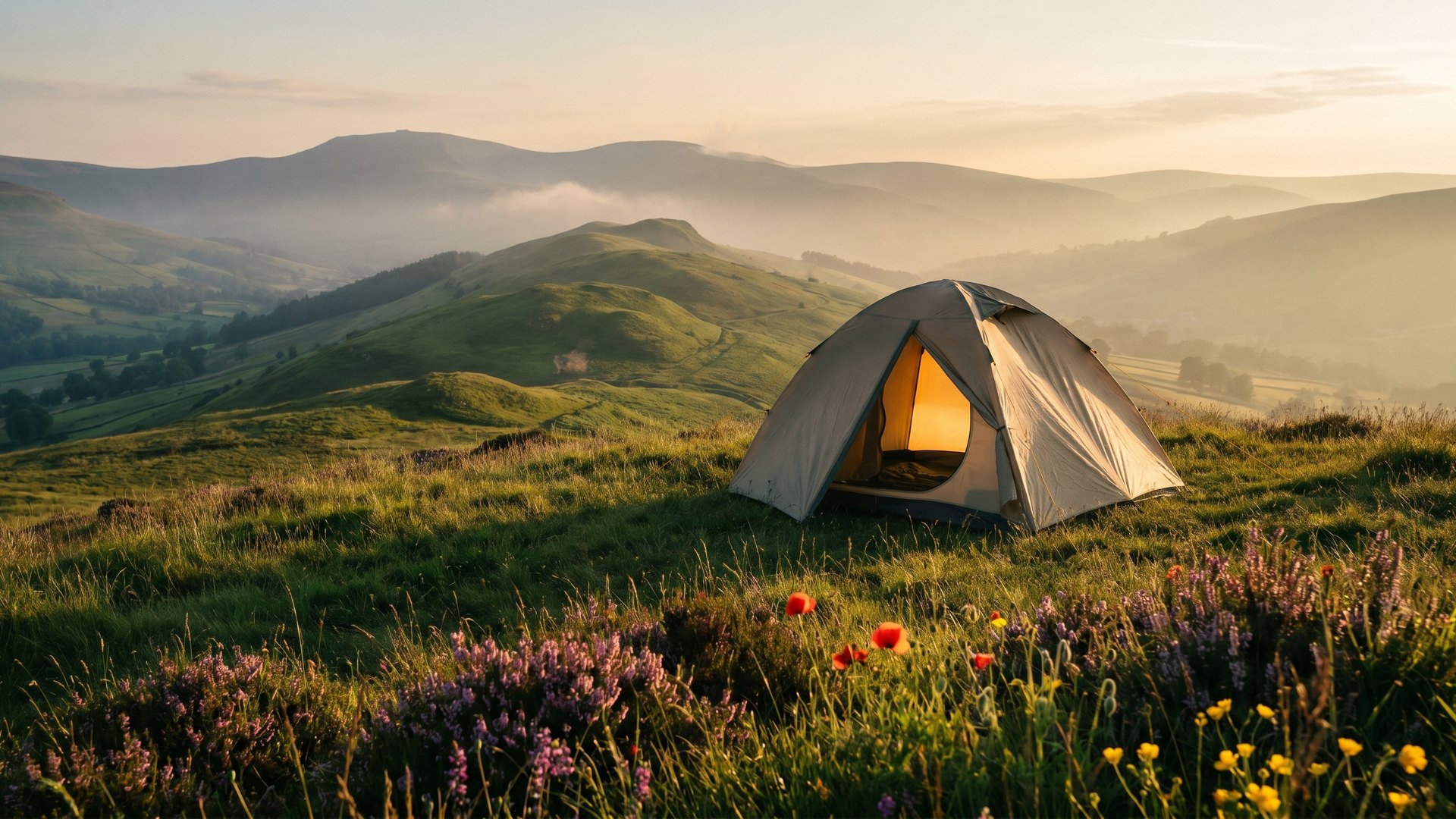
One Buyer Ran Pond Water Through SimPure's Gravity Water Filter for Wild Camping UK Nights
We earn commission from qualifying Amazon purchases. It costs you nothing and does not affect what we recommend.
One buyer filled the 3L bag from a pond and reckoned the result beat their tap. Another threw away every litre that came out, ten fills in a row. Same kit, same cartridge.
- Why Carrying the Filter Beats Carrying the Water
- Everything That Falls Out of the Drawstring Pouch
- Four Stages, and the Number That Shrinks Between Bullet and Diagram
- 27 Litres an Hour Needs Somewhere to Hang It
- Pond Water That Beat the Tap, and Ten Fills Poured Away
- 5,000 Litres on Paper, and the Warning Printed on the Bag
- Our Score, and the First Thing to Do When It Lands
Pond water goes into a 3 litre bag, the bag hangs off a branch, and what drips out the far end is supposed to be safe to drink. One UK buyer did exactly that as a deliberate test and rated the result better than their own tap. A buyer in Australia ran fifty litres or more through the same cartridge across ten separate attempts and tipped every drop away, because it smelled and tasted of plastic.
Both sit on the same Amazon listing, which carries a 4.6-star badge across 1,761 ratings. Amazon publishes just 8 individual reviews on the page itself, and those 8 are what we read for this article. That is a thin base for judging a piece of kit whose only job is making water safe, so this review treats it as thin rather than dressing it up.
Why Carrying the Filter Beats Carrying the Water
Water is the heaviest thing in a rucksack. A litre weighs a kilo, and a two-night wild camp for two people, with cooking and brews on top of drinking, is a load nobody wants hauling up from the car park. The alternative is a filter that weighs almost nothing and taking the water off the hill instead. SimPure's is the gravity version of that idea: a 3 litre bag you fill at a burn or a tarn, a length of hose, and a cartridge the water falls through under its own weight.
Gravity is the distinction worth understanding before you buy. A squeeze filter needs you to squeeze. A pump needs pumping. A straw filter has you face down at the water's edge every time you are thirsty. A gravity system needs somewhere to hang the bag and then asks nothing of you at all, which is why it belongs at camp rather than on the move.
UK conditions sharpen the case. In Scotland, access rights cover most unenclosed land, so a pitch beside a burn is an ordinary weekend. Across England and Wales you need the landowner's permission, with parts of Dartmoor the well-known exception, and the practical upshot is that English and Welsh wild camping tends to be higher and more remote, which is precisely where there is no tap. The 3 litre capacity is sized for that: an evening meal and overnight for two, then a refill in the morning rather than a carry.
Everything That Falls Out of the Drawstring Pouch
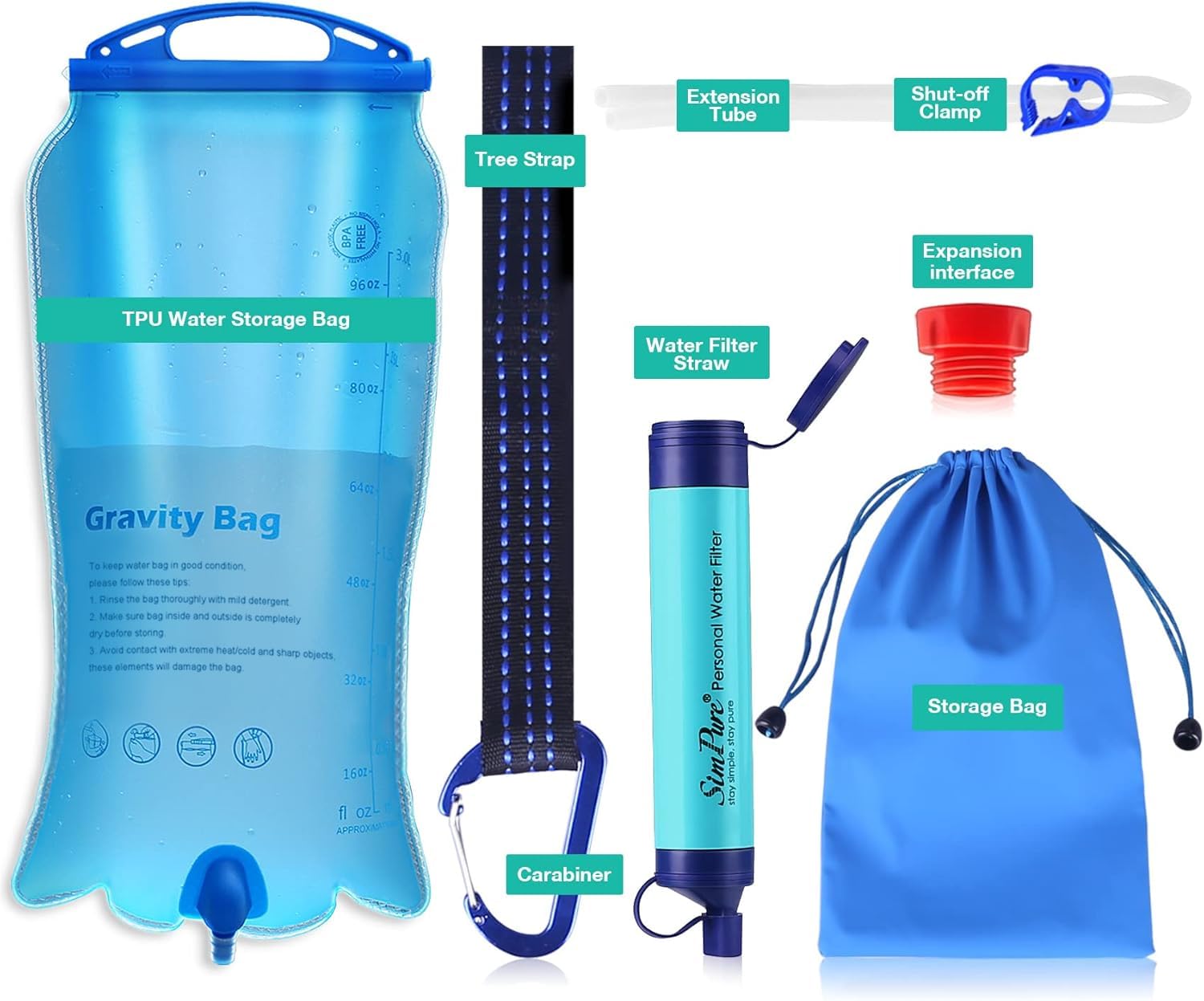
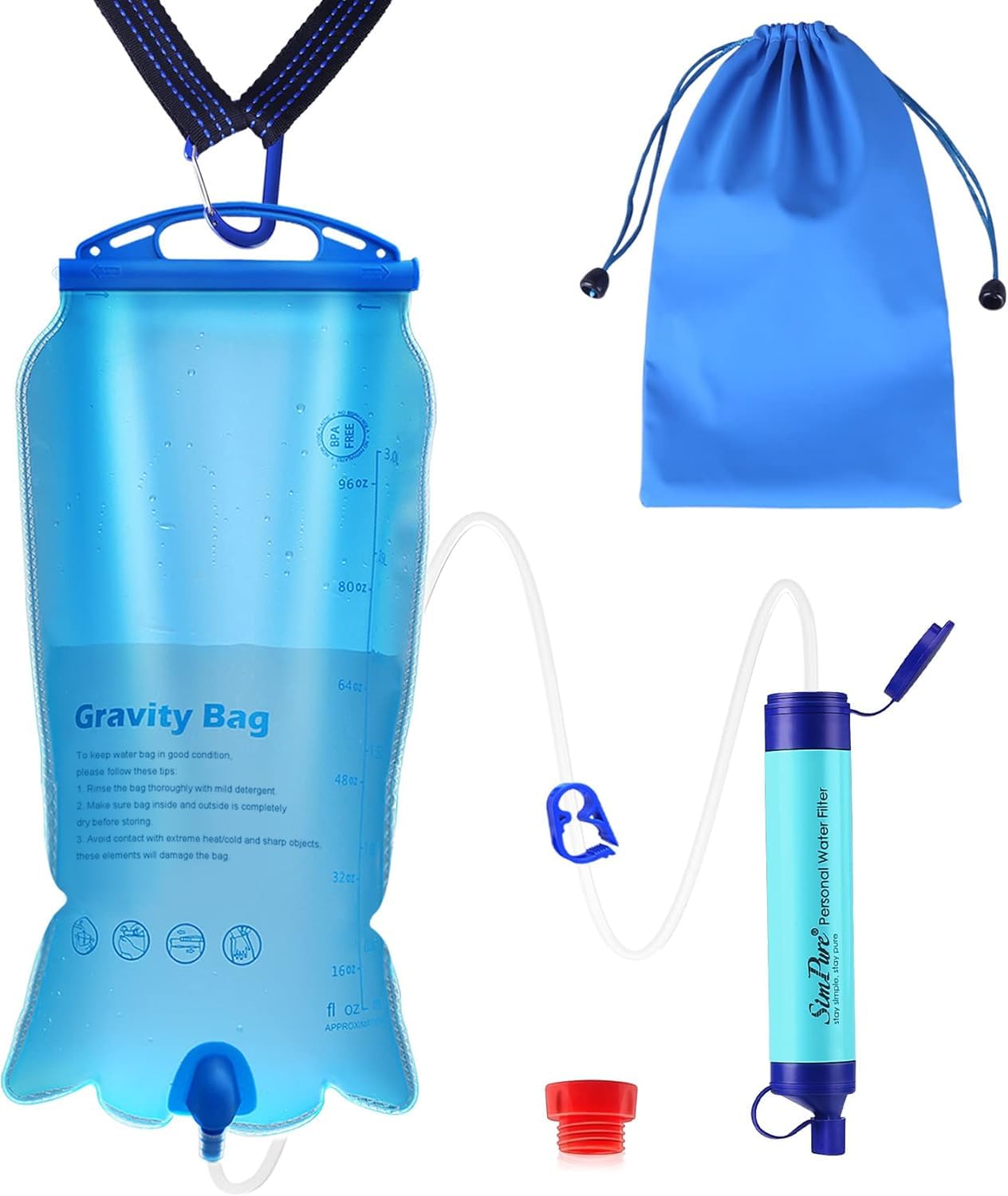
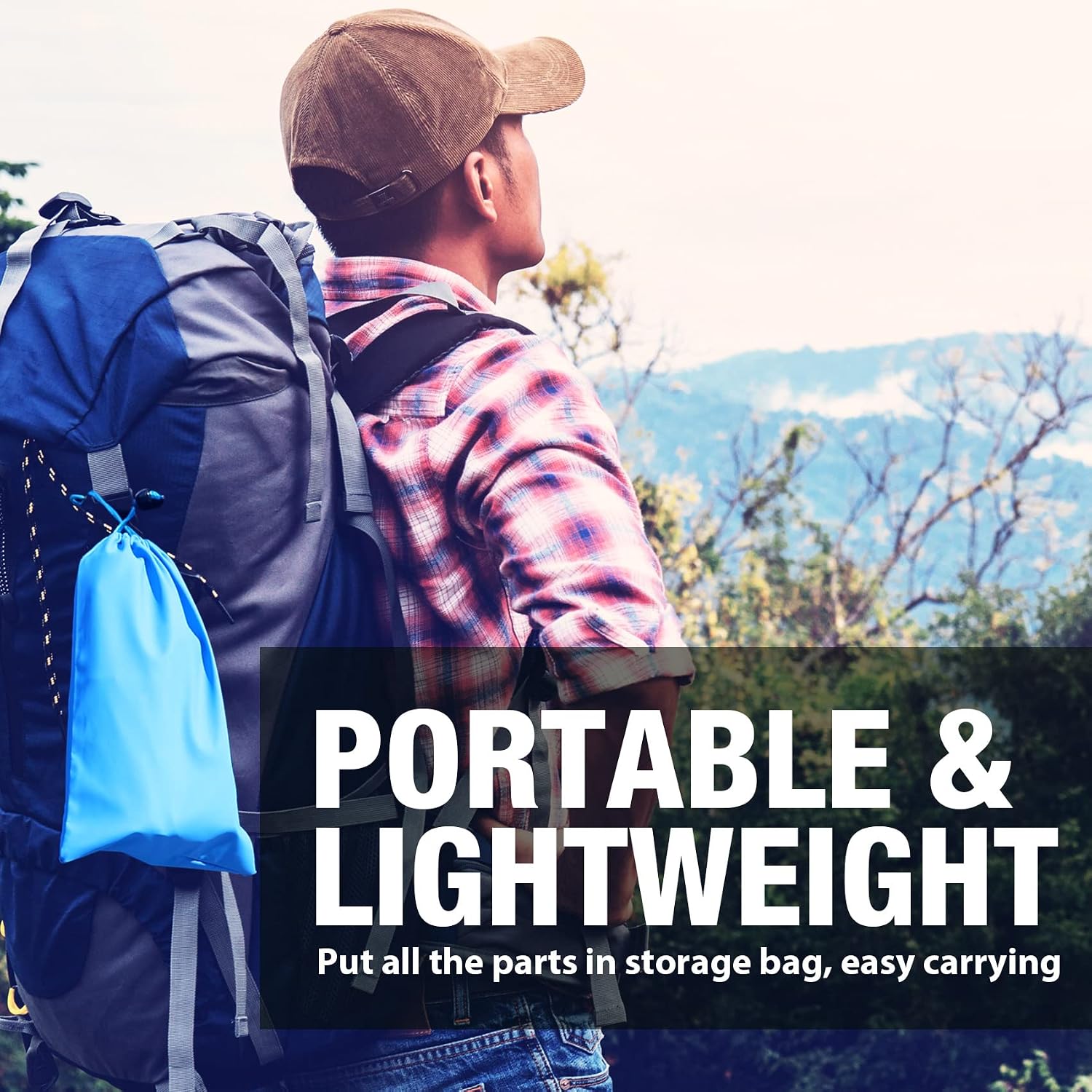
The listing images label the parts and there are eight: the TPU water storage bag, a tree strap, a carabiner, the filter straw itself, an extension tube, a shut-off clamp, a red expansion interface that screws onto a bottle, and the drawstring storage bag the lot packs into.
The bag is the piece you handle most. It carries a graduated scale up one side, marked in fluid ounces from 16oz to 96oz with litre marks alongside at 2.5L and 3.0L, so you can see how much has gone through and how much is left without guessing. There is a BPA free stamp near the top. The mouth is a full-width slide-lock closure rather than a screw cap, which is what lets you scoop from a shallow stream and roll the thing flat when it is empty.
SimPure puts the filter at 2.8 ounces, about 79g. That is the cartridge alone. The listing gives no figure for the packed kit with bag, strap, tube and pouch together, so treat 79g as the headline number rather than what shows up on your luggage scales. Two overseas reviewers vouch for completeness rather than weight: a US buyer notes it "comes with all accessories", and an Italian-language review describes the kit as complete and ready to use, well packaged, and made of good, very resistant materials after three outings.
Four Stages, and the Number That Shrinks Between Bullet and Diagram
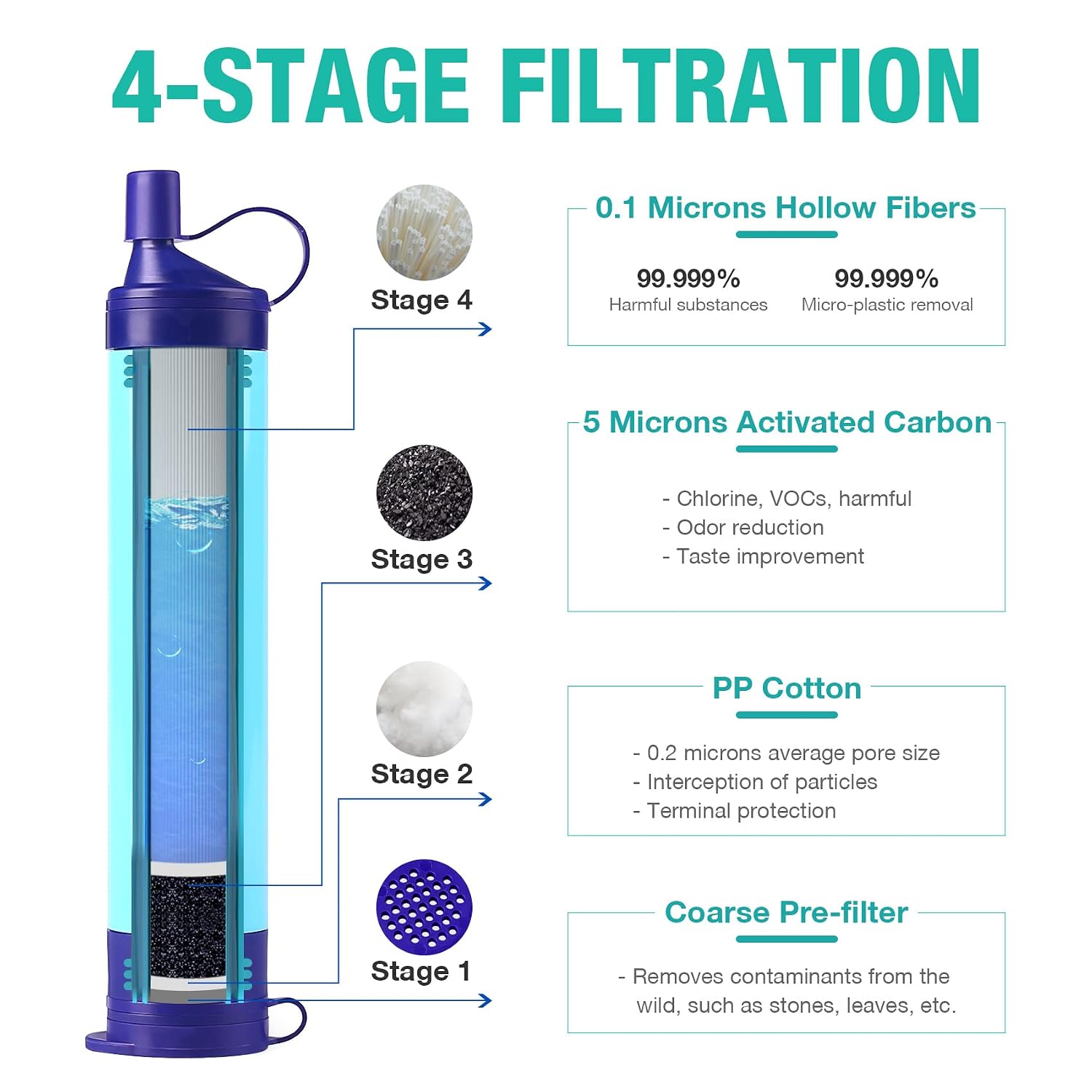
The filtration diagram in the listing images splits the cartridge into four stages. Stage one is a coarse pre-filter that stops stones and leaves. Stage two is PP cotton with an average pore size of 0.2 microns, intercepting particles. Stage three is 5 micron activated carbon, which the diagram credits with chlorine, VOCs, odour reduction and taste improvement. Stage four is the 0.1 micron hollow fibre membrane, a bundle of microscopic straws whose pores are measured in thousandths of a millimetre.
Then the number. The listing bullet says the filter removes 99.99999% of harmful substances. The listing's own diagram, a few images down the same page, says 99.999% for harmful substances and 99.999% for micro-plastic removal. Those are two claims about one cartridge, made by one brand, separated by a factor of a hundred. Neither figure is attached to a named test standard anywhere on the listing, so there is nothing a buyer can check either against.
What the bullet actually lists is heavy metals, odour, chlorine and organic chemicals. It does not name a single waterborne bug. For a hill stream running off grazed ground, which is most UK wild camping water, the microbiology is the whole reason you filter, and a listing that sells hard on chemicals while staying quiet on that is worth noticing before you make it your only source. The pore size is stated plainly. What that pore size is meant to stop, in the terms a water filter is normally sold on, is not.
SimPure Gravity Camping Water Filter with 3L Water Bag
A 3 litre gravity setup, a tree strap and four ways to drink from it, for the wild pitches where there is no tap within five miles.
27 Litres an Hour Needs Somewhere to Hang It
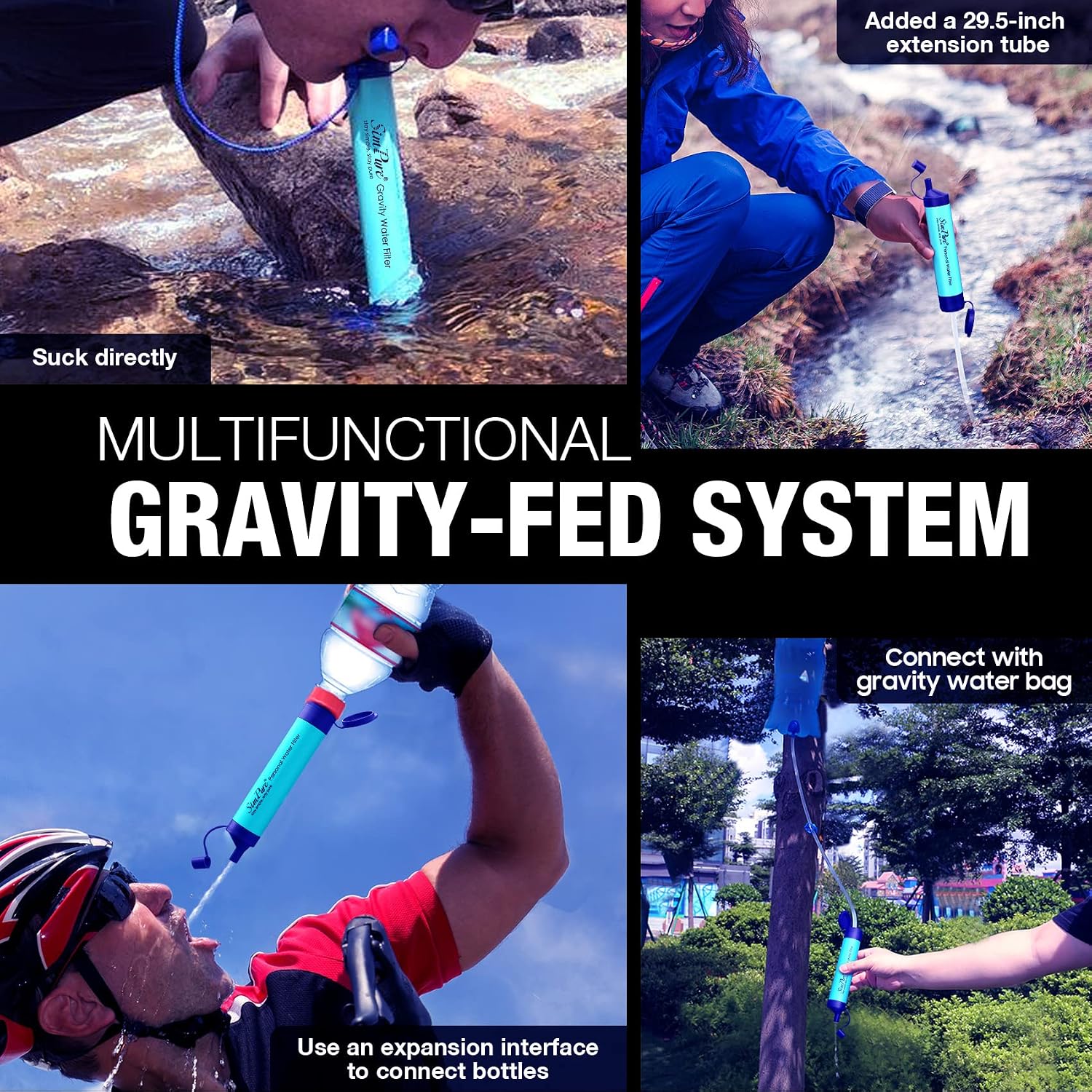
SimPure quotes a flow rate of 27 litres an hour, restated in the images as 7 gallons an hour. Run that against the bag and a full 3 litres clears in a shade under seven minutes. That is the figure that makes the faff worthwhile: fill, hang, put the tent up, and the water is done before the pegs are in.
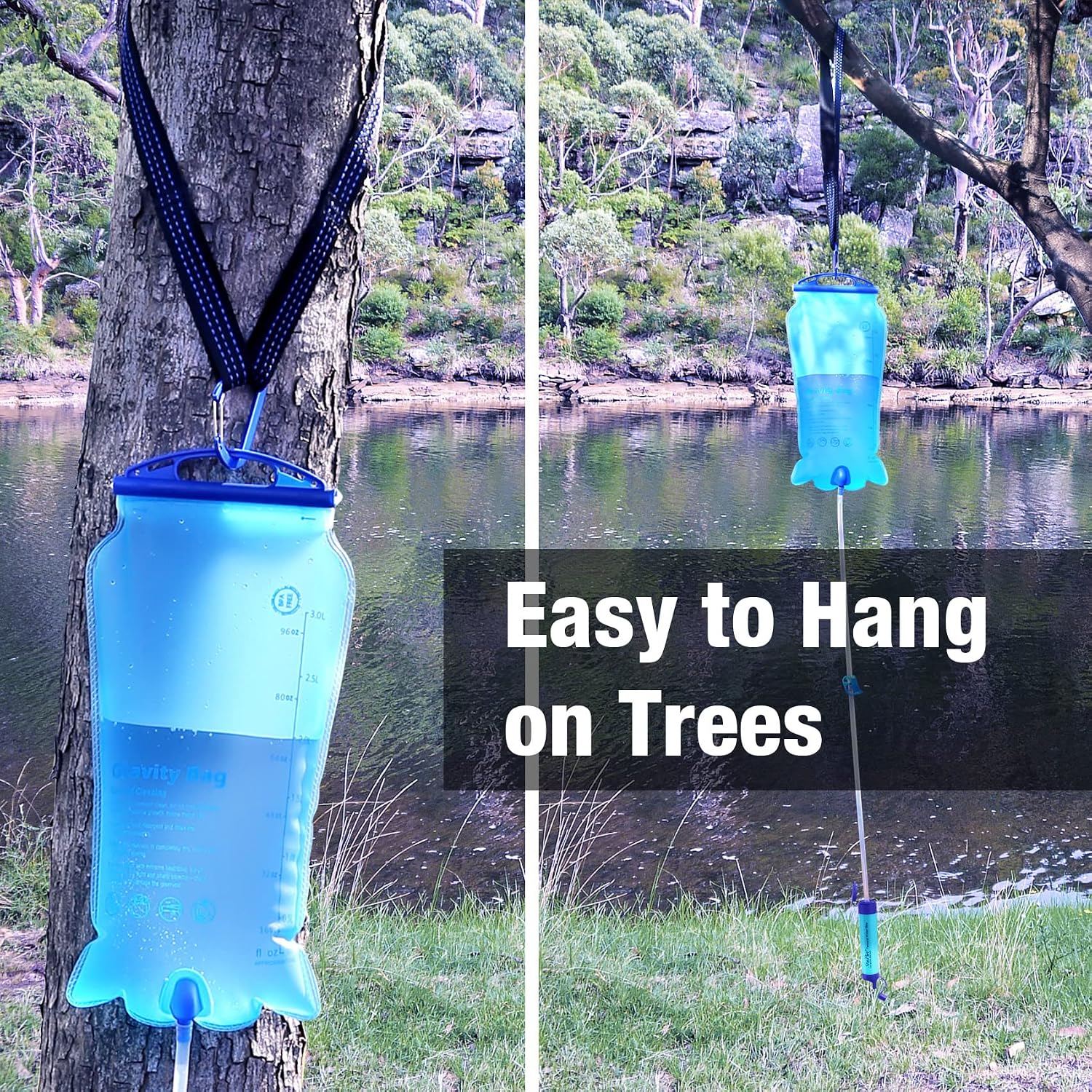
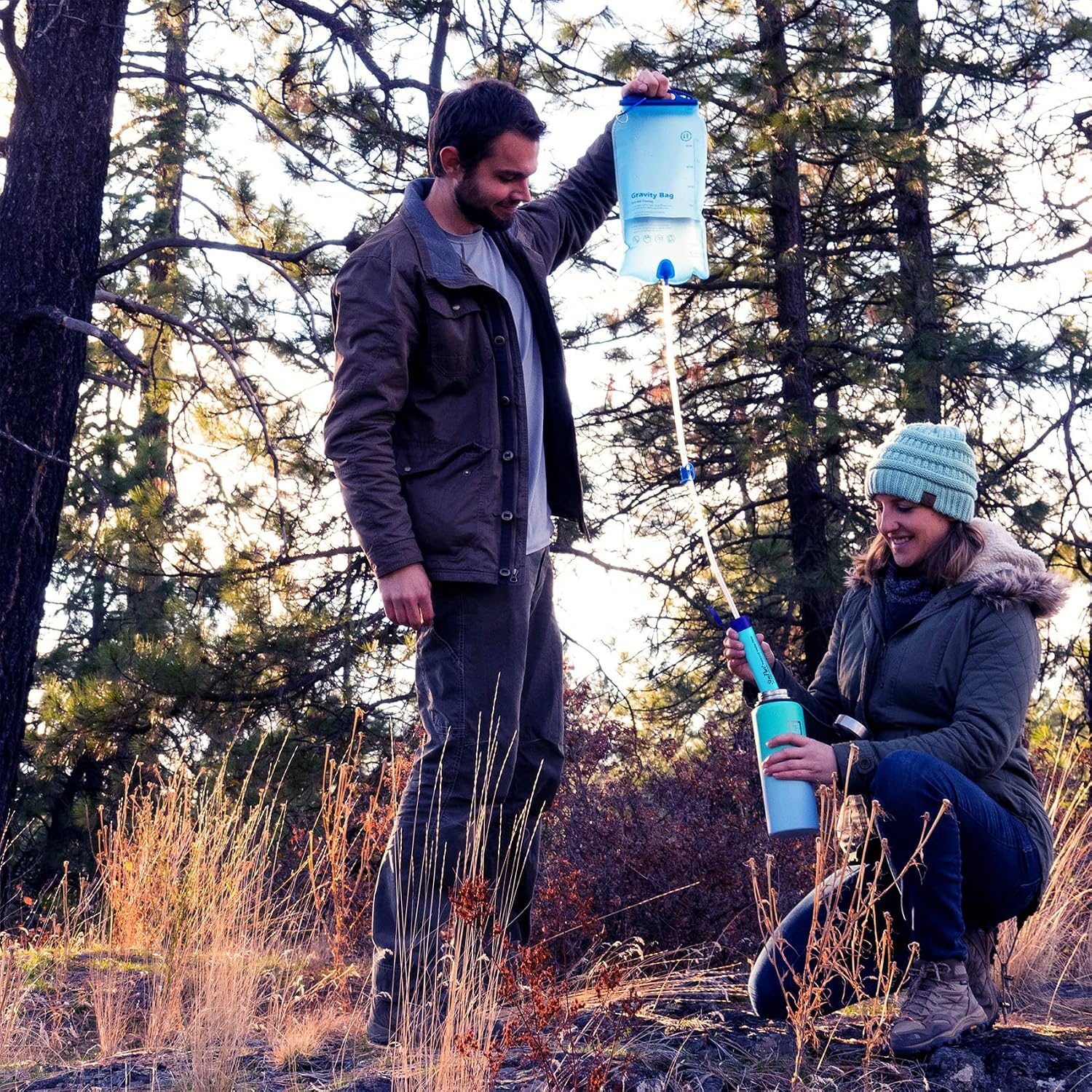
The catch is the hanging. You get a webbing tree strap and a carabiner, and the listing photographs the bag slung round a trunk beside a river. Plenty of UK wild pitches have no trunk. On a Cairngorm plateau, above the treeline in the Lakes or out on open Welsh moorland there is nothing to loop a strap around, and you are then either holding 3kg of water at head height or improvising with a pole, which the listing does not cover at all.
The fallbacks are the strongest thing about this kit. The images show four ways to use it: drink straight from the source through the filter, add the 29.5 inch extension tube, roughly 75cm, and drink from a little further back, screw the red adaptor onto a bottle and push water through that way, or run the full gravity setup. A shut-off clamp on the hose stops the flow mid-bag, so you can fill a bottle, pinch it off and walk away without losing the rest. One UK buyer, who says the review took a while because they wanted to be fair to it, reports they "have now used it a number of times without incident" and rates the size for backpacking and trail work.
Pond Water That Beat the Tap, and Ten Fills Poured Away
This is the disagreement that decides the purchase, and only two reviews in the set speak to it directly.
On one side, a UK buyer in August 2026 used pond water as a deliberate test. On appearance: "waters appearance had changed dramatically, slight tint but for free clean water on the go, you really can't go wrong." On taste: "Tasted great too! Even better than the water that comes out of the tap." That is a verified purchase, and about the roughest input anyone would realistically feed it.
On the other, the only substantive negative in the whole set: a one star from Australia in November 2025. Flow was good and size was good, by their own account. The problem was what came out the bottom. The water "smelt and tasted like it had been flooded with plastic and chemicals", undrinkable "from the first time to the 10th time we tried", with 5 to 10 litres run through on each attempt and thrown away every time. They also mention having drunk only self-filtered water for twenty years, so this is not somebody meeting a hollow fibre filter for the first time and being caught out by it.
The usual explanation for a new filter tasting of plastic is that it wants flushing, and that explanation does not survive this account: fifty litres or more went through it and the taste never cleared. Activated carbon is stage three of the four, and taste improvement is the job the diagram gives it, so a taste failure here is a failure of the stage the listing pushes hardest. One review in eight reports it. With eight reviews there is no way to tell whether that is one bad cartridge or a bad batch, and anybody quoting you odds off this sample is guessing.
5,000 Litres on Paper, and the Warning Printed on the Bag
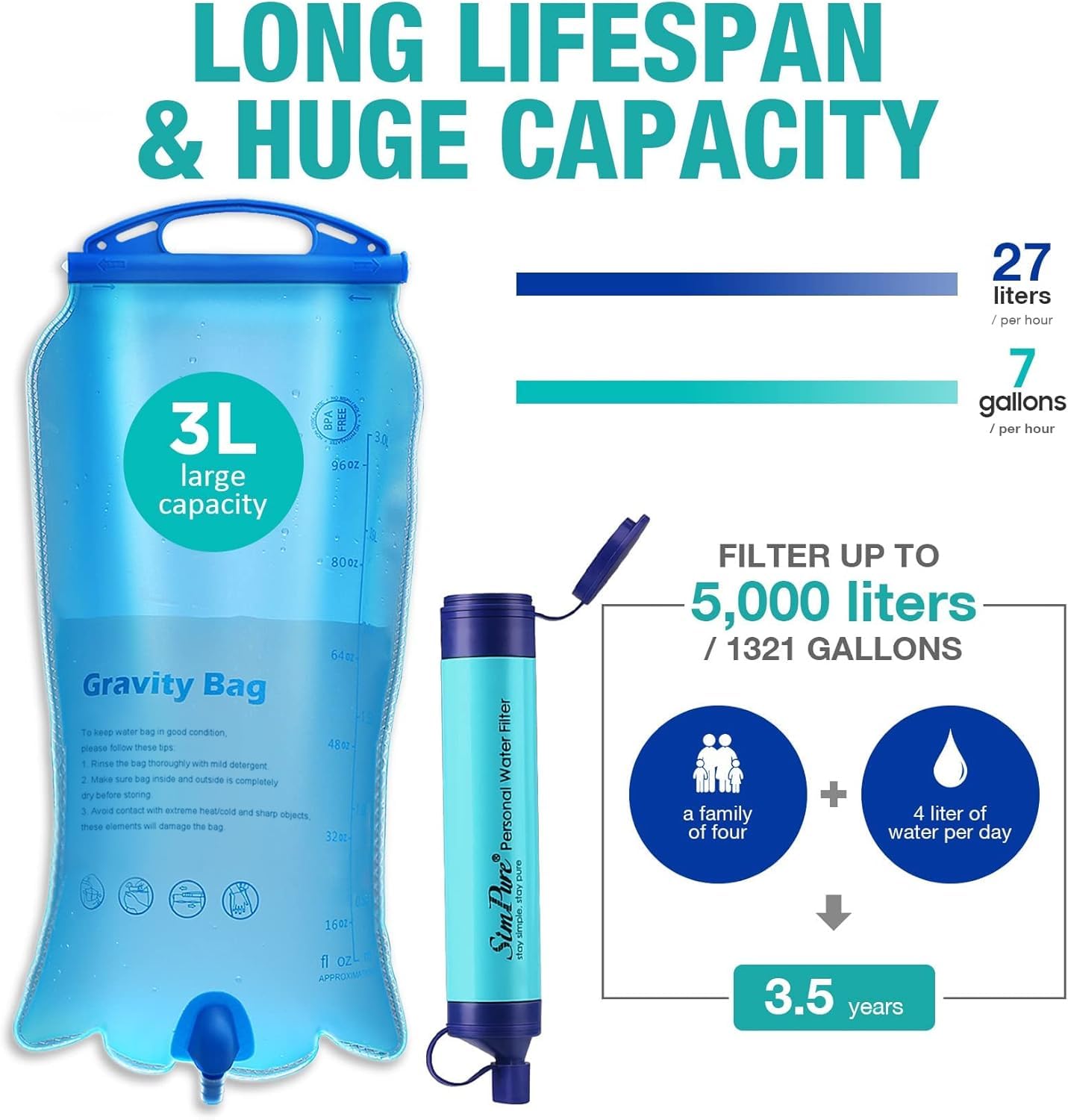
The cartridge is rated for 5,000 litres, or 1,321 gallons. SimPure turns that into 3.5 years for a family of four, and the assumption underneath is worth reading: the diagram has that family getting through 4 litres of water a day between them. One litre per person per day is less than a walker gets through before lunch on a warm hill.
Scale it to something recognisable and the answer is still generous. Two people on walking weekends putting 6 litres a day through it would need roughly 830 days out to reach 5,000 litres, which is more nights under canvas than most of us manage in a decade. The 3.5 years is a marketing figure resting on a light assumption, not a service interval to plan around.
A US reviewer mentions the filter can be back flushed, which is useful to know and does not appear anywhere in the listing bullets or the diagrams, so the instruction is not in front of the buyer at the point of sale. The care notes that are printed, on the bag itself, run as follows: rinse thoroughly with mild detergent, make sure the bag is completely dry inside and out before storing, and avoid extreme heat, extreme cold and sharp objects. That last one has teeth in a British winter. A damp 3 litre bladder left in an unheated garage or the back of a van through January is exactly the case SimPure warns against, and drying the inside of one properly takes longer than you would think.
Our Score, and the First Thing to Do When It Lands
The working, in full. The listing badge is 4.6 stars from 1,761 ratings. The 8 reviews Amazon publishes on the page average 4.25: six at five stars, one at three, one at one. All eight are verified purchases. Only three come from the UK, and one of those three is two words long. The oldest, from Canada in 2021, praises the delivery speed and the seller and says nothing whatsoever about filtering water. The three star, from France, is from a buyer who states they have not used it yet and bought it for a survival kit, so it drags the average down while telling you nothing about how it performs.
Take out the reviews carrying no information and what is left is four positive accounts of a filter doing its job and one detailed account of a filter producing water nobody could drink. The largest failure cluster is that taste complaint, one review in eight, which is under the level we would treat as a systemic fault and equally under the level at which a count off this sample means anything.
Our score is 4.0 out of 5, six tenths under the lifetime badge. The kit is a lot of gear for the money, the flow rate stands up to arithmetic, the fallback modes are more thoughtful than most gravity systems at this end of the market, and the UK buyers in the set are pleased with it. The mark comes off for a reported failure that would leave the product useless if it landed on you, sitting on a review base far too thin to tell you the odds.
One piece of advice, then. When it arrives, do not put it straight in the loft with the rest of the kit. Run a couple of litres of tap water through it at home, smell it, taste it, and find out which of those two reviews you have bought. Do that inside the return window and the worst outcome is a refund instead of a dry mouth on a hill. Check the current listing on Amazon for availability before you order.
SimPure Gravity Camping Water Filter with 3L Water Bag
A 3 litre gravity setup, a tree strap and four ways to drink from it, for the wild pitches where there is no tap within five miles.