
Lewis-Plast 90-Count First Aid Kit: Why 8,511 Reviewers Keep Putting It In The Car Boot
We earn commission from qualifying Amazon purchases. It costs you nothing and does not affect what we recommend.
8,511 Amazon UK ratings, a 4.7-star average and £9.34 for a 90-item pouch that most reviewers end up stashing in the car. This is the home/holiday/workplace sibling to the better-known Lewis-Plast camping kit. Here's what it actually does, where the complaints land, and whether it has a place on a UK camper's packing list.
- The Two Lewis-Plast Kits, And Why Picking The Right One Matters
- The Size Reality Check Every Buyer Should Read First
- What The Listing Confirms Is In The Bag
- The Glovebox Kit That Reviewers Keep Putting In The Glovebox
- Where It Falls Down: The Expiry Problem And The Logistics Problem
- Does It Belong On A UK Camping Packing List?
- Price, Volume And The Bottom Line
Most first aid kits on Amazon UK scrape a few hundred ratings. This one has 8,511, and that number alone is worth a minute of attention before the review proper starts. Volume at that scale tells you something a star average on its own cannot: that thousands of households have bought the same red Reliance Medical pouch, lobbed it into a car boot or a kitchen cupboard, and come back to leave a one-line verdict. On the 30 most recent reviews we looked at, 25 were five stars, 26 were four or five stars, and every single one was a verified purchase.
There is a catch, and it is a deliberate one: this is not the Lewis-Plast kit most UK campers already know. The 92-piece camping-and-hiking variant is a separate SKU with its own listing. This is the 90-count "Home, Car, Holiday and Workplace" version, ASIN B07FRPXF44, £9.34, and the marketing copy nudges it towards glovebox duty rather than rucksack duty. Whether that split matters for a UK camper depends on a few things. Let's work through them.
The Two Lewis-Plast Kits, And Why Picking The Right One Matters
Reliance Medical sells more than one Lewis-Plast kit under nearly identical branding and pouch colours, and Amazon's search results happily mix them together. The two you are most likely to see are the 92-piece Premium kit (marketed for camping, hiking and general use, ASIN B09B1GFM3R) and the 90-count Premium kit on review here (marketed for home, car, holiday and workplace, ASIN B07FRPXF44). Nearly the same item count. Nearly the same price. Different product pages, different review pools, different listing copy.
Practically speaking, the two kits share most of their DNA. Both are compact zip pouches with multiple compartments. Both are built around the same working assumption: plasters, wipes, dressings, bandages, tweezers, scissors and gloves for small incidents. If you are buying for a family car or a kitchen cupboard, either will do the job. If you care about the specific content mix (eye pods, ice packs, workplace signage, so on) the listings diverge enough that it pays to read the one you are about to click.
The 90-count Home version leans on four use cases in its listing copy: home, workplace, travel and sports. The product title also calls out "Bandages, Eye Pods, Ice Packs And Essentials For Everyday Situations". We have not pulled a labelled inventory image for this kit the way Reliance Medical provides for the 92-piece, so we are sticking to what the Amazon listing actually states and what reviewers confirm they received. If an item is not mentioned in those two sources, we have not invented it below.
The Size Reality Check Every Buyer Should Read First
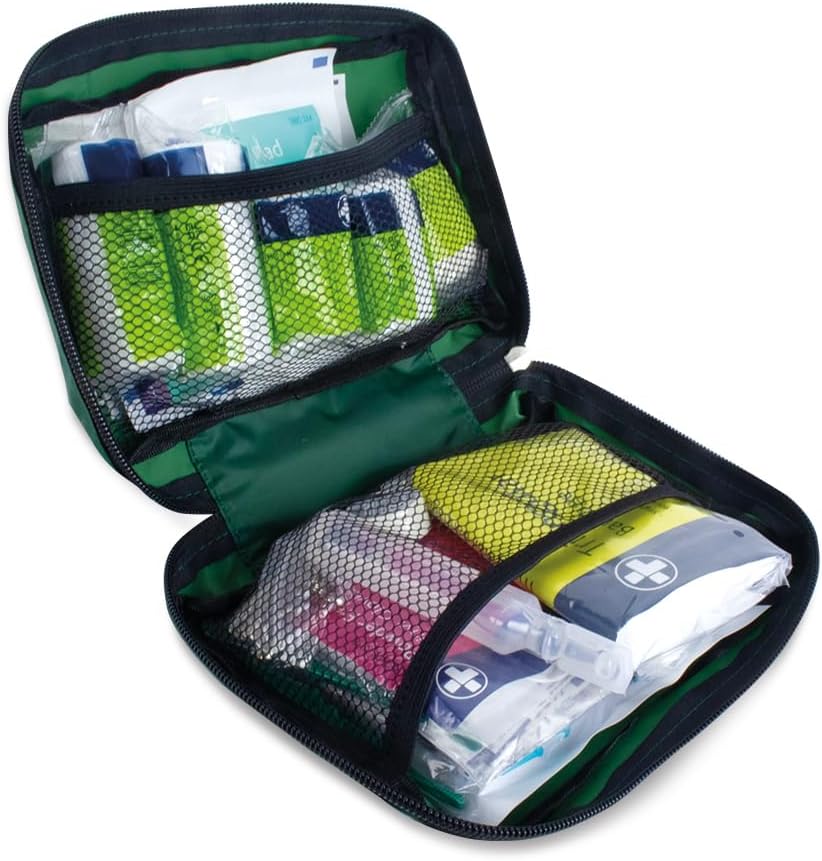
The most consistent complaint across the reviews is not about content, expiry dates or build quality. It is about size. Two separate reviewers flag it directly. One, a one-star review: "Beware, item too small, The photo is misleading." Another, a two-star: "Much smaller than expected. Very compact. When I take the items out, I doubt I'd get them back in the bag is so small and tightly packed."
Both complaints point at the same thing. Amazon's product photography tends to show the kit laid out with every component spread across a large white background, which gives the impression of a substantial spread. In the hand, it is a small zip pouch. The listing is upfront that the kit is "compact" and that its selling point is fitting "a car, kitchen cupboard, garage, or suitcase". That is the feature for most buyers. For a small minority, it is a disappointment, and it is the sort of disappointment that tips into a two-star review rather than a three-star one.
Before you order, take a moment to mentally price in that this is pouch-sized, not wash-bag sized. If what you actually want is a wall-mounted or drawer-sized home kit with large-volume consumables (big rolls of tape, multiple triangular bandages, a stack of eye pads), this is the wrong purchase. Different product category entirely.
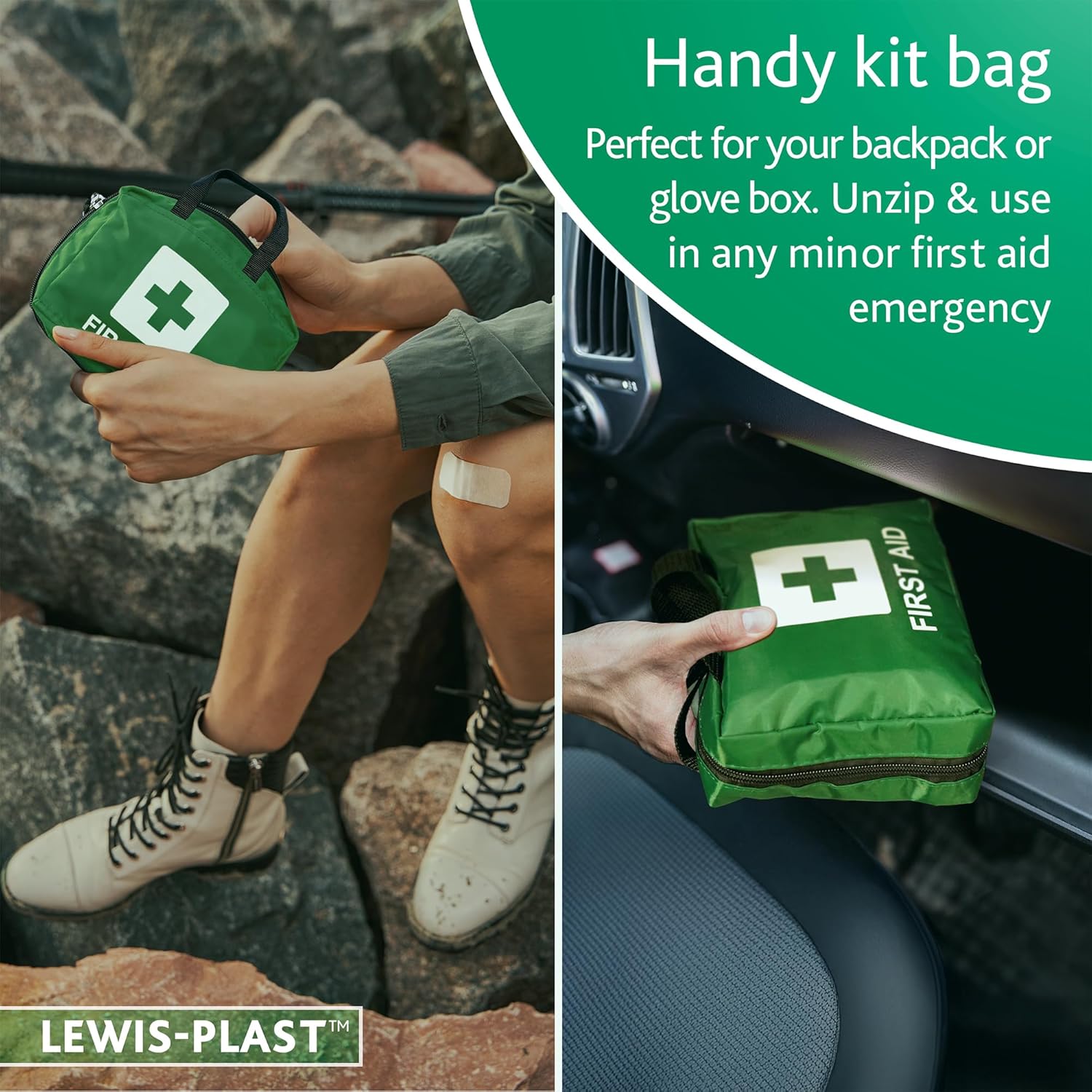
The upside of the compact form is the one every car-and-caravan reviewer keeps returning to. It goes in a glovebox, a boot pocket, a rucksack lid or a camper van door bin without eating space. If the day you actually reach for it is also a day you are pressed for space, you are getting exactly what the listing promised.
What The Listing Confirms Is In The Bag
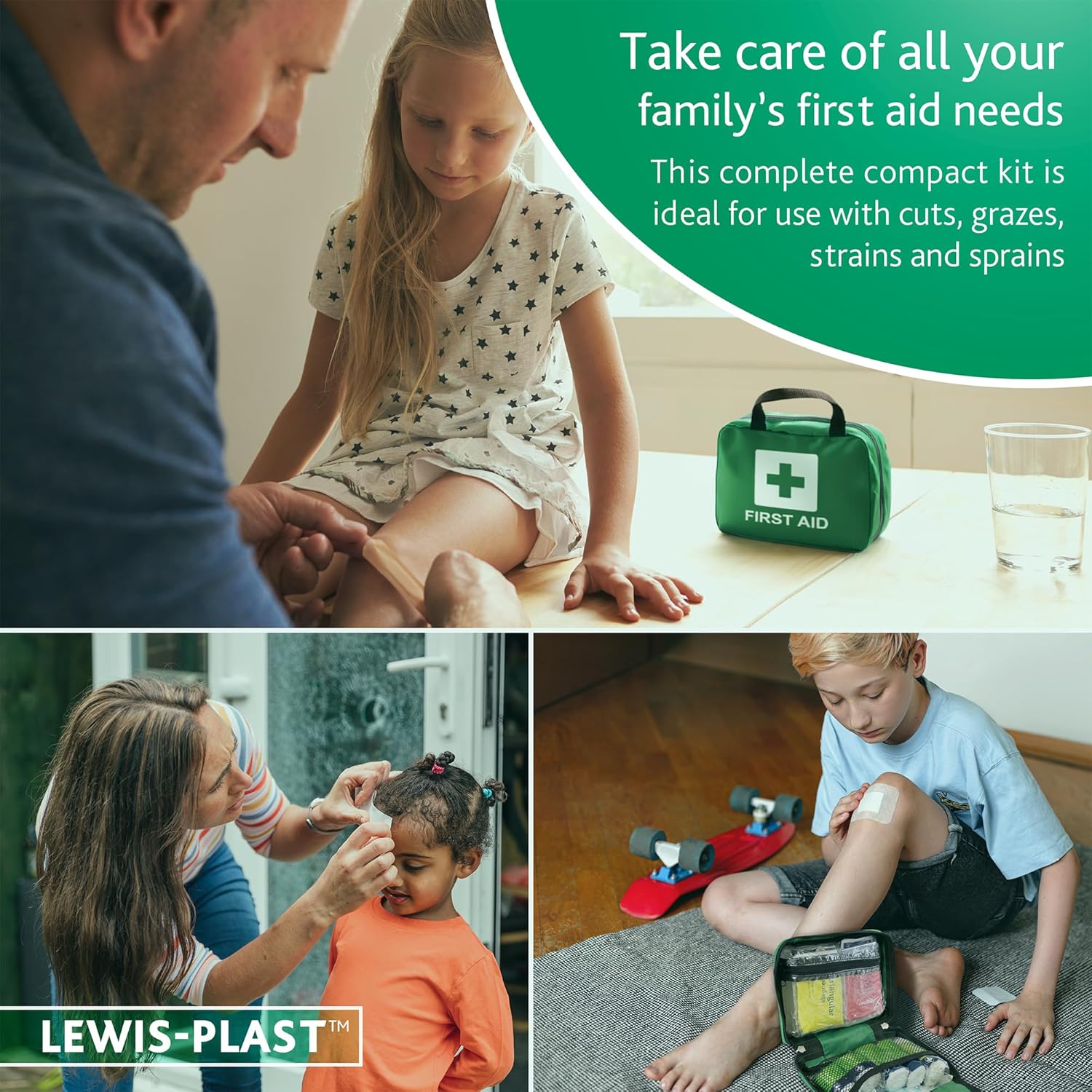
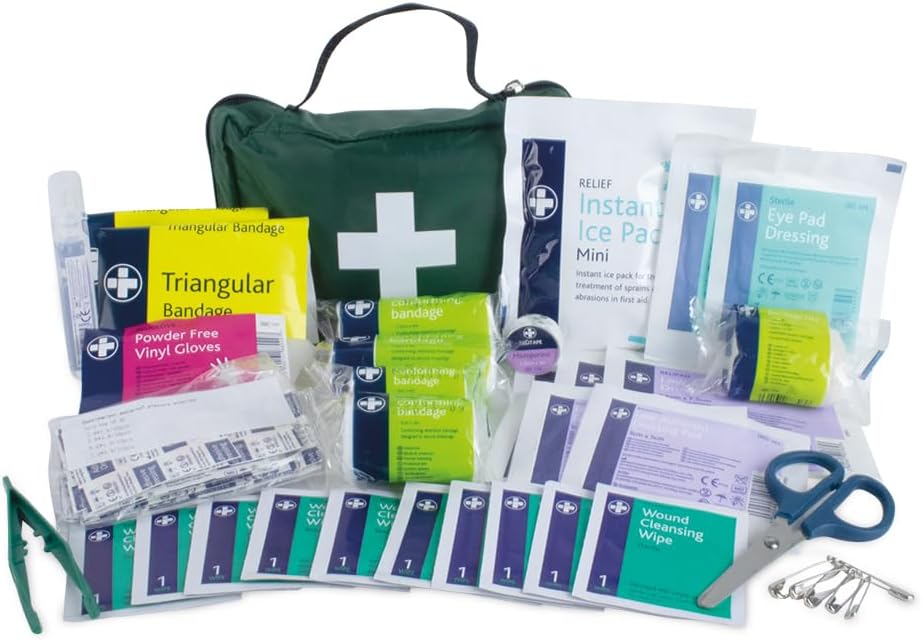
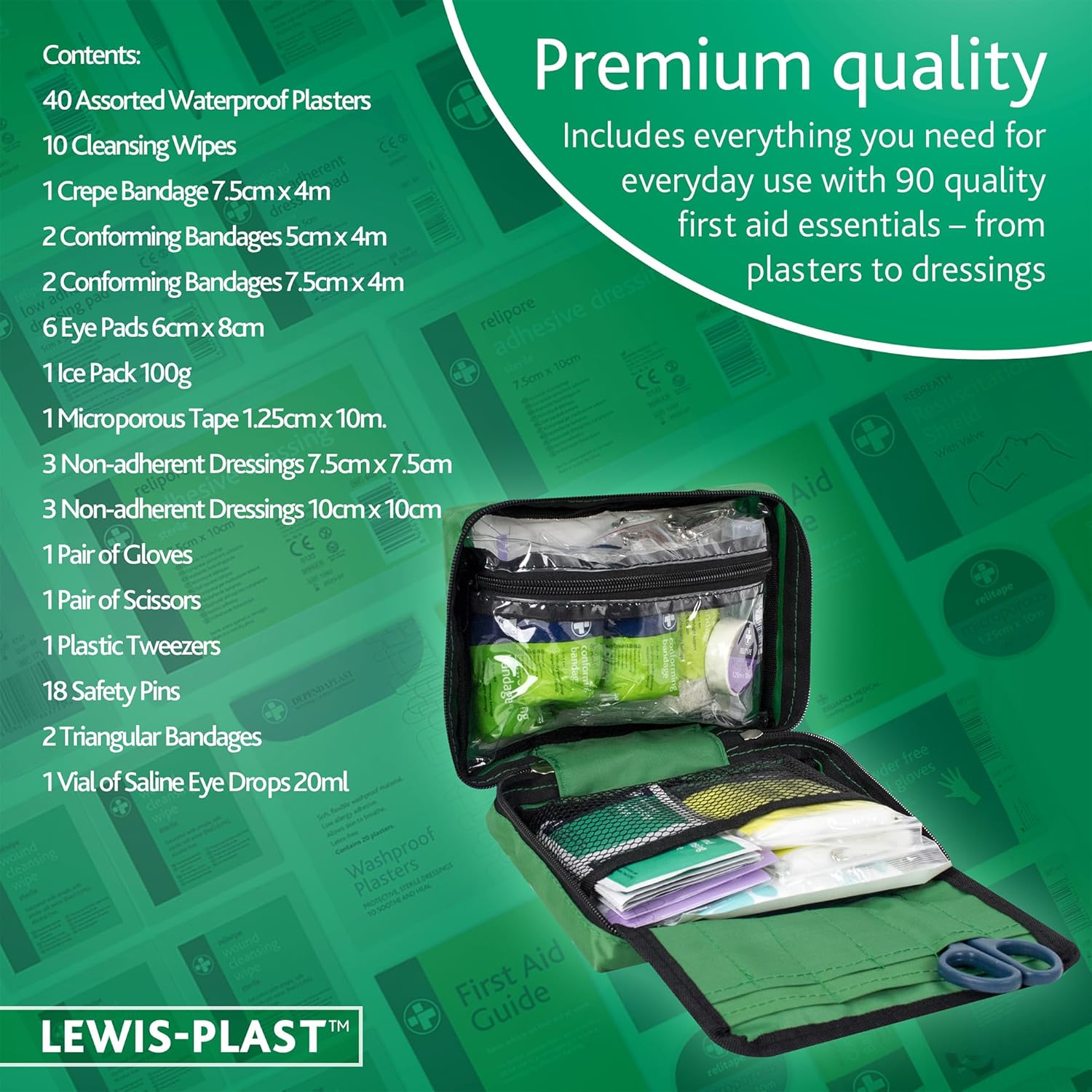
The Amazon listing for this kit is light on line-by-line inventory. What it does commit to, verbatim, is this. The product title says the kit "Includes Bandages, Eye Pods, Ice Packs And Essentials For Everyday Situations". The bullet copy adds that contents "include bandages, plasters, antiseptics, and tools, making it suitable for treating a wide array of injuries and emergencies". The headline number is 90 items.
Reviewer confirmations round that out. A five-star reviewer who bought the kit to downsize into a student-focused pack reports that theirs arrived with "slings, large gauzes, bandages and neck braces" alongside the plasters, which they stripped out before topping up with pain relief and peptobismol from a pharmacy. That gives us a rough picture of the content skew: more hospital-spec dressings and cold/ice provisions than you'd find in an ultra-lean pouch, which is consistent with the home/workplace framing in the listing copy.
What we are deliberately not doing here is listing the exact per-item breakdown. Reliance Medical do not publish one on this specific SKU and we are not in the business of making it up. If you want a precise labelled inventory, the 92-piece camping variant is the one with the gallery image that lists every item down to the safety pin count. For the 90-count home version, the trade-off is a slightly less transparent box in exchange for a content mix tuned more towards static household use.
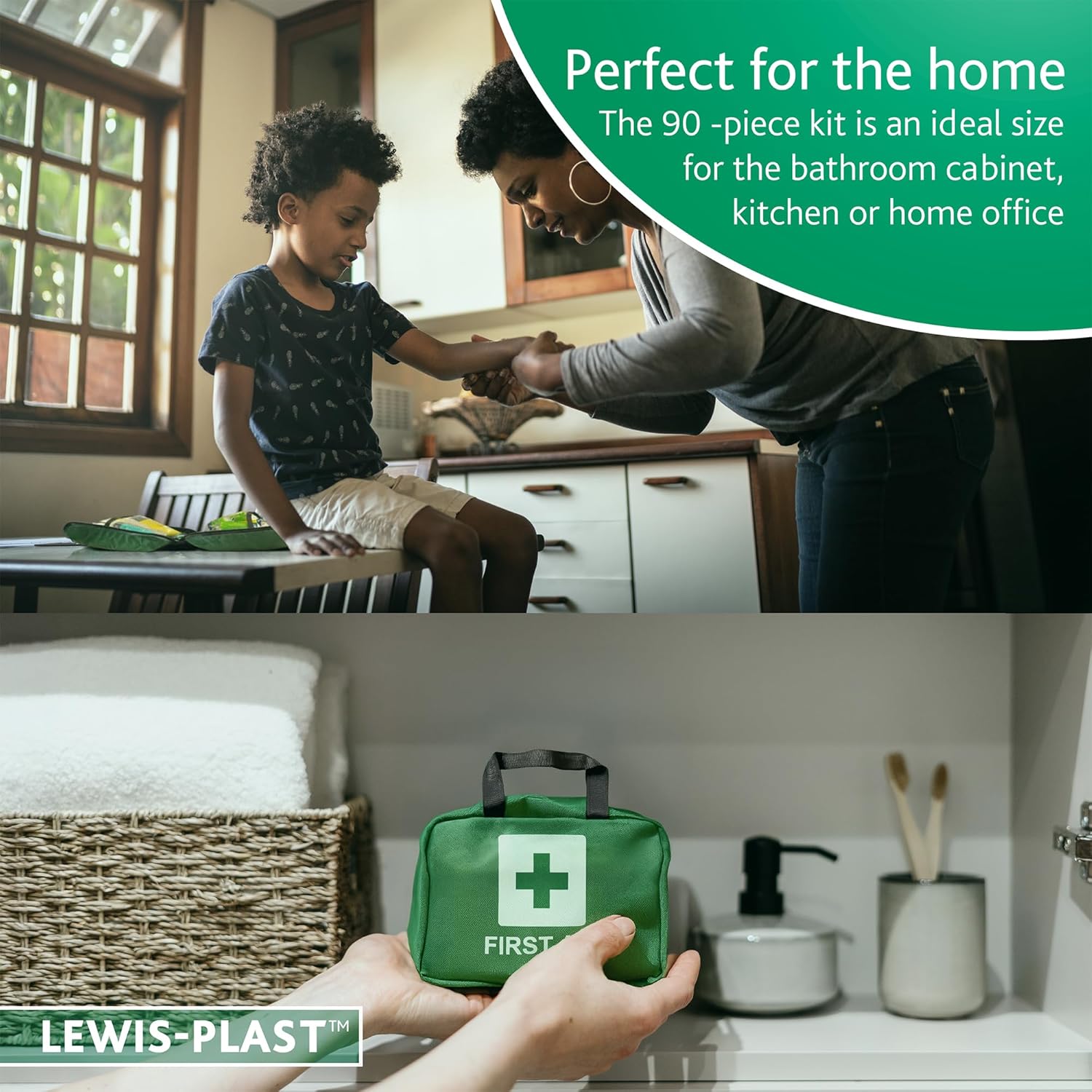
Lewis-Plast Premium 90-Count First Aid Kit
8,511 Amazon UK ratings, 4.7-star average. A compact Reliance Medical zip pouch with 90 items (bandages, plasters, antiseptics and tools) designed for home, car, holiday and workplace use. Fits a glovebox, a kitchen cupboard, a suitcase or a camper van door bin.
The Glovebox Kit That Reviewers Keep Putting In The Glovebox
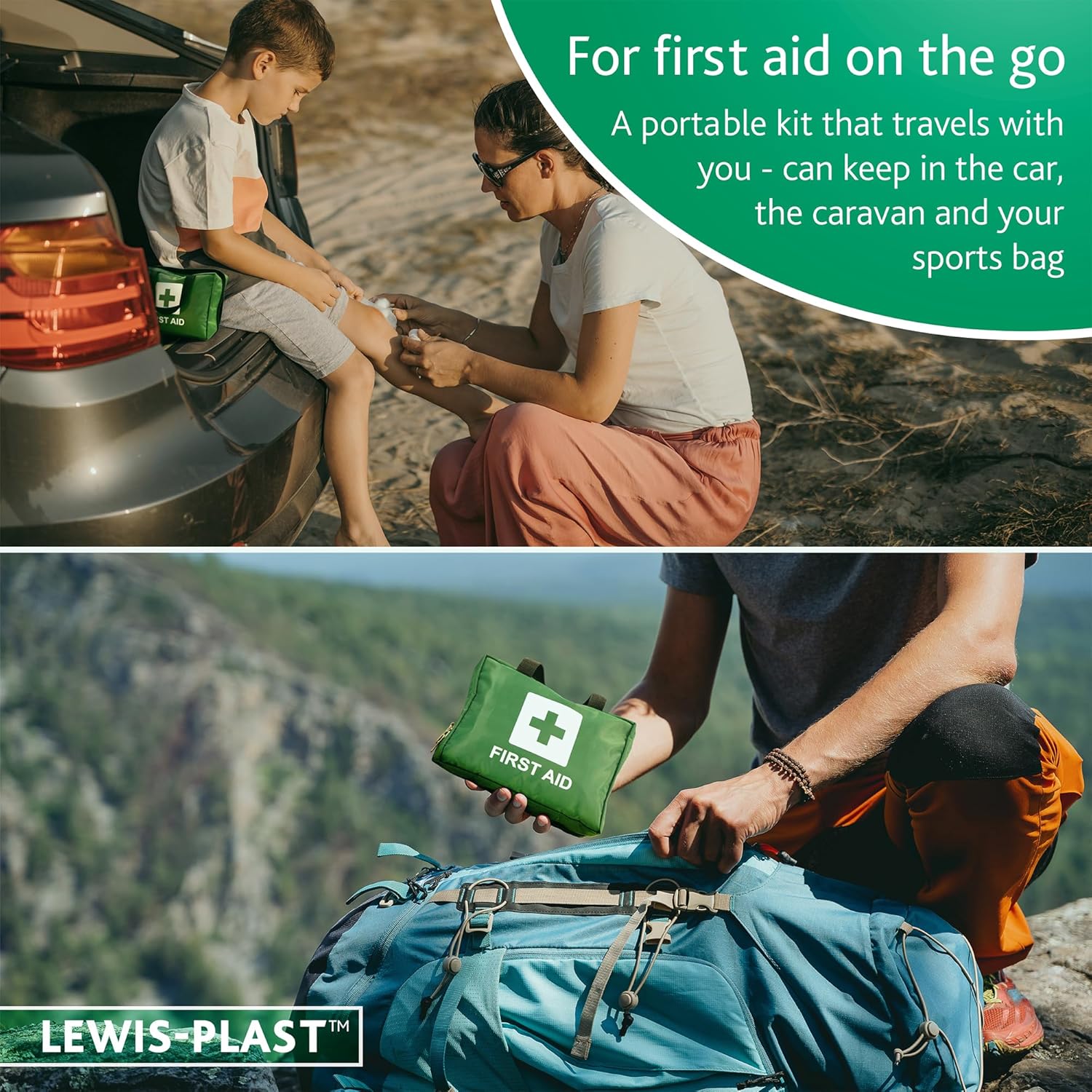
Once you filter out the two or three size-mismatch reviews, the use case that dominates the feedback is singular and straightforward: this is a car kit. The reviews read almost like a chorus on this point.
One reviewer: "Got what is needed an staying in the car." Another: "Keep in the boot of my car, so handy to have." A third: "PURCHASED AS FIRST AID KIT FOR CAR. Good value for money." A fourth: "The right size to keep in the car glovebox." A fifth: "Great first to have in the house and car." A parent: "I bought these to go in our cars. I also have one in my home too in an easily accessible place in my kitchen. My children also know where they are if they should need to use them."
Even the reviewer who wrote a discursive piece about who the kit is for reached the same conclusion: "Probably worth at least one for your transport, but I no longer drive. Everyone should have this." The subtext across all of this is that buyers are treating £9.34 as a reasonable tax on the peace of mind of knowing there is a plaster within reach when a child skins a knee on a service station forecourt. Whether they ever use it is almost beside the point. For most of these buyers, the kit is a hedge. A sticker in the glovebox that says "sorted".
For a UK camper this matters because the same logic travels. A kit that lives in the car boot on the drive up to the Lakes or down to Cornwall is a kit that is there at the campsite without you having to remember to pack it. The 90-count's specific marketing towards home and car means most owners probably never take it out of the car. Which is fine, because when you do arrive at a pitch it is two steps away rather than buried in a rucksack.
Where It Falls Down: The Expiry Problem And The Logistics Problem
Two recurring problems crop up in the minority of negative reviews, and both are worth taking seriously before you buy.
The first is expiry dates. One one-star reviewer, blunt: "All the items in the kit had expired their best before dates by two years- not acceptable." First aid kit shelf life is finite. Plasters, wipes, gloves and dressings all have sealed expiry dates, and when a kit is warehoused for a long time before being picked for your order, those dates get eaten into before the box arrives on your doormat. This is not a Lewis-Plast specific failure, it is common across the budget end of the first aid kit market. It is also the single clearest reason to inspect every kit the day it arrives.
The action is simple. Open the pouch the day it lands, pull out a couple of items at random, read the expiry date on the packaging. If it is less than 12 months out, send it back inside Amazon's return window and ask for a replacement. If it is three or more years out, you are fine. If it has already expired, you have a clear-cut return case. That single five-minute check is the difference between "great value" and "useless when I needed it".
The second problem is smaller and patchy: one two-star review mentioned "Items in the bag are incomplete, and no support available to replace it." Across 8,511 total ratings that is not a systemic fault, but it is a reminder to open the bag on arrival rather than tucking it away unopened for the next emergency. If items are short, Amazon's returns process is faster than chasing Reliance Medical directly.
Does It Belong On A UK Camping Packing List?
The fair question, given the audience. This kit is not marketed for camping. The listing copy puts it in home, workplace, travel and sports lanes. The 92-piece sibling SKU is the one Reliance Medical explicitly pitch at the camping and hiking market.
That said, most UK campers do not need a dedicated camping-branded kit, they need a kit that turns up when someone cuts a hand on a peg, trips over a guy line or blisters up a boot on the walk to the showers. For that job, the 90-count works fine. The things that matter for a UK camping pitch (a few plasters, a pair of tweezers, a pair of scissors, gloves, some cleansing wipes, enough bandage to wrap an ankle sprain) are covered by the listing's own description of the contents.
Two specifics worth flagging for campers. First, the product title explicitly calls out "Ice Packs" as included. If that is verified by what arrives, the kit nudges ahead of the 92-piece camping version for people who worry about twists and sprains on uneven ground. You would need to check on unboxing. Second, there is no foil emergency blanket called out in the listing text we can see. If exposure is a real concern on your trip type (wild camping, shoulder season hill walking, festivals in October), pair this pouch with a £5 MIXIAO-style foil blanket kept alongside and you have most of the common UK camping incidents covered for under fifteen pounds total.
For car camping, caravans and camper vans where this kit would live in a door bin or under a seat anyway, it is close to the obvious pick. For weight-conscious backpackers counting grams, the 92-piece camping variant with its published contents list is the easier kit to trust, because you can see exactly what you are carrying up a hill.
Price, Volume And The Bottom Line
£9.34 for a 90-item kit in a durable zip pouch with multiple compartments, shipping on Amazon Prime, sitting on 8,511 lifetime ratings and a 4.7-star average. On sample data from the 30 most recent reviews the split is 25 five-star, 1 four-star, 2 two-star, 2 one-star. The complaints are consistent (smaller than expected pouch, occasional expired stock, rare missing items) and the positives are consistent too (car and home use, compact format, simple peace of mind).
Some reviewers go further than the one-liners. One writes that the kit is a "very good piece of kit. Probably worth at least one for your transport... Everyone should have this. You never know when you may need it. Ask yourself, how many lives do these save." Another, stripping it down for a student heading off to university: "Good size unit, but ideal to tuck away until needed."
Our verdict: 4 out of 5. The Lewis-Plast 90-Count First Aid Kit is a sensible £9.34 pouch for the car boot, kitchen cupboard, holiday suitcase or camper van glovebox. The listing gives you the 90-item headline and the four intended use cases, the reviews back up that owners are using it exactly as designed, and the price sits at the level where buying rather than building from pharmacy singles is the sharper choice. A mark comes off for two things: you need to open the bag on arrival to confirm nothing has expired, and you need to arrive at the listing with the right size expectation. Do both and it is a quiet workhorse that will sit where you left it for years, waiting for the one day you need a plaster and a pair of tweezers within arm's reach.
If you specifically want the camping-labelled kit with a published contents list, the 92-piece sibling SKU (reviewed separately) is the call. If you want a kit that lives in the car from the day it arrives, this is the one.
Lewis-Plast Premium 90-Count First Aid Kit
8,511 Amazon UK ratings, 4.7-star average. A compact Reliance Medical zip pouch with 90 items (bandages, plasters, antiseptics and tools) designed for home, car, holiday and workplace use. Fits a glovebox, a kitchen cupboard, a suitcase or a camper van door bin.