How Far Can Waterproof Socks for Wet Weather Hiking UK Take You? Ask the Reviewer Who Took Them to Greenland
We earn commission from qualifying Amazon purchases. It costs you nothing and does not affect what we recommend.
ArcticDry puts the question straight onto its own listing: are waterproof socks good for hiking? Its buyers give a more interesting answer than its marketing does.
- Where the Buyer Evidence Comes From, and Where It Stops
- Three Layers, and What Happens When Water Hits Them
- Nine Sports on the Listing, One Long Hike in the Reviews
- Three Size Bands for UK 4 to 13, and Two Overlaps
- Drip-Dry Only, and the Two Buyers Whose Pair Stopped Working
- Why We Stop at 4.0, and Who Should Pass
Scroll far enough down this Amazon listing and ArcticDry asks a question about its own product: “Are Waterproof Socks good for Hiking?” Bold thing to put in your own marketing, and it answers itself: waterproof socks are good for hiking, the listing says, because they are versatile and withstand water. Nothing in ArcticDry's own copy shows that answer checked by anyone outside ArcticDry. There is no bullet list either, and the only size table on the page sits inside an image.
So we went to the buyers further down the page. What comes back is a sock that is very good at one job, keeping feet dry over short wet distances, and much shakier at the job the search box promises. One of ArcticDry's own images lists hiking first among nine sports. In the reviews we could recover, one person walked a properly long hiking route in them, and that verdict ran to four stars: “Frustratingly short of greatness”.
Plenty here is worth the money, and some of it is not settled. Both go in, along with a sizing quirk that catches anyone with a UK 8 foot.
Where the Buyer Evidence Comes From, and Where It Stops
Start with what this rests on. The live product page displayed thirteen review cards; eight were recoverable, and the other five sit in an international widget that is not verifiably about this product. Eight is the whole evidence base, and eight is thin.
Those eight break down as six five-star, one four-star and one one-star, averaging 4.38 against a listing badge of 4.4. A recovered handful often reads sunnier than the lifetime figure, so landing on the badge is worth noting. All eight are United Kingdom reviews, all eight verified purchases, all eight in English.
The dates do more work than usual. They run from 8 February 2019 to 4 June 2026, and the two most upvoted, at 25 and 14 helpful votes, are also the two oldest. The warmest praise in the set is a review titled “My best purchase of 2018”.
Amazon pools these across three sizes and two colourways, but every pooled variant is the same sock, so nobody here is reviewing something else.
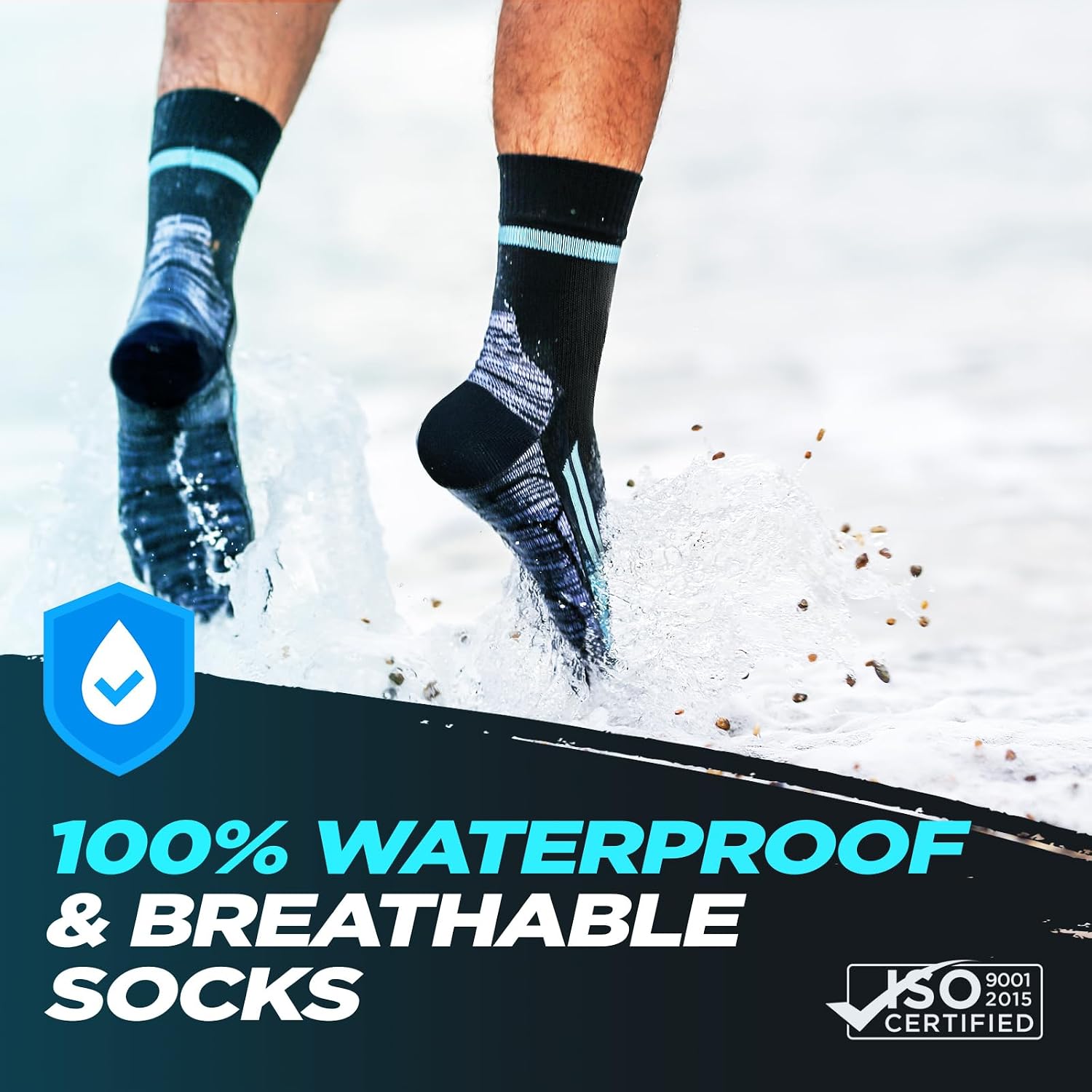
On the listing side, one of the images on the current Amazon listing claims “100% WATERPROOF & BREATHABLE SOCKS” and carries an ISO 9001:2015 certified badge. ISO 9001 is a quality management standard about how a company documents its processes, not a waterproofing test, and it says nothing about how much water this sock keeps out.
Three Layers, and What Happens When Water Hits Them
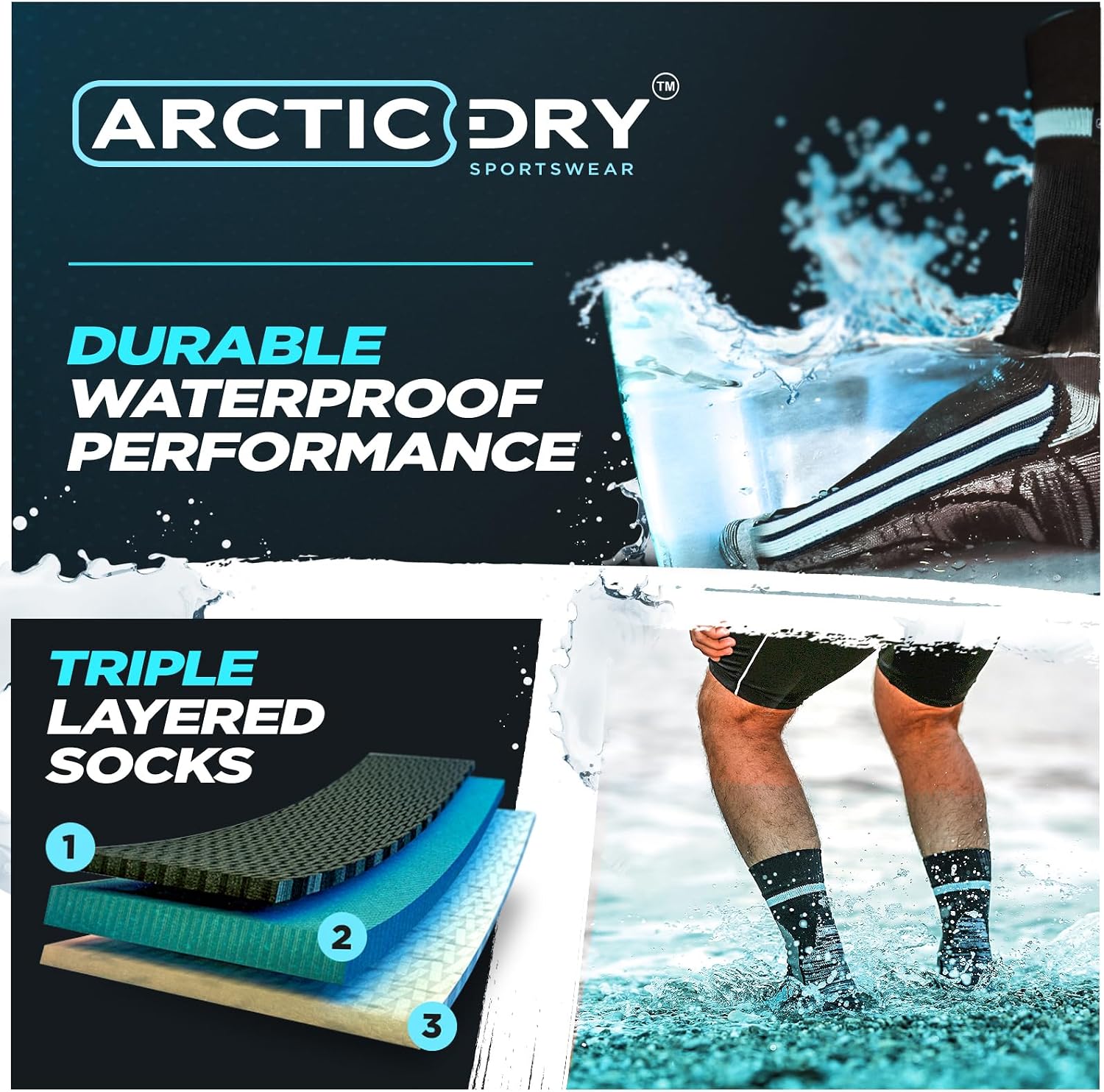
The listing explains construction twice. A cutaway image stacks three layers but labels them with circled numerals only, so nothing on it says which face sits against your skin. The panel is headed “DURABLE WATERPROOF PERFORMANCE” and “TRIPLE LAYERED SOCKS”. The listing's product details put the item weight at 100 g. The A+ text supplies the principle: waterproof socks work “by utilising an impermeable waterproof membrane in the central layer”, porous enough to let vapour out but not in.
Which layer is which comes from a buyer, not the brand. Sajjad held a pair under a running tap for about thirty seconds and reported the outer layer soaking up the water while “the middle membrane was a final barrier” and the third layer stayed completely dry: outer knit, membrane, lining, which matches the brand's sentence rather than the unlabelled picture. The same review explains the noise: “a slight rustling when you curl your toes” is the membrane between the layers. Take it for what it is, a kitchen-sink check; that reviewer wrote in capitals that they still had to try the socks outdoors in the rain.
Four of the eight describe the waterproofing working in named conditions. One wore them on a daily cycling commute and a snow trip to Bulgaria, arriving at work “with soaking wet shoes but very dry feet”. Simona Cristea ran and walked in snow and water for almost eleven hours with dry feet at the end. Daniel Blackshaw works outside all day, got a foot drenched, and traced the dampness to the soaked trainer, not the sock: “Absolutely no water at all on the inside of the socks.” I P ROBERTS wears them inside golf shoes in all weathers and reports warm, dry feet.
Breathability comes up twice and both times positively: “surprisingly breathable” from a buyer who expected smelly feet that never arrived, “quite breathable” from one who also finds them “a little thick”. Two mentions in eight is a thin base.
ArcticDry Waterproof Socks
The buy if your wet weather comes in hours rather than days: rainy commutes, outdoor shifts and rounds of golf in the wet.
Nine Sports on the Listing, One Long Hike in the Reviews
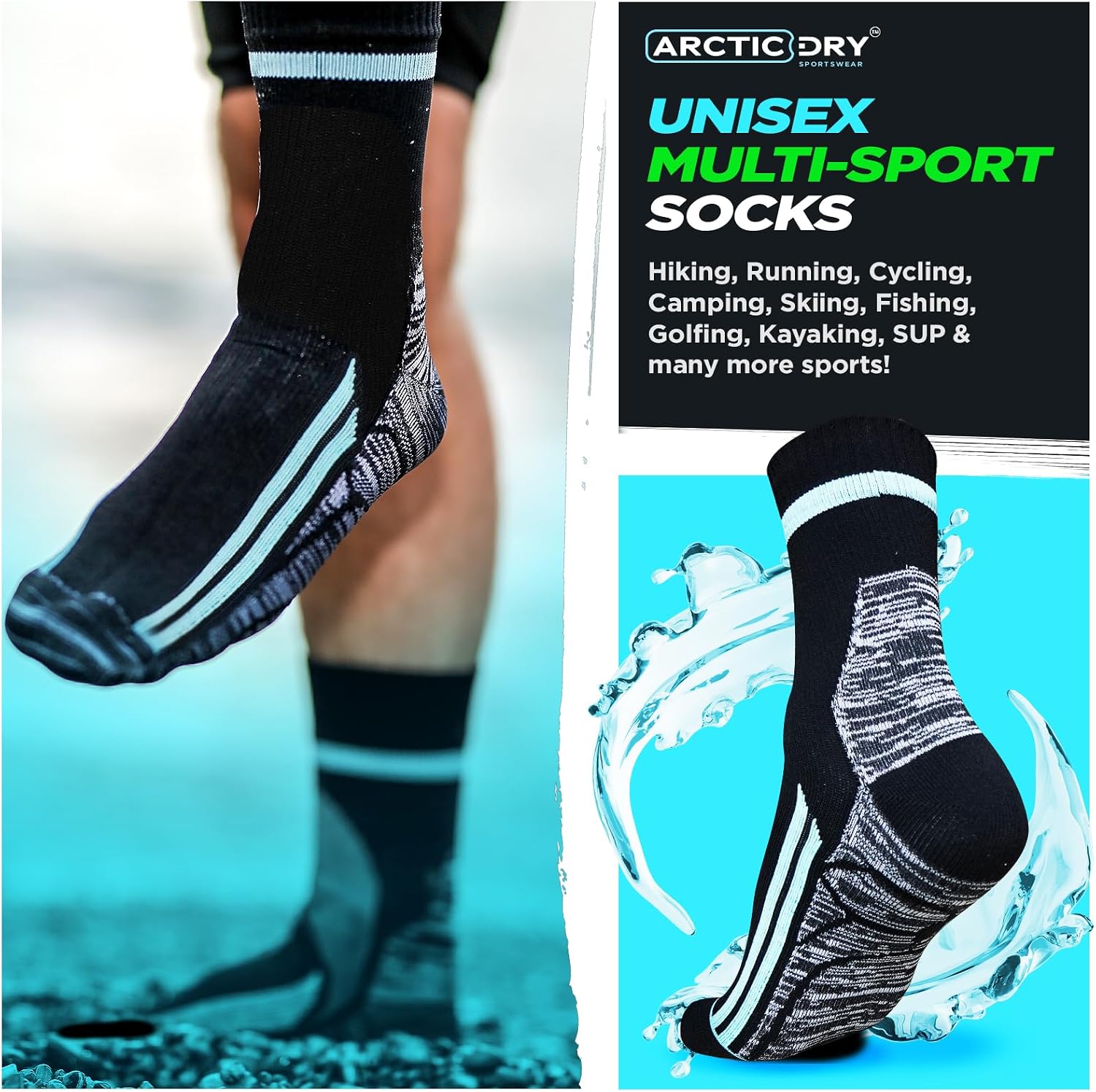
ArcticDry names nine sports on the product images: hiking, running, cycling, camping, skiing, fishing, golfing, kayaking and stand-up paddleboarding. Hiking is first. The brand text also claims its products “have been tested over Crib Goch, Snowdon, Striding Edge in the Lakes and the Peaks”: unverifiable marketing that no buyer in our eight corroborates.
The reviews answer differently, and that gap is what anyone searching for hiking socks needs. Of the eight, three touch walking or hiking at all, and only one covers a long hiking route. The cycling commute, the outdoor shift and the golf rounds are good wet-weather evidence, but none is a hike. Simona Cristea's near-eleven hours of walking and running is the closest second, and I P ROBERTS only plans to buy a second pair for walking boots.
That leaves Mr. A. Pomeroy, who took a pair to Greenland, had a go at the Arctic Circle Trail and posted a photo of feet cooling in a frozen lake. Four stars. As socks the report is warm: comfortable, with “a bit of natural spring”, feet never cold, though awkward to put on because “they balloon up when you slide them on your feet”.
As hiking socks it is blunt: “for hiking over long distances they're neither fish nor fowl”. Water could not be stopped “wicking in from the neck, which is inevitable if you're hiking through a bog”, and once the toes were wet, drying them meant turning them inside out repeatedly or water pooled inside. Gaiters are the usual answer to a wet sock neck: the pair we reviewed stands 33 to 41cm tall depending on size, enough for splash and wet heather, not for anything deeper.
Then the comparison that decides it. Their ordinary wool socks also got wet, but “I could squeeze them out and dry them in the warm”. That is a limitation rather than a defect, and the word in the review is wicking rather than flooding: water works in at the neck of the sock. Even ArcticDry's own photography keeps the standing water below the cuff. Their own read, offered as a hunch rather than a finding, is the one to buy on: over shorter distances, with waterproof boots, “they would be the icing on the cake”.
So if your hiking means long distances through bog, where water works in at the neck and stays in, buy DANISH ENDURANCE Merino Wool Hiking Socks, 3 Pack instead. They are not waterproof and make no claim to be, which is the point: a membrane sock that has taken water in at the neck holds it against your foot, and a wool one can be wrung out and dried. That is the trade Pomeroy wanted. We scored those 4.2 in our own review, where the strongest evidence was temperature regulation rather than the blister prevention in the title. One caveat carries over: a buyer with wider calves found the leg too tight to wear all day and sent them back.
Three Size Bands for UK 4 to 13, and Two Overlaps
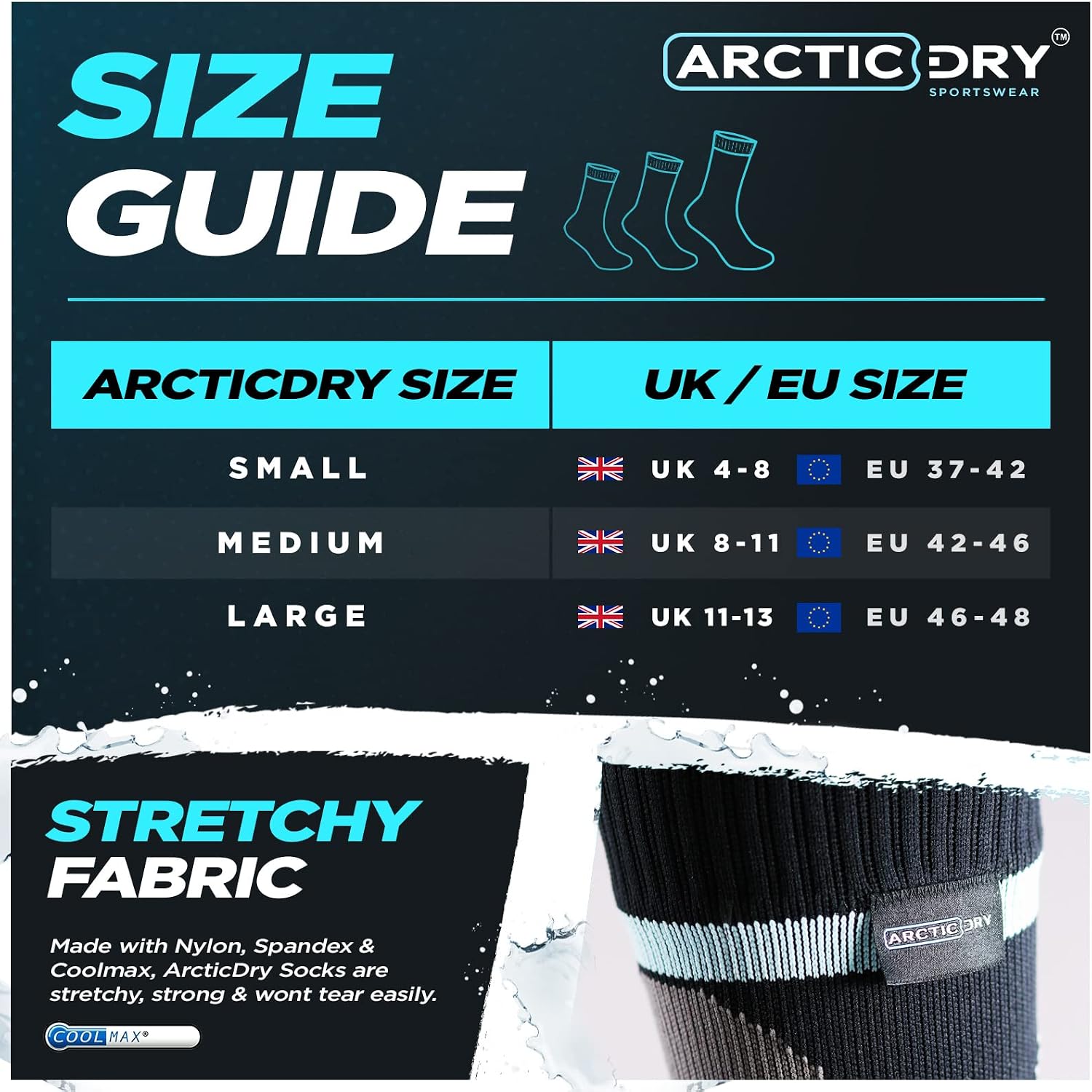
The size table is published only as an image, so here it is in text. Small covers UK 4 to 8, EU 37 to 42. Medium covers UK 8 to 11, EU 42 to 46. Large covers UK 11 to 13, EU 46 to 48. Three bands cover ten UK shoe sizes, and they overlap at their edges. A UK 8 sits in both small and medium, a UK 11 in both medium and large. The listing's own FAQ settles the second one, sending “11+ mens” to large, and says nothing anywhere about UK 8. On a sock whose seal depends on fit, that matters. No cuff measurement is published either, though the images show a crew-height sock sitting a few inches above the ankle bone.
The fabric note on the same image says the socks are “stretchy, strong & wont tear easily”, made with nylon, spandex and Coolmax, with a Coolmax logo alongside. ArcticDry's brand text says its products use blends of nylon, spandex, Coolmax and merino wool, without saying which of them applies here, and no fibre percentages appear anywhere. Stretch does real work when a single band covers UK 4 to 8.
Fit reports are mostly good. The 2019 cycling commuter found them warm and comfortable “without being to bulky to fit inside a trainer or cycling shoe”. MikeH reports “good sizing”, and Mr. A. Pomeroy found getting them on awkward. Nobody states their size, so treat all of it as directional.
Three of the eight raise wearing an ordinary sock underneath, the most practical tip in the set: Sajjad suggests “a thin pair of normal socks underneath these” for comfort and durability. MikeH adds: “Could easily be worn with inner ankle socks if desired.” Jill was wearing socks beneath the waterproof pair, and the photo of one wet inner sock and one dry showed which had failed. That leaves the UK 8 boundary, which nothing on the listing addresses. Our own read is to take the medium if you intend to wear a sock underneath, and the small if you do not.
Drip-Dry Only, and the Two Buyers Whose Pair Stopped Working
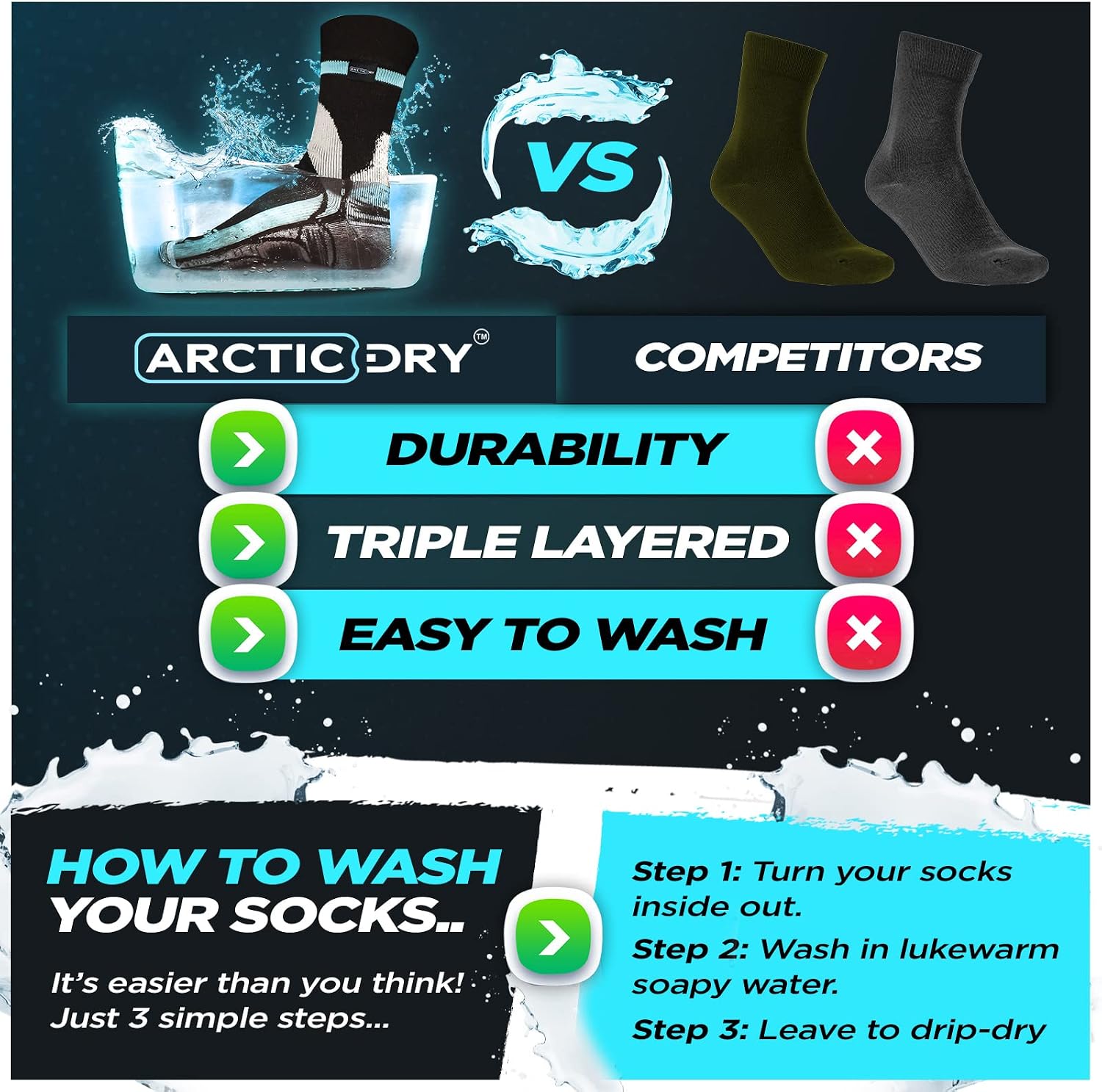
Washing guidance appears in three places that do not agree. An image gives three steps: inside out, lukewarm soapy water, drip-dry. The A+ FAQ gives the first two and stops; the brand text adds that hot water may damage the membrane. Only the image mentions drip-dry, and nothing mentions tumble drying. Machine washing appears once on the whole page, inside that warning: “make sure not to machine wash the socks on too high a heat”. Neither an instruction nor a ban.
Three of the eight raise drying, and they agree. The 2019 cycling commuter found “drying after washing can be a bit time consuming”, because once the outside is dry the sock has to be turned inside out to dry the inside. Sajjad reports the outer layer taking its time unless you give it a spell on a radiator or air dry it “so to not damage the integrity of the material”. Mr. A. Pomeroy hit the same thing on the trail in Greenland, not just after a wash. Neither washing report calls it a fault; Pomeroy did mind, and the drying problem feeds that four-star verdict.
Durability is the uncomfortable part. One listing image runs a comparison chart against unnamed competitors, awarding ArcticDry a green chevron on durability, triple layered and easy to wash. Durability is the exact attribute three of the eight question. The Greenland reviewer's doubt is only an impression: they “don't strike me as durable enough” to replace sandals or grippy socks. The other two are specific, and in both the waterproofing stopped rather than the fabric tearing.
MikeH left a five-star review that opens “Good socks, good sizing, completely waterproof and comfortable to wear”, then came back and added one line: “Edit: no longer waterproof after just a few months”. The rating still reads five, so the listing counts it as a five. Jill's is the one-star: the socks kept both feet dry on the first wear, and “The second time I wore them, one sock completely failed.” The 30-day return window had closed, because the socks had not been worn straight away.
Two reports out of eight is not a failure rate, and a sample this size cannot support one. What it establishes is that the failure happens, that it hit one buyer within a few months and another on the second wear, and that durability is exactly what the listing's chart claims as an advantage. Nobody explains why either pair stopped working, and we are not going to invent a reason.
Why We Stop at 4.0, and Who Should Pass
Here is the working. Our eight average 4.38 against a lifetime badge of 4.4 from 1,235 ratings, so sample and badge agree. Against that: two report the waterproofing failing, and the only long hike in the set is the one that found a real limit.
We score it 4.0, below the badge and below our own sample average. Two things pull it there: a durability question neither the listing nor the reviews resolve, and hiking, the use case in the search box, carrying the least evidence. It is still a good score: four field reports of dry feet, in snow, in water, inside a soaked work trainer and in golf shoes in all weathers, plus the buyer who ran a tap over them and found the membrane doing what the listing describes.
Buy them if your wet weather comes in hours: a rainy commute, a shift outdoors, a round of golf in the wet, and, on the Greenland reviewer's hunch rather than any field report, a day walk in waterproof boots where the sock is a second line, not the only one. Add a thin inner sock, which three of the eight mention and one recommends. Order carefully at UK 8, the one boundary neither the size table nor the listing's FAQ resolves. Plan on more than one pair if your wet weather is daily: drying is slow and two-sided, and Pomeroy's fix for a long trip was to “take a couple of pairs of extra socks”.
Skip them for long distances in boggy ground: once water gets in at the neck, it will not wring out. Skip them if you want a sock you can wash hot and tumble dry: drip-dry is the only route the listing offers. And wear them inside the 30-day return window rather than saving them for a trip: the buyer who waited lost the easy Amazon returns route. Thirty days is Amazon's returns policy, not the limit of your rights if a pair stops being waterproof early.
ArcticDry Waterproof Socks
The buy if your wet weather comes in hours rather than days: rainy commutes, outdoor shifts and rounds of golf in the wet.